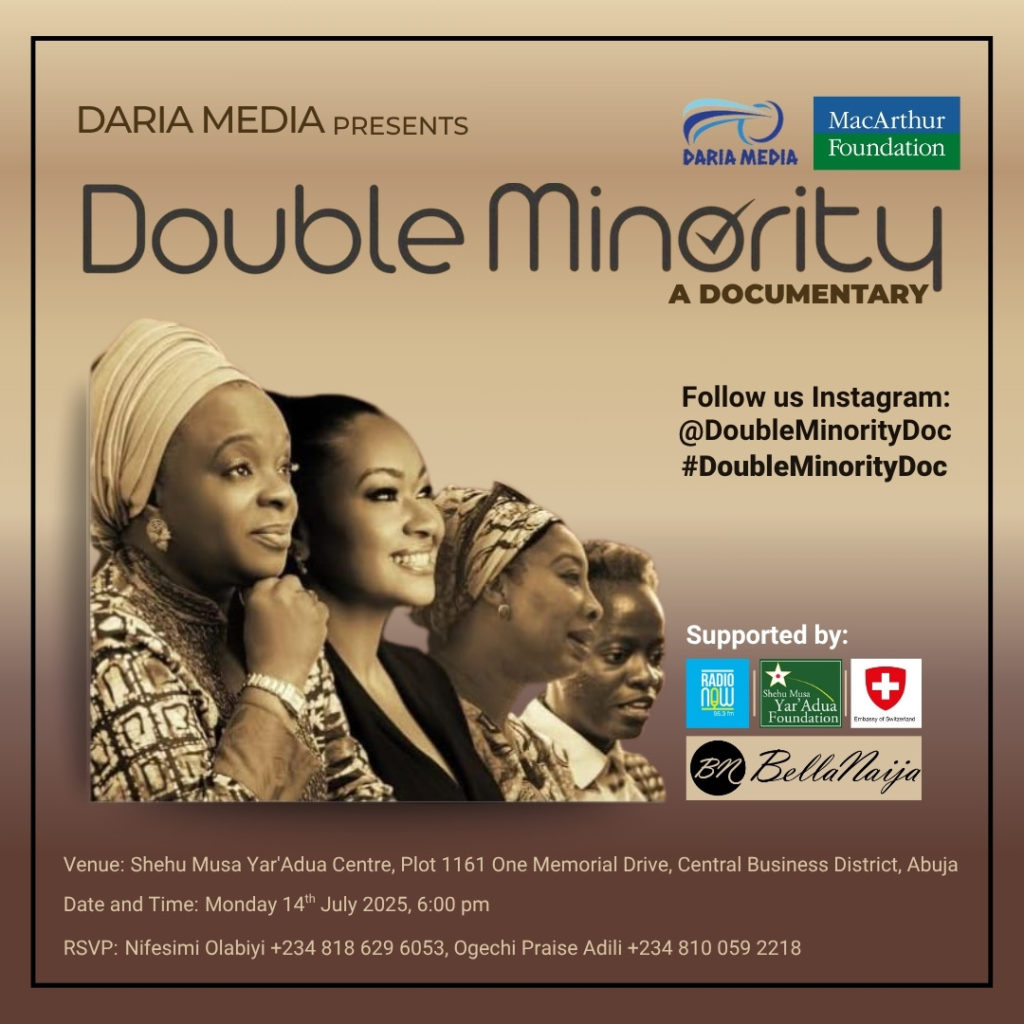
“Double Minority” is a powerful new documentary by Daria Media, which explores the triumphs, challenges, and resilience of women shaping Nigeria’s political landscape.
The film charts the journey of 9 Nigerian female political candidates who ran for elective offices in the 2023 election cycle, breaking barriers in a male-dominated arena.
The 9 women featured in the documentary are: Senator Natasha Akpoti-Uduaghan, Senator Ireti Kingibe, Hon Nnenna Elendu–Ukeje, Adeola Azeez, Simi Olusola, Hauwa Gambo, Khadijah Abdullahi Iya, Hon Munira Suleiman Tanimu, and Joyce Daniels.
In “Double Minority”, we hear directly from the women and learn about the systemic obstacles—cultural bias, limited funding, and witness the violence they confront, just for daring to aspire to hold political office and lead.
In Nigeria, women hold just 3.6% of elective office, a far cry from the 35% recommended in the Nigerian National Gender Policy for women in elective and appointive public service positions. Such dismal percentage is also out of sync with the diversity of the country’s demography, where women make up almost half of the general and voting populations. Despite conclusive research that shows that nations where women are fully represented outperform across all development indices, over countries that don’t allow for full representation, Nigeria, continues to lag very far behind.
“Female exclusion from elective offices and governance is therefore not just bad for women but also bad for the country,” says the film’s Executive Producer and Director, Kadaria Ahmed.
The film is premiering at a focal moment when the Gender and Equal Opportunities Bill is once again in the National discourse.
“Double Minority” is a strident, forthright, and illuminating film which aims to amplify the nationwide dialogue about the gender imbalance of Nigeria’s political landscape.
Get More Zikoko Goodness in Your Mail
Subscribe to our newsletters and never miss any of the action
According to the Africa Director of the MacArthur Foundation, Dr Kole Shettima, “the minoritisation of women is an embarrassment, and causes significant reputational damage to Nigeria.” In addition, Dr Shettima reiterates that, “the political status of women is an indicator of the development of a country, so Nigeria needs to decide what is more important, its development or its exclusionary policies?”
Sponsored by the MacArthur Foundation, “Double Minority” aims to support and pivot decades-old demand for gender parity by women-led NGOs, and alert policymakers to the detriments of their actions and inactions.
This premier screening event, which will be held on the 14th of July 2025, includes a panel conversation with notable guests, moderated by Broadcast Journalist, Nabilah Usman of Radio Now 95.3FM Lagos.
“Probably the most important documentary I’ve watched in the last five to ten years” – Funmi Ade–Ajayi Ogunlesi, Head of Government Affairs/ Director at Citi.
For further information, contact Kamri Apollo, 0907 806 9687 & kamri.apollo@daria.media , or @DoubleMinoritydoc
[ad]
There was one moment during a plenary session in the House of Representatives on March 1, 2022 when lawmakers openly jumped for joy. The chamber was filled with cheers, wide smiles and fist bumps that would make you think they’d just solved world hunger or negotiated debt cancellation for Nigeria. However, what they had just done was vote against a bill that would have given women special seats in federal and state legislative chambers.
In the Senate chamber, just across the hall from the representatives in the National Assembly complex, the mood was not so different when they voted against the same bill. The Senate President, Ahmad Lawan, was in a fit of laughter that lasted for nearly 30 seconds as he recorded the vote. He said he was reluctant to declare that the vote had failed, but it was hard to believe him.
What happened in those two chambers on March 1 was a missed opportunity to advance the rights of women in what has been a robust constitutional amendment process.
Constitutional what now?
Think of the constitution as a document that guides how a home operates. It outlines how the head of the family is chosen, how they’re supposed to take care of the home and how everyone else conducts themselves so the home does not collapse.
Since human behaviour is guided by the social times we live in, the way people lived 40 years ago would be different from the present — hopefully for the better.
And this is why the constitution leaves room for itself to be updated occasionally. Nigeria’s current constitution was enacted in 1999 and has been updated four times since then.
After years of consultation on a new list of amendments, the National Assembly voted on 68 bills covering many issues. Five of those bills especially affected women.
The main rule was that each of the bills had to be approved by both the House and the Senate. Failure in one chamber meant failure in both.
What did the National Assembly do to the women?
This is the short version of how lawmakers voted on all the bills that affected women:
Here’s the long version:
1. No special seats
Only 4% of the 469 lawmakers in the current National Assembly are women — a statistic that spotlights the low visibility of women in elected office in Nigeria. This bill would have created 111 exclusive seats for women in the National Assembly and 108 seats in the 36 state legislative chambers if it had passed. It would also not have prevented women from contesting for other seats against male candidates.
The most popular argument against this bill is that it would inflate the size of legislative chambers at a time when many Nigerians are calling for a reduction, especially in the size of the National Assembly and wages of lawmakers.
2. No citizenship for foreign husbands
Section 26(2)(a) of the 1999 constitution allows any foreign woman married to a Nigerian man to become a citizen by registration. Nigerian women have no such gift to hand to their foreign husbands. This would have been corrected if lawmakers voted for a bill to fix it on March 1.
But they said:
The bill failed to pass in the House of Representatives. When House Speaker, Femi Gbajabiamila, tried to explain the importance of passing it, in an attempt to force a second round of voting, a lawmaker off-camera said, “We know this thing; we don’t like it.”
The bill was passed in the Senate, but that won’t matter.
3. No affirmative action in party politics
The low representation of women in elected public office is partly tied to their low representation in party politics. This was why a bill was proposed to ensure 35% of executive committee positions of political parties are filled by women. Many parties have promised to do this on their own in the past but hardly implemented it. Codifying it in the constitution would force implementation. The bill failed in both the Senate and House of Representatives.
4. No indigeneship
The bill on indigeneship would have allowed a woman who is married to an indigene of another state for more than five years to automatically become an indigene of that state. Since Nigerian women face so many issues over getting cleared for appointive and elective positions based on indigeneship alone, this bill should have passed easily. The bill would also allow anyone to become an indigene of a state where they’ve been resident for 10 years. It passed in the Senate but failed in the House of Representatives.
5. No cabinet quota
The cabinet quota bill was another attempt to ensure at least 10% of federal and state cabinets are filled by women. A frustrated Gbajabiamila found a way to force the bill through in the House after increasing the quota to 20%. When lawmakers rejected it through electronic voting, he ignored the result and put it up to a voice vote, the mode of voting in which they shout “Aye” or “Nay” like it’s 1982. He then passed the bill even though it was hard to tell which side’s voice was louder. The Senate voted against the bill anyway.
At the end of the day, women finished with zero bills passed in their favour.
How are Nigerian women taking this?
What Nigerians should be worried about is not just that all those bills were rejected, but the manner in which they happened. Lawmakers jumped in glee and rejoiced over the rejection of the bills like they weren’t alienating half of the population.
This happened while the nation’s Second Lady, Dolapo Osinbajo, was seated in the House of Representatives chamber to observe the process and press for women’s rights. The First Lady, Aisha Buhari, had also been present in both chambers when the bills were presented on February 23.
The rejection of the bills did not sit well with Nigerian women who mobilised and protested in front of the National Assembly complex on March 2.
In less than 24hrs, Nigerian women organized themselves and came out to protest the unjust actions of some men with very low self-esteem at the National Assembly during the constitutional amendment on March 1, 2022. So proud.
Their demands were simple: enhanced inclusion of Nigerian women in politics, governance and society. This is not too much to ask for, but the National Assembly has a history of standing in the way.
For some reason, Nigerians seem to have a huge problem with feminism as a concept. If you throw a stone into a crowd of people odds are it’s going to land on a Nigerian who thinks feminism means ‘hate men’.
So I asked a bunch of people to tell me what questions they had about feminism and tried to give them some answers.
“What’s this feminism thing you people are always talking about sef?”
Look at this, a boy gets an apple, a girl gets an apple. Then the boy gets an orange. And when the girl asks for her own orange, they tell her she only gets an apple, because oranges belong to boys. Feminism is saying that everyone has a right to apples or oranges, male or female. Equal opportunities.
“Why are women trying to equate themselves with men?”
Women hate having to deal with cramps and periods every month, but we aren’t out here trying to become men. All we’re saying is, we want access to the same opportunities as men. So if a man wants to be a Doctor, a woman can also want to be a Doctor. If a man wants to be an Engineer, a woman can also want to be an Engineer.
“Feminists just want women to be superior to men.”
Okay, back to the apples and oranges. Feminists believe women should have access to oranges like men. Not “only women get the oranges.” Feminists are saying, “everyone has a right to oranges, male or female.”
“But it’s not all men who are trying to keep women down.”
We know it’s not all men. What we also know is that it’s enough men for it to be a problem. When you say #NotAllMen, you shift attention from the fact that women are being oppressed. For you, it becomes about just the protection of men, and not the inclusion of women.
“Where’s the proof that women are being marginalized?”
Where do I even start? Is it child marriage that’s prevalent in the North and other regions in Nigeria? Or genital mutilation in the south? Or to the part where women must choose between family roles or gender roles, a burden that’s hardly placed on men? Or is it how Nigeria is ranked the 9th most dangerous place for women in the world? Look around you, who’s most likely to get pressured into a marriage? Or most likely will not be inheriting property because of gender?
“So you mean you won’t cook for your husband?”
Centuries ago–maybe millennia–men tended to play a role of provider and protector. The women naturally took on the role of nurturer and caretaker.
But look around you today, man goes to work, to be able to provide and protect the future of the family. Woman goes to work, to be able to provide and protect the future of the family. Why is still that a survival skill–as basic as cooking–still remains the responsibility of the woman? Why then aren’t women allowed to choose whether they want the role of cook and caretaker? If women want to cook, okay. If they decide they don’t want to, should they be forced to? No. Cooking for oneself, and for others, can be an enjoyable experience but only when it’s done out of one’s own volition.
“Why don’t feminists ever discuss real problems?”
The question is, are you paying attention? If you are, and still don’t see the point, it’s probably because you’re trivializing women’s problems. An example, men don’t have to worry about what to wear, because no one will call them names. They don’t get turned out of places because their sense of style seems to affront the doorman. They don’t get blamed for sexual assault because “your skirt was too short”. So the question is, are you listening, or do you consider problems women have as trivial?
“Why are feminists only fighting for women’s rights, they should also fight for men’s rights.”
Imagine a C.E.O asking his employees to protest that he’s not getting his bonuses. His employees? They’re overworked, underpaid and have no health insurance. That’s exactly how it feels when men ask women to fight for men’s rights. Even so, feminism doesn’t only speak about women’s struggles. It speaks about the tough standards society has set for men, and how they affect women.
“Shebi women want to be equal to men, why aren’t they doing bricklayer work?”
Choice. If a woman decides she wants to be a bricklayer, let her. Besides, if you haven’t seen women do physically demanding jobs, are you paying attention?
“But men are stronger than women.”
Let’s ignore all the other factors and focus on physical strength. Yes, the average man might be physically stronger than the average woman. So, the man can do heavy-lifting. But if the woman chooses to do the same, even if she’s not as strong as the man? Let her make her own choice.
“Nigerian feminists are hypocrites. They want chores to be shared equally but don’t want bills to be shared equally.”
Bills should be shared according to a person’s earning power. Sometimes that means that bills are shared equally. It might even mean that the woman ends up picking up a larger tab. Very often it means that the man picks up the larger tab. The fact is, women tend to earn less than men. It’s also interesting to note that African women have, for the longest time played a silent but significant role in the family unit as breadwinners.
“What about the women against feminism?”
There are a few reasons why. Many women say they want equal opportunities, but don’t like labels. We get that. There are others who don’t understand it. Take FGM, there are women who still insist it’s right. But it’s because they are ignorant of all the dangers that exist in it for women.
Every woman who reads this and doesn’t believe in feminism, think about this. At some point in history, people wanted to stop women from getting education. Some resisted this and thought “everyone, male or female, deserves an education.” The people who resisted it, those are feminists.
“You know what? Feminists just hate men.”
The word you are looking for is misandrists. Although the two terms are often confused, they are completely different. When you hear “all feminists are men-haters”, it’s no different from where false stereotypes. Like “all Calabar people eat dog meat” or “all Warri men are fraudsters”. Or every Nigerian man is a Nigerian Prince.
“Why do feminists hate marriage?”
Marriage is a beautiful thing. What isn’t beautiful is a tradition that considers a woman to be her father’s property. One to handed over to her husband by her father, after a ‘payment’. The significance of this, is that she becomes her husband’s ‘property’ and he wields power over her. Some feminists want to marry, as long as they’re not made to feel like property, because they’re not. Some feminists don’t want to marry, and that should be okay too.
“Feminism is against our culture.”
A couple of decades ago part of our culture in parts of Nigeria was killing twins now it’s not. Mary Slessor tried to stop the killing of twins, But there were people who thought it wasn’t ‘part of their culture’. Culture evolves. We evolve and settle for what’s better. So what’s better, a culture of equal opportunities for everyone, or for one gender?
“God created women to assist and be a companion for men. God said Adam should have dominion over Eve.”
This idea stems from a bible verse that remains misconstrued till this day. The belief is that Adam was given authority to name and dominion over all the animals in Eden. Adam also happened to name Eve which means that he must have had authority over her also. But the Bible goes on to say that both Adam and Eve were given dominion over the animals. Not that Adam was given dominion over both the animals and Eve.
“Women need to be careful not to create an imbalance in the society because it would be at the detriment of their children.”
The irony is that this imbalance already exists. The ‘balance’ you are talking about is exactly what feminists are fighting for. It’s easy to think this balance already exists when you view society from a point of privilege.
“Nigerian ladies only turn to feminism when they fail to find a male partner to love”
LOL.
“Nigeria is not ready for feminism.”
Nigeria might not be ready for feminism, but it needs feminism. It’s the same way people say we’re not ready for proper leadership, even though there’s a dire need for it. “Nigeria isn’t ready for feminism” is synonymous with “Nigeria isn’t ready for progress”. The average person feels about Nigeria’s state what the average woman feels about women. Systemic oppression, regardless of age or social status.
In the end, feminism is not about division. It’s about creating a better future, where everyone–male or female–has a seat at the table.
Thank you for coming to my Ted Talk.
Here’s another Ted talk you should pay attention to;
We wondered why the Senators rejected a Bill that moved for the protection of widows, rape victims and the elimination of discrimination against women.
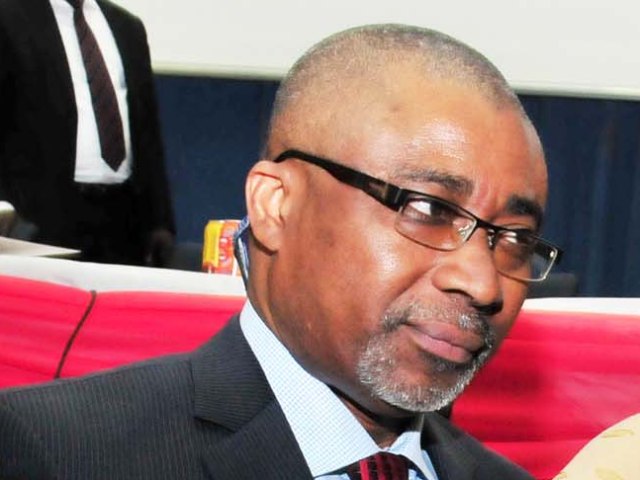
Finally, Senator Eyinnaya Abaribe from the Abia South Senatorial District came to our rescue and disclosed that the Bill was rejected because some of the senators were afraid.
According to him, the senators felt the Bill would make women abandon their responsibilities and become prostitutes and lesbians.
Unbelievable!!!
How does empowering women, making laws that prevent them from oppression and rape have to do with prostitution?
Because it looks like the Senators are actually afraid of independent women with rights.
When your senators are only good at embarrassing and disappointing you.
When your senators keep doing nothing except ‘keeping money’ and taking the country backwards.
We just hope things change soon and Nigerians keep up the fight for equality.