• We’re weeks away from the 2023 general elections, and the country is buzzing with anticipation. Politicians are running helter-skelter trying to convince voters they are the best thing since sliced bread, and people are burning bridges with friends who aren’t supporting their choice of candidates.  

    BVAS Election rigging Electoral act general elections

    Given the importance of the upcoming elections, the electorate, like never before, is keeping an eye out for anything that smells or looks like electoral fraud, also known as rigging.

    Unfortunately, rigging has always been an ugly characteristic of our elections. Some of the ways politicians rigged elections in the past are:

    Threaten electoral officials

    One of the easiest ways elections were rigged in the past was by threatening the Independent National Electoral Commission (INEC) officials. This would mainly happen if the candidate is a strong political figure or belongs to a prominent party.

    Presence of the military

    Elections shouldn’t be a do-or-die affair, and very rarely, if not never, would the help of the military be needed during the voting process. So, once a polling unit is militarised, it makes voters afraid and discourages them from voting.

    Vote buying

    This is the most common method of election rigging. Many people need money, and unfortunately, politicians take advantage of this. People in need of food or money happily sell their votes in favour of these politicians.

    Thuggery

    This is another popular method of rigging elections. Thugs are recruited to disrupt the voting process or steal and destroy electoral materials. 

    BVAS Election rigging Electoral act general elections

    This, consequently, leads to a low turnout of voters or the polling unit is altogether cancelled.

    Bribery

    In 2017, an INEC official, Christian Nwosu, pleaded guilty to receiving a ₦30 million bribe from former petroleum minister Diezani Alison-Madueke to compromise the election in favour of the Peoples Democratic Party (PDP). 

    BVAS Election rigging Electoral act general elections

    Electoral officials are often promised appointments, money and properties if they agree to compromise the election’s integrity. 

    Fortunately, these things may soon become a thing of the past as the government has recently taken steps to clamp down on electoral fraud.

    Introduction of BVAS

    For the 2023 general elections, INEC will use the Bimodal Voter Accreditation System (BVAS) for voters’ authentication. Unlike the smart card reader, BVAS authenticates not only a voter’s fingerprints but also has a facial recognition sensor. 

    BVAS Election rigging Electoral act general elections

    It would also help INEC officials electronically upload results from the polling units. This has automatically created a problem for politicians who clone or buy Permanent Voter Cards (PVCs). No wonder some have opposed INEC’s plan to use it in the elections.

    The new electoral act

    On February 25, 2022, President Buhari signed a new electoral act which might make electoral fraud even more difficult. Some key points of the act are:

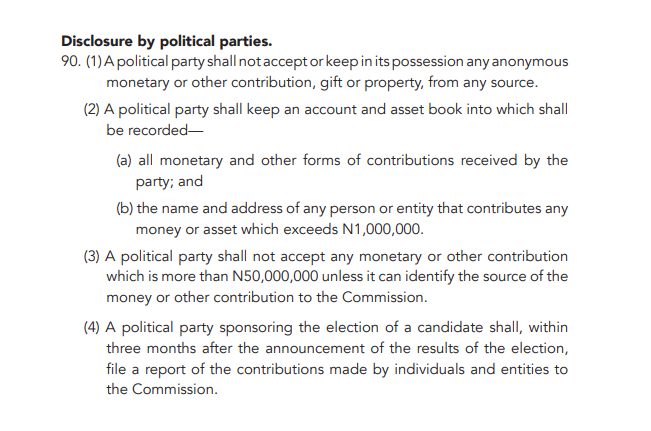
    • Political parties cannot receive anonymous donations.
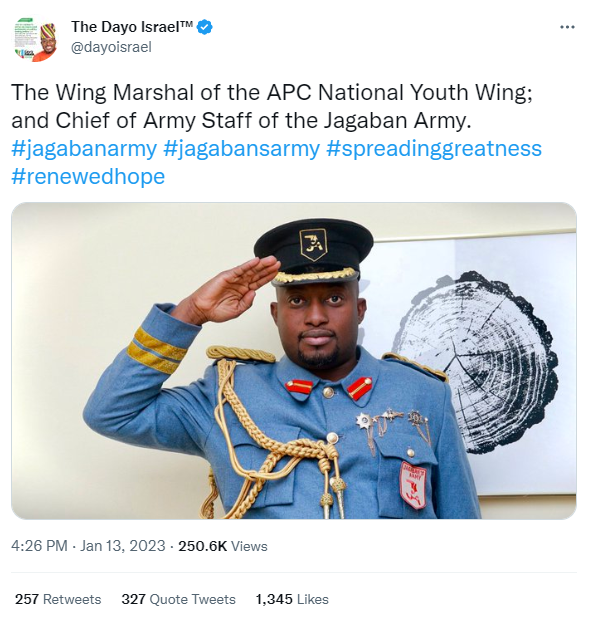
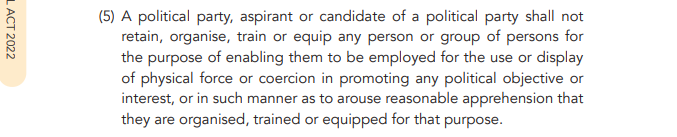
    • Political parties cannot create, recruit or train an “army” to carry out their objectives.
    • Ballot papers with any marks or stains will be rejected.

    Hopefully, this election will go as seamlessly as possible, and people will be able to vote for the candidate of their choice without having to face intimidation or be victims of electoral violence.

    You can read more about the regulations in the electoral act guiding the upcoming regulations here.

    Are you signed up to our Game of Votes newsletter yet? We help you make sense of news jargon and keep you up-to-date especially with election news. Make the subscription of a lifetime here
  • With about five weeks left until the 2023 presidential election, Citizen went through the Electoral Act and found some interesting things. The Act was signed by President Muhammadu Buhari on February 25, 2022 — exactly one year before D-day. For Navigating Nigeria this week, we present some key things to know.

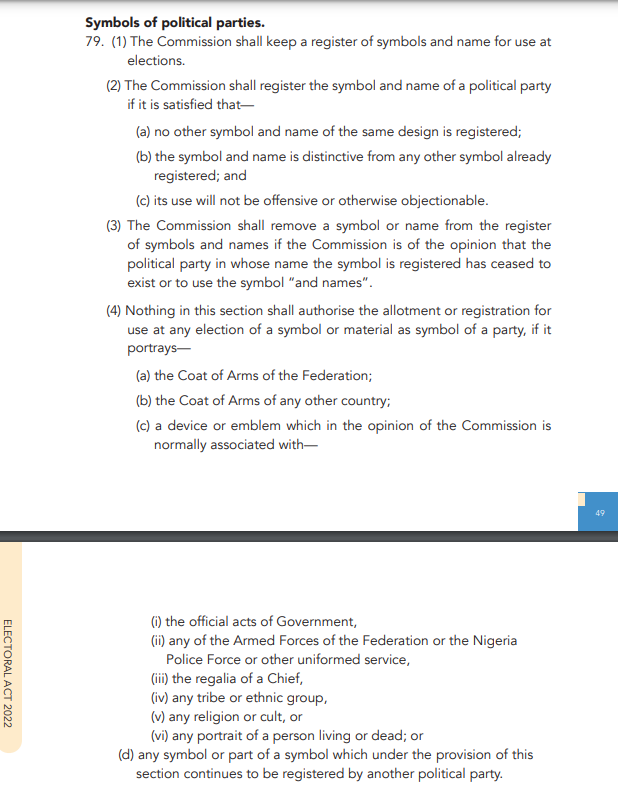
    A party’s logo on the ballot paper can’t bear the portrait of a person, living or dead

    For many voters, next month would be the first time they’d lay their eyes on a ballot paper. This sensitive election material contains a list of all the parties participating in the elections and their logos. In 2019, 73 parties participated, which of course made the ballot papers unusually long.

    An interesting point to note is that the logos never bear the portraits of individuals, living or dead. The Electoral Act 2022 provides dos and don’ts on how parties should go about selecting their logos. See section 79, subsection 4c(vi).

    Political parties are banned from receiving anonymous donations

    As a way to audit and monitor campaign financing, political parties are banned from receiving anonymous donations. It’s not clear how enforceable this has been despite the Electoral Act’s provision.

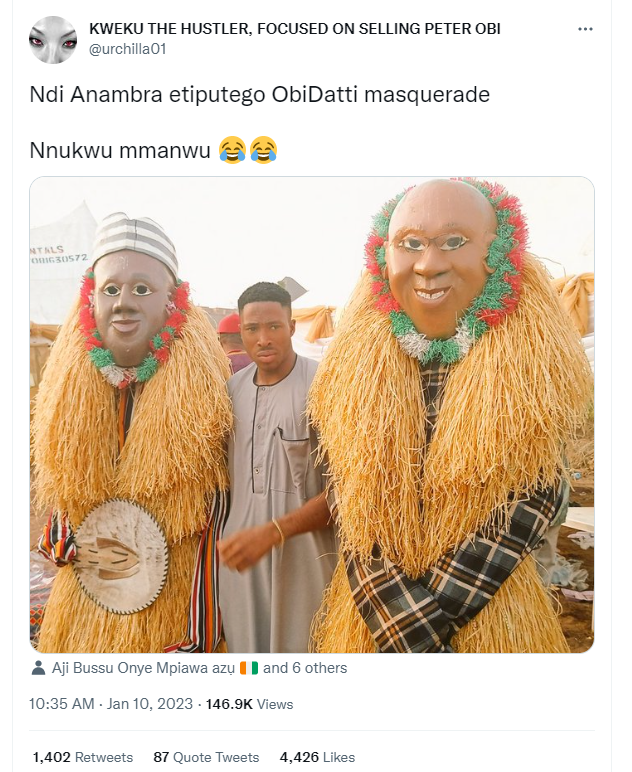
    Political parties aren’t allowed to use masquerades for their campaigns

    Section 92 subsection 4 prohibits the use of masquerades during campaigns. Even though it can be said the law isn’t always followed, the Independent National Electoral Commission (INEC) has it clearly stated. 

    It’s illegal to operate an army in support of any political candidate

    INEC may need to step up to curb the excesses of political parties that flout its rules. Having an “army” — no matter the intention — goes against the Electoral Act, as can very clearly be seen in Section 92, subsection 5.

    The penalties for taking part in any of the two acts above are a maximum fine of ₦1,000,000 or imprisonment for a term of 12 months for candidates. For a political party, a fine of ₦2,000,000 in the first instance and ₦1,000,000 for any subsequent offence.

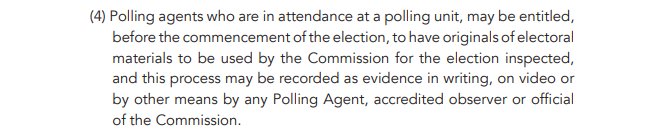
    Party agents can have original copies of ballot papers for inspection on election day

    Election materials like the ballot paper and smart card reader are sensitive. Ordinarily, you wouldn’t be able to touch them until you’re about to vote. However, a particular class of people (outside electoral officers) are exempted. These include accredited election observers and party agents. These agents are those selected by the respective parties and approved by INEC to monitor proceedings at various wards. This can only happen before polls officially begin.

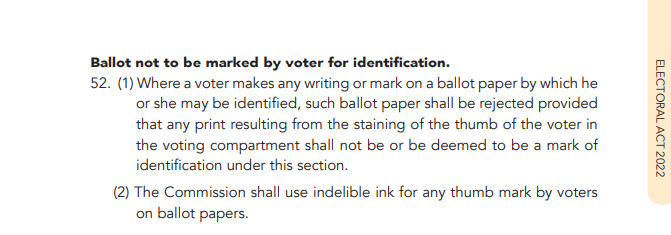
    If you mark your ballot paper, it’ll be rejected

    Your finger will be marked with indelible ink before you cast your vote. The ballot paper isn’t classwork that you’re marking. Only a fingerprint is recognised. Anything else will be rejected when votes are counted. 

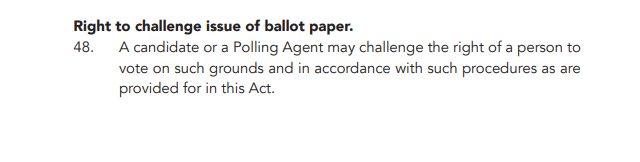
    Polling agents can challenge your right to vote

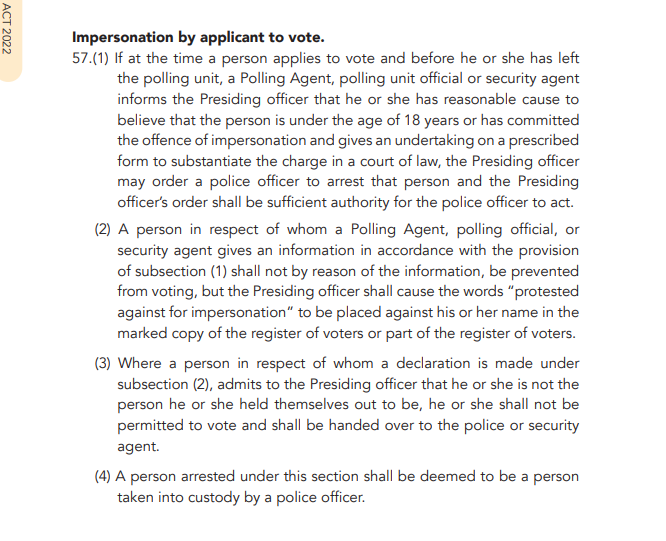
    As mentioned earlier, polling agents will be at polling units to monitor how elections are conducted. Polling agents can flag you as suspicious if they have any reason to believe you’re ineligible, maybe because you’re underage or impersonating someone. 

    If that happens, that’s wahala for you, and you could get arrested.

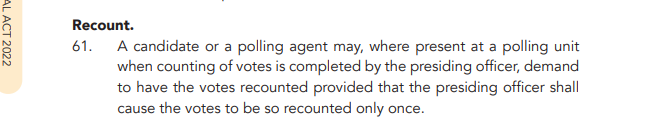
    At the close of ballot, votes can be recounted but only once

    After polls have closed, the presiding officer counts the ballot. If there are any objections, a party agent could ask for a recount but only once.

    There are other interesting provisions covered in the Electoral Act. If you want to know more about the regulations guiding the conduct of Nigerian elections, click here to download the Electoral Act.


    We write the news and track the 2023 elections for citizens by citizens in our weekly newsletter, Game of Votes. Make the subscription of a lifetime here.

  • Supreme Leader President Muhammadu Buhari finally signed the Electoral Act Amendment Bill into law on February 25, 2022.

    He rejected it five times since 2018 and needed some encouragement to finally sign, but Nigeria can finally prepare for the 2023 general elections.

    Nigerians can rejoice that a new Electoral Act has been signed

    What is this Electoral Act about?

    Elections in Nigeria are majorly guided by the laws in the Electoral Act.

    These laws determine if we’re casting votes with cowry shells or ballot paper.

    The Electoral Act is pivotal to the conduct of elections in Nigeria

    The last major changes were made in 2010 when Goodluck Jonathan was still president.

    Much of the content of the Electoral Act 2010 has since been considered outdated, but Buhari refused amendment proposals, until now.

    How’s this my business?

    Voters should care about the Electoral Act

    Nigerian elections are not the most trusted in the world, especially locally.

    Much of this lack of trust is informed by how elections are conducted and how easy they are to manipulate.

    Some of the things that make this culture of manipulation easy can be fixed by updating the laws.

    As a voter, the signing of this bill is good news because it’s filled with improvements that can build trust.

    What improvements?

    We can’t go over everything yet, but here are some nice ones:

    Electronic transmission of results

    This law gives the Independent National Electoral Commission (INEC) the freedom to determine whether election results are transmitted manually or electronically. 

    Manual transmission of election results has made vote-rigging easy to do in Nigeria for years. 

    The electronic transmission will fix that in a big way, and INEC is very interested.

    Overvoting

    Election rigging is a game of numbers. You want to make sure 2+2 = 7, and be able to turn 6 upside down to become 9. 

    The Electoral Act eliminates fraud

    Even when ballot boxes are snatched, it’s to ensure voters in that location don’t contribute to the final tally. 

    The numbers can sometimes be overcooked so that there are more votes than voters. This is called overvoting. 

    The old law only accounted for overvoting when it exceeded the number of registered voters, but the new one is more specific and targets the number of voters that actually show up on election day. 

    If only 12 out of 100 registered voters are accredited for an election, then the result cannot show that 13 people voted.

    ALSO READ: How Bubu Caused National Day of Protest

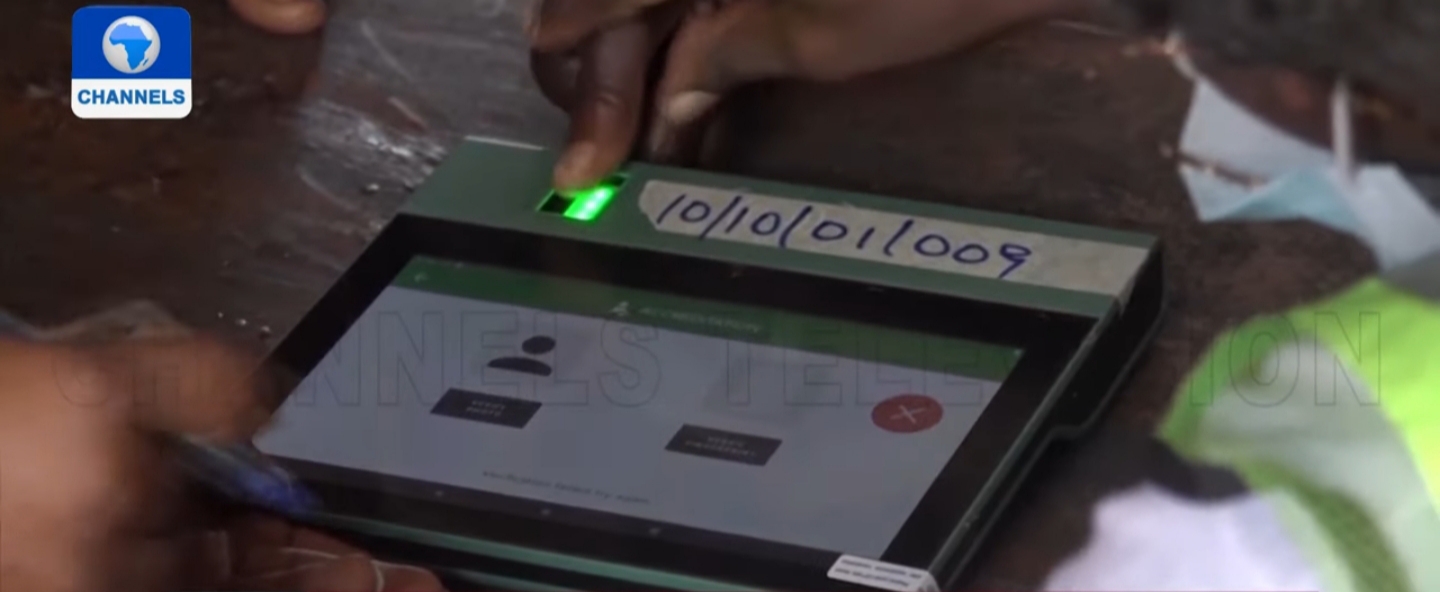
    Electronic accreditation

    Upgrading the Electoral Act to accommodate technology has been needed for a long time

    [Image via Channels TV]

    The new law has legalised the electronic accreditation of voters. INEC could electronically accredit voters in the past, but this was inadmissible in court because it was not backed by law.

    Upgrading the process that confirms the number of people that show up to vote is an effective way to prevent easy manipulation.

    Review of results

    INEC now has the power to review election results that are declared by its officers under duress. 

    Politicians have in the past intimidated electoral officers to declare results in their favour against the wishes of the officers

    It was impossible for INEC to overturn such fraudulent results on its own authority even with evidence of intimidation. No more of that illegality with this new law.

    Inclusive

    The new law places a burden of responsibility on INEC to ensure that polling units are equipped to cater to people living with disabilities. 

    This includes the provision of communication materials such as Braille, sign language interpretation, etc.

    Campaign duration

    According to the old laws, candidates were only allowed to campaign for 90 days before election day. The new law allows them 150 days. 

    This gives voters a lot more time to get to know candidates, ask hard questions and make better choices. We hope.

    What’s Buhari unhappy about?

    We mentioned before that Buhari has rejected five different opportunities since 2018 to review the laws.

    While giving his post-signing speech on February 25, he mentioned that he was still uncomfortable about one thing in the bill he signed.

    Section 84 (12) stops serving political appointees from voting or being voted for at the convention or congress of their parties.

    This means a minister in Buhari’s government cannot contest for an executive or legislative position without first having to resign from office.

    They could contest in the past and only needed to resign from office 30 days to the election after they had secured the party’s ticket.

    Buhari considers Section 84 (12) a constitutional violation of the rights of appointees and wants it amended immediately.

    But critics have already tackled him and asked lawmakers not to amend the section.

    What happens now?

    INEC is expected to release election guidelines and the timetable. The 2023 general elections are finally underway.

    And the very first step for you as a voter is to start with getting your PVC.

    May the best candidates win.

    ALSO READ: What Does Buhari’s Anti-Corruption Report Card Look Like? (Hint: It’s Terrible)