• Everyone wants to japa, but not everyone makes it. Almost Abroad shares the near-misses and big wins of Nigerians chasing greener pastures against all odds in 2025.


    Tired of the stress of moving money across borders? With Juicyway, you can seamlessly send, receive, and convert fiat or stablecoins like USD, CAD, USDT, and USDC in Nigeria—at great rates. Free multi-currency accounts, instant transfers, and top-tier security? Say no more. Click here to get started!


    When did you start considering the idea of leaving the country?

    I’ve never been the type of person who just wants to japa and say goodbye to the country forever. Even when my brother offered to sponsor my masters in the United Kingdom (UK) in 2022, I turned it down.

    My decision might seem stupid, but I have no regrets. I made it for three reasons: My brother and I don’t have the best relationship, I don’t want to owe anybody that much, and I wanted to leave Nigeria on my own terms with my own money.

    In 2024, I finally felt ready for my master’s and started working towards it. My original plan was to get my master’s degree in the UK and return to the country afterwards. But that plan is no longer valid. 

    What changed?

    Nigeria changed. In 2023, I was earning ₦250,000 and could easily save ₦1 million from my annual income. I’m 23 now, and I earn ₦600,000, yet I can barely afford to buy clothes. The worst part is that I’m not a reckless spender, and no matter how much I stretch myself, it’s never enough; I no longer go out or work from cafes. I don’t even go to the cinemas anymore. My favourite type of therapy used to be retail therapy, but now, I can barely afford to buy clothes just for fun.

    Every month, I ask myself where my money is going, and I can confidently tell you it’s going where it needs to go. I pay my tithe and try my best to give to people in need. I contribute to crowdfunding efforts I come across on X. Sometimes, I send some money to my parents and siblings, but most of my money is spent on food.

    Can you break it down a little?

    I live alone, and my grocery shopping for each month costs ₦50,000. That doesn’t include the cost of cooking. For almost three weeks now, I’ve been buying pepper for the most ridiculous price. And don’t even get me started on the price of plantain.

    Once in a while, I fill my gas cylinder and pay my light bill. I also spend close to ₦30,000 on my monthly wifi plan and about ₦30,000 on beauty maintenance. As I mentioned earlier, I don’t go out anymore. The only place I go to is church, and I don’t spend more than ₦5,000 on Uber every Sunday. 

    Get More Zikoko Goodness in Your Mail

    Subscribe to our newsletters and never miss any of the action

    That’s a lot

    Yes. I’ve suddenly realised that the economy is working against me. I’m not doing anything unusual, yet my money can barely keep up with my expenses. I’m getting ready to pay ₦800,000 in rent, and I honestly don’t see how that’s sustainable anymore.

    There has been a power outage here for one week now. Since then, I’ve been spending ₦5,000 once every two days to power my generator. I can’t afford to cook until the electricity is restored because there’s no way to store my food. As a result, I have been ordering food from Chowdeck. It’s time for me to leave the country because the country itself is working against my personal growth. 

    I feel that. How’s the relocation process going?

    People have called me crazy because my entire relocation plan is based on faith and prayer. I have no money to spend, yet I have these big dreams.

    One of the reasons I didn’t take my brother’s offer was because of the kind of school he wanted me to attend. Many immigrants go to schools that are not ranked high globally, and that’s not something I want to do. Considering my line of work, my best shot at creating an excellent life for myself as an immigrant is attending an Ivy League or any other highly respected school. That’s the plan I’m working towards. I’ve managed to get into one of those schools, but I’m still waiting to hear back from the scholarships I applied for.

    What has trying to fund your UK plans from Nigeria felt like?

    You’d think I could at least cover some part of my tuition with what I earn, but I can’t even cover rent. I’m supposed to book my accommodation at school with £300 this month; I considered it a fair amount until I converted it to naira and found that it’s way over ₦600,000. 

    Right now, all I have is my faith. Is it crazy? Yes. But with God, all things are possible. All I know is that there’s nothing for me in Nigeria anymore. I feel like I’m slaving away, and there’s no chance it will improve.

    With my qualifications, I can get another job that’ll pay ₦1 million per month, because my former salary was close to that (I earn less now because I made some sacrifices to follow my passion), but that wouldn’t change anything. It won’t change the exchange rate or the price of pepper in the market. 

    Do you have a backup plan?

    That’s not how faith works. I’ve done crazier things out of faith, and they’ve worked out. I’m not about to start doubting God now. God is my main plan and backup plan. My brother’s offer is still available, but like I mentioned earlier, I don’t want to owe anybody that much in life. He doesn’t want to pay for the school I got into because it costs more than the lower-ranked schools, and that’s completely understandable. But I won’t leave this country and move somewhere else without at least some sort of academic advantage. I’d hate myself if I did that. 

    The school I’m going to has big clout and an incredibly low acceptance rate. It’s faith in God that got me there. And I’ll keep that faith alive until everything else falls in place. 

    I’m also saving as much as possible, but saving in naira is a waste. I’ve also tried saving in dollars, but it’s still not a match for pounds. I plan to sell a couple of things in my apartment to raise some money. I don’t know how it will go, but I know I’m starting my master’s this fall. 

    I’m rooting for you. I wish you a safe flight in advance

    Thank you!


    Want to share your Almost Abroad story? Reach out to me here

  • Sewa (*27) is many things — a queer woman, the breadwinner of a family of five, and a tired Nigerian with immigration dreams. In this story, she shares how her desire to flee the troubles that come with being a breadwinner with no job security almost forced her to marry a gay man who promised to fund her relocation. 

    Like Sewa, about 56% of Nigerian youths are considering relocating in search of greener pastures. This japa wave does more harm than good to the country. For instance, the healthcare sector in Nigeria is dangerously losing its best hands. The country’s 200 million+ citizens are at the losing end of this loss, as the current doctor-to-patient ratio stands at one doctor to ten thousand patients.

    Everyone has their own story and reason for wanting to leave, but Sewa’s story highlights the bigger issues pushing many to make that choice: limited opportunities and a struggling economy.

    This is Sewa’s story, as told to Margaret

    Earlier this year, the US President, Donald Trump, suspended USAID funding, and it hugely affected the organisation where I work. The impact was so bad that the management began a downsizing process that reduced the staff size from 22 to eight. Immediately, the number got to eight, and I realised that I no longer had job security.  I also realised that it would be nearly impossible to get a job that would pay as much as what I’m earning right now.. I currently earn about ₦2 million monthly; getting that sort of pay in Nigeria won’t be easy 

    I weighed all my options and realised it was time to leave the country.  I first started applying to schools and international jobs. Unfortunately, I got no job offers, but was admitted to schools. That also didn’t work out because I didn’t get any scholarships, and the school fees were more than I could handle.

    The cheapest school fees from the offers I got were £16,000. I had only $3,000 and about ₦6 million in naira. I considered saving 1 million per month until September, but it felt useless when I calculated and converted it to pounds. For context, if I save ₦9 million, it would be around £4,200. That would barely cover tuition, accommodation, visa, health insurance, and other expenses. I also happen to be the breadwinner of my family, and relocating wouldn’t stop me from sending allowance to my parents, paying school fees for my siblings, and paying my parents’ rent. 

    Get More Zikoko Goodness in Your Mail

    Subscribe to our newsletters and never miss any of the action

    Even if I figured out a way to suspend sending money home for one month, it still wasn’t a sustainable option. It was hard, but I came to terms with this. I also accepted that I could only move abroad through a fully funded scholarship.  That would mean waiting in Nigeria for one more year, so I decided to do something for myself— travel the world with about ₦5 million. I started with some West African countries that cost me about ₦500,000  to explore.  When I returned to Nigeria, I felt better than I had felt in a long time. While all of this happened, the nagging job insecurity was still there. It made me depressed because the next round of downsizing will likely force two or three people to leave their jobs.  But I didn’t want to keep thinking about it, so I took another vacation to Qatar, Rwanda, Kenya, and Ghana. 

    It felt like a financially reckless decision because I could lose my job anytime, but I just wanted to put myself first for once. My friends were against it because ₦5 million seemed like a lot of money, but it was nothing when I compared it to the amount  I needed to relocate. I just had to convince everybody to let me do what I wanted.

    Being the breadwinner is draining, mainly because it’s been that way since my third year in university. My family were above average, so I went to private school. I remember my dad giving me ₦100,000 for feeding in my first year of university. Money had more value then, so that should give you an idea of how comfortable we were.

    In my second year of university, my dad had a diabetes relapse. It got so bad that he had to retire early. His health kept getting worse, and we had to sell most of our properties. We had only one car left, so my dad gave it to his driver at the time for use in public transportation. The driver got into an accident, and the other driver he crashed into died instantly. That was the beginning of the end for my family. The driver was arrested, and my dad had to bail him out. He also had to handle the funeral fees for the person who died. 

    Unfortunately, the man who died was the breadwinner of his family. The family insisted on an expensive burial rite and kept his body in the mortuary until my dad agreed to pay for it. He also had to start sending money to his kids and the other people who were hospitalised. At some point, he had to start taking a loan to pay those bills.

    My mom was a housewife before all of this, so finding a job was difficult. They stopped sending me money, and I had to take up ushering jobs. I was a first-class student when these things started happening, but my grades dropped to a second-class upper after I began skipping classes to help other people write their exams for extra cash. My siblings also had to leave their private schools to attend public schools. Then I started getting calls from neighbours at home, telling me that my mom was looking thin and my siblings were no longer going to school. I had to start doing whatever I could to send enough money to cover their feeding, medication, rent and school fees. 

    Luckily for me, I started earning well when I graduated from university. I got a job in a bank and eventually transitioned to a Non-Governmental Organisation(NGO). I was earning better than most people my age, but I couldn’t afford what they could because my money was going to my family. Most people who find themselves in my shoes usually feel some sort of relief when they find romantic partners who are willing to lift some of that financial burden off them. But I’m queer and that’s never really the case. Even in romantic relationships, I’ve gotten used to playing the provider role. So far, most of the relationships I’ve been in are 50/50. Sometimes, I look at my straight friends and how much they get to experience the provider perk, and I love it for them.

    I know I need therapy to unpack some of these feelings, but I’m not ready to be that vulnerable yet.  That’s the main reason why I chose traveling. It’s healing some parts of me in a unique way. Those experiences are mine. When I buy even things that are as small as clothes, there is a chance that my siblings or even my girlfriend will take them. But those travel experiences are mine and nobody can take them from me. 

    But I’m back to work now, and another downsizing process is starting. I’m not sure how that’s going to go. That’s why I need to leave Nigeria. I don’t even care what country I go to, as long as I find a fully funded way. I got a proposal from a gay man who wanted to get married to please his parents. It would be a lavender marriage, but he promised to sponsor my relocation.  He seemed like a rich and well-travelled man, so I thought it was a good idea. But I chickened out after we started the process. 

    I would have to lie to my parents and his parents, and it just didn’t seem fair to enter that kind of contract marriage. 

    That was the easiest way for me to relocate. But I couldn’t do it when he said I would need to rebrand every part of my life to fit the perfect wife image his parents had in mind. 

    Now that that’s no longer an option, I must find another way to leave the country. When I leave this job, I don’t want to earn less than I currently earn because I have too many bills to pay. I have no idea what the future holds, but I know I need to figure it out soon.

    [ad]

  • Being a Nigerian has always come with its fair share of unique troubles, but nothing too complicated for the resilient to overcome. However, with the country experiencing what many have described as its most economically challenging reality yet, even the most resilient Nigerians are at their wits’ end. 

    Alero, a baker and single mother of two children, is one of those Nigerians. In this story, she shares how taking on the responsibility of laying her parents to rest forced her to make a financial decision that almost altered the lives of her children and how she can no longer afford to give them the life she used to.

    This is Alero’s story, as told to Margaret

    I’m a single mom of two kids and a baker. Being a single mom has been mentally, emotionally and financially challenging. There’s a certain stigma that comes with my status. People assume that you are a product of the bad choices you made. 

    It takes two people to stay in a marriage, but somehow, only one person takes the fall. Suddenly, you find yourself trying to prove a point to people who won’t care if you stop breathing. And the financial burden of trying to be the best you can be for your children doesn’t help either. Yet, you must show up daily regardless of how you feel. 

    Things were fairly manageable until my parents passed on, and they took a turn for the worse. I am my parents’ only surviving child, so this meant I had to foot the bills for the burial. There were so many demands to meet and so many bills to pay. I started cutting costs at home at some point, but that still wasn’t enough. When the bills started getting too much, I decided to withdraw my children from school.

    Get More Zikoko Goodness in Your Mail

    Subscribe to our newsletters and never miss any of the action

    My eldest was already a teenager then, so we found ourselves in that situation. Before taking the step, I spoke to someone who told me that I could take him somewhere to become a mechanic’s apprentice. I thought about it for two days, but I felt the urge to rant to someone before taking him there. I was tired of suffering and smiling, so I posted on X about considering withdrawing my kids from school for at least one year.

    Acknowledging you can no longer afford to give your children something that is vital to them is the nightmare of any single parent, and I am living mine.

    The financial burden has always been heavy, but has worsened over the last two years. Before 2023, I could afford things like fruits without batting an eyelid, but now, I can barely afford them. It also doesn’t help that my income hasn’t increased since then. Now, I can barely keep up with my daily expenses. As of 2022, I could feed a family of six up to three times with ₦10,000 daily. Fast forward to 2023, that same amount could barely feed us for two days.

    My family has now reduced to just four people, but I still need way more than ₦10,000 to feed them daily. We no longer turn on our generator, nor do we use our air conditioner or television. We only turn on our fan and freezer, while everybody makes do by watching whatever they want on their phone.

    I stay up at night trying to figure out how to make more money. I have tried different ways to increase my income, but it’s still insufficient. There’s no way to sugarcoat it because things have gotten bad so quickly, and it has significantly impacted my family. I used to feed my children fruits before to help their bodies get the nutrients they need, but I can’t do that anymore because fruits are expensive. We can eat solid food or fruits, but not both simultaneously.

    My children are getting older and need personal space, but I can’t afford to move the family into a bigger apartment. We manage what we have now and try to fit into our small apartment. Even our healthcare costs have become outrageous. Before, I could take them to the hospital for a general body checkup, which would cost ₦50,000, but now, the same services cost over ₦100,000.  This has pushed us to try alternative medicines. For example, if my children have a cold, we use Coca-Cola and a lemon to treat it rather than the flu pills we’d usually buy.

    It’s been hell, but I’m grateful for the blessings we have.  After I made the tweet I mentioned earlier, some kind Nigerians crowdfunded and raised enough money to cover the cost of my children’s education for at least one year. It was such an unexpected blessing, and I still appreciate it. I was so relieved because it meant an entire year of not worrying about where my children’s school fees would come from. Speaking out about my struggles helped me, and I want to encourage other parents who are in similar situations to do the same. A closed mouth is a closed destiny.

    I was dying inside, but I wanted to shoulder my responsibilities alone and smile through them. It might sound brave, but that doesn’t help anybody. Get help however you can and try to cut costs in the best ways possible. If you can’t afford the private schools, you can move your children to public schools. If you can no longer afford new shoes, buy thrifted shoes for them.  The biggest lesson I’ve learnt is that my children need a healthy mother, and I have to manage whatever pressure life throws at me for their sake.

    I try to be optimistic, but the future still looks bleak for people like me, and it’s overwhelming. I wish I could say something positive about the future, but right now, I only have faith that things will improve. My baking business will become more profitable, and I’ll be able to give my children a good life.


    News is boring, but we make it fun. Subscribe to The Big Daily to be the first to know the day’s biggest news. 

    [ad]

  • In a lot of ways, 2024 was a hell of a year for Nigerians; from fuel scarcity and hikes in fuel prices to sky-high inflation, poor power supply, and crazy exchange rates, people living in Nigeria braved so much to survive.

    Micro, Medium, and Small Enterprises (MSMEs) were no different. Like every other year, 2024 came with its ups and downs, but the lows were so severe that their impact was felt nationwide. From the Manufacturing Association of Nigeria (MAN) announcing that unsold products worth about ₦1.24 trillion were stuck in different warehouses across the country (just by the first half of the year) due to the inability of their owners to sell them, to the Bank Of Industry (BOI) stating that MSMEs in Nigeria need about $160 billion bailout funds, the country didn’t exactly prove itself as a good business environment.

    As the year comes to an end today, Zikoko Citizen spoke to three young micro business owners to understand how the Nigerian economy affected their businesses in 2024 and what they look forward to in the coming year.

    Chisom, 27– Fashion Designer, Abuja.

    I don’t want to sound cliche, but doing business in Nigeria this year was hard. I consider this one of the most difficult times to be a young adult in Nigeria. The economy and everything is just so difficult. The cost of living is high, and the cost of doing business is even higher.

    The crazy thing is that because customers struggled, they didn’t understand that business owners had it difficult as well. It’s even worse with my kind of business because some people feel like you just want to overcharge them or think you are overpriced.

    You might just tell a customer the price for something this minute, then go to the market the next minute to buy that same thing, only to find out that the price is way higher than what you’ve already charged. Only a few people understand when you come back to them to say you’d need to increase the initial price you told them. I’ll give you an example– one time within the year, a bundle of lining was about ₦9000 to  ₦1000.  A few weeks after I bought some, I felt like the prices of sewing accessories might go up, so I went to the market to restock, but I was super shocked to find that it had increased to  ₦35K and the sellers at the market were not even begging or haggling price. The energy they gave was like, “If you’re not buying, go.”

    Navigating price increments and incorporating them into my business was not easy for me this year, and I don’t think it was easy for others, either. It came to a point where I needed to charge more to sustain my business. A lot of things came into play and I  had to consider all those factors to be able to charge appropriately for my brand, so you have to accept the reality that not everybody who could afford me before will be able to afford me presently and just be fine with it.

    People who appreciate the services you offer enough will keep patronising you, while those who can’t handle the price increase will go to another place that is cheaper and more affordable for them. It has nothing to do with the quality you offer; it’s just about what they can afford.

    I don’t think there’s a specific thing that’ll make my business easier in 2025. I’m saying this because I don’t think it’s a matter of specifics– as it stands, everything and everyone is struggling. Even middle-income earners now are not fully able to afford our (fashion designers) services.

    Every aspect of the economy is struggling right now. I can’t even say that access to loans, funding, or policies that’ll increase the ease of doing business will ease things for me in 2025 when every other aspect of the economy is suffering. It won’t really make sense because I can now have access to that funding or loan, and then find that my customers are still struggling, so everything just needs to be better in 2025 for other things to be better. I don’t know if that makes sense.

    Sarah, 25. Jewellery Vendor– Warri

    Living and doing business in Nigeria as a jewellery vendor in 2024 came with its own unique challenges and opportunities. The jewellery industry in Nigeria is already highly saturated due to its profitability, but 2024 was slightly stressful for a number of reasons.

    This year, the cost of procurement and shipping became drastically high. Import prices, for instance, climbed by about 35%, and this affected the amount of goods I was able to purchase at a go.

    Normally, doing business in Nigeria is quite difficult, so you have to be strategic, but this year required extra strategy to avoid running mad due to the way prices skyrocketed. The country’s economic environment was just unpredictable, with fluctuations in currency exchange rates, inflation, and government policies affecting the cost of doing business.

    2024 has been a tough year for me and my brand, but I was able to scale through and make the best of it through careful planning, adaptability, and a deep understanding of the local market and culture. Coming up with the right strategy and mindset helped me achieve good results.

    My initial plan for my brand was to sell super affordable jewellery, but with the increase in procurement and shipping, I just had to increase my own prices to avoid running at a loss. However increasing my price due to the whole exchange rate madness and other things actually brought in new customers, who are now my target audience. Because of that change, I strategised and moved from just selling regular earrings to luxury items like custom-made unique designs and venturing fully into niches like wedding rings and male jewellery accessories. 

    So yes, I lost a few clients because most of them were no longer able to afford me due to the increase in prices, but I also gained newer customers.

    My business will be four years old next year, and this year, we recorded lots of sales than we’ve made in the past four years, not because the environment was encouraging but because I was strategic in adding new niches

    When it comes to things that’ll make business easier for me in 2025, I’ll say the exchange rate first of all– I know it’s sort of decreasing right now, but I need the Nigerian government to look into it next year. If the exchange rate was actually good, people won’t be complaining, and businesses won’t be struggling. 

    A lot of the time when I’d reach out to my suppliers to calculate the prices of goods, I realised over and over again that the gap between the exchange rate in 2023 and this year was just too much. 

    Another thing I want the government to take a look at is this whole custom-clearing thing. To clear goods has now become another issue. The payment for clearing goods has become so heavy that many business owners now have to order bit by bit because ordering so much at once brings a lot of issues. The delay is also insane. These things just need to be better for businesses to thrive in 2025.

    Ugonna, 29. Footwear Vendor– Lagos

    Doing business in Nigeria was very challenging for me this year, and I tried to evade and minimize costs as much as possible.

    The exchange rate didn’t make things easier either because it affected me like mad and this made me withdraw from importing by myself and buying from a friend that had a stronger capacity than I did. I’ll explain– When we order from shipping companies, the goods take about two months to get to Nigeria, but you can’t really monitor the exchange rate and take advantage because even though you had ordered two months away, you’ll still have to clear the containers at whatever price the exchange rate is at when you goods finally arrive. You also have to settle Alayes and Owo da boys. 

    I didn’t make as much profit as I set out to this year and I couldn’t take my business offline because the crazy costs of rent in prime locations were way more than I could afford.

    What will make my business easier in 2025? Access to funding. This is particularly important to me because I need to diversify and look into other sectors because having more than one source of income will shoot me up the ladder. One of those sectors is entertainment/full-scale film production. I’m already working on this. My production company is set to release its first film by January, but there are so many ups and downs in the industry that make this type of venture unsustainable by a singular individual, so going into 2025, I need avenues to access more that’ll enable me to run my film production and footwear businesses properly and profitably.


    Currently, MSMEs account for 40% of Nigeria’s Gross Domestic Product (GDP) and provide 90% of jobs in the country, making them the backbone of the economy, without which the country will experience more harsh times than it already is. Just like the young entrepreneurs who spoke to us, we hope that 2025 is a better year for MSMEs in Nigeria.

  • Lagos residents walk fast, speak fast, and run fast toward anywhere the money is, but these days, no amount of speed can help the average Lagosian escape Nigeria’s rising poverty. 

    Halima, a single mother and laundrywoman (who washes by hand), is a practical example of this. In a chat with Zikoko Citizen on November 16, Halima revealed that she left everything she knew in Kano State to make money in Lagos. 

    But even though she came to the big city with these high hopes, Halima says she doesn’t make more than ₦6,000  in a good week. It hasn’t always been like this, but recently, with the rising inflation and high cost of living,  outsourcing things like laundry has become a luxury that a lot of Nigerians can no longer afford. Halima says she’s lucky to find two customers in a week. 

    “Only girls who are alive menstruate”

    The blazing Lagos sun wasn’t bright enough to hide the worry in her eyes as she spoke to me about her money struggles. While we chatted, her 13-year-old daughter returned from school, carrying a bag bigger than her frame. Soon, I understood why– Halima’s daughter, who she fondly calls Nunu, had taken the part-time role of a delivery girl, picking up dirty laundry from her mother’s customers on her way back from school. 

    For the first time that afternoon, I saw Halima smile when she saw Nunu. But the worry returned to her eyes almost immediately after Nunu mentioned that she hadn’t eaten all day. At this point, I was unsure if it was okay to ask Halima the sanitary pad-related question I had already written down, but I decided to try anyway. 

    “Has Nunu started menstruating?”

    “Yes na, since she was 11 even”. Halima said. 

    “How do you afford to buy her sanitary products?” I asked. 

    She burst into laughter and then paused after a few minutes, looking more serious than she had since the beginning of our conversation. 

    “My sister, I can’t even buy food for this girl. She’s hungry, and you’re asking about sanitary products? Is it not somebody who is alive that will menstruate? Only girls who are alive menstruate. Even I, the mother, don’t use sanitary products,” She said.

    Halima told me that it wasn’t always like this, but since the beginning of the year, they’ve had to choose between sanitary products and food. So now, she and Nunu use a washable piece of fabric that causes itches and rashes. The National Library of Medicine, says the use of fabrics like that  can increase the risk of urogenital infections, but that sort of worry is a luxury Halima cannot afford

    “What can we do? A pad costs more than ₦1,000 now, but food is even more expensive. She’s a growing child; she needs nutrients like her mates. We pick our struggles wisely. One day, she will use pads again,” Halima says.

    It’s not just Halima and Nunu

    As of 2021, more than 37 million women and girls could not afford to buy sanitary pads. This number is projected to have increased this year as Nigeria is currently facing its worst economic crisis, which is affecting everything from food prices to pad prices. 

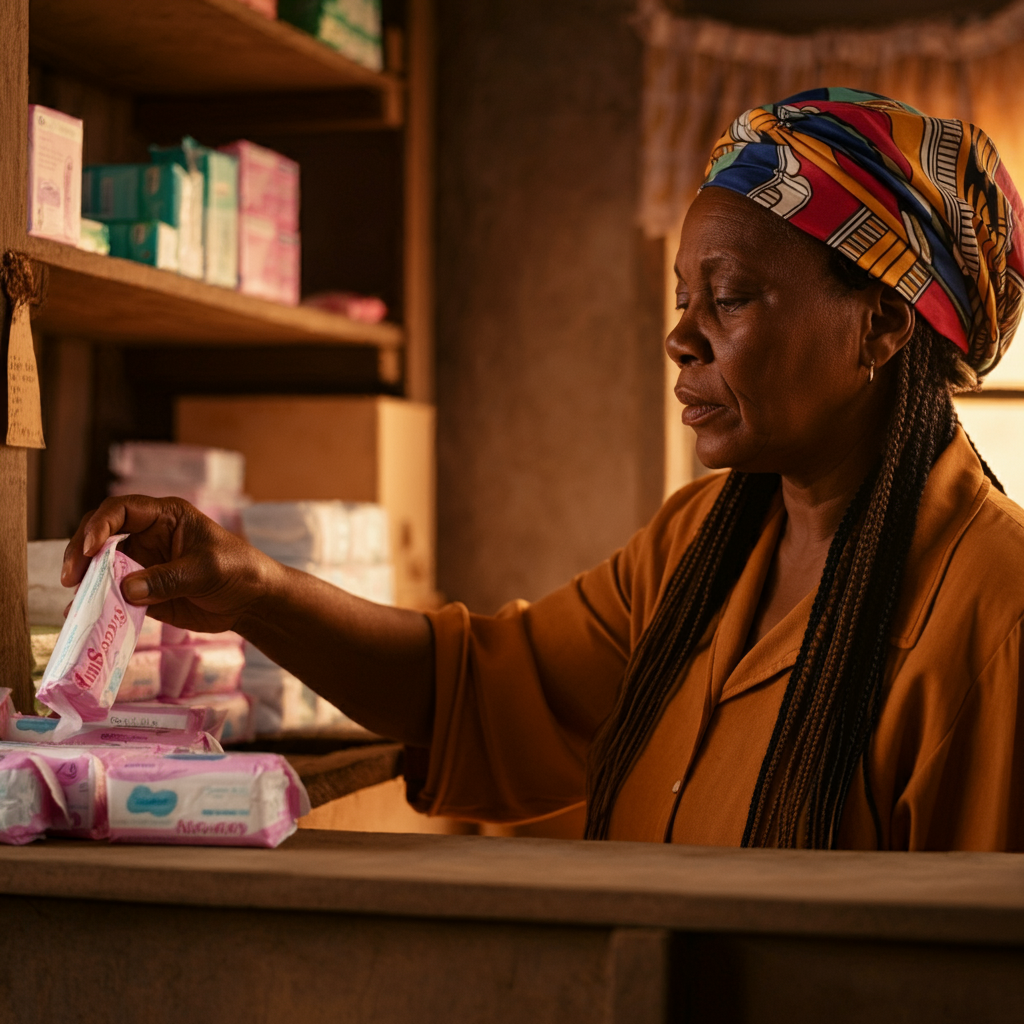
    Iya Aanu, a shop owner in Gbadaga, Lagos State, told Zikoko Citizen that sanitary pads now cost between ₦700 and ₦4,000, depending on the brand. This is a huge  increase from the ₦150 to ₦250 price range of 2019  

    As a result of these price increases, more girls and women are being thrown into period poverty as they now have to settle for less sanitary options like rags and towels to contain their menstrual flow. Like Halima and Nunu, they pick their struggles. 

    What can the government do to reduce period poverty?

    The government currently charges a 20% import duty fee on sanitary products that are not made in Nigeria. This is a major contributor to the rising cost of pads, tampons, and other sanitary products. Some women’s rights advocates have consistently called for the elimination of period taxes for a while now, but so far, the government has only cancelled taxes on locally produced menstrual products. By scrapping this import duty, the government can make sanitary products more affordable for women like Halima and Nunu.

    How can you help women like Halima??

    The Nigerian government has done a poor job of helping its most vulnerable citizens adjust to the effects of President Tinubu’s economic reforms, but here’s how we can help.

    • You can start by signing petitions advocating for the eradication of period poverty.
    • Support NGOs that are working hard to make sanitary products accessible to women. You can do this by volunteering, donating or sharing their work. 
    • If you belong to the category of Nigerians who can still afford essentials like pads, you can also donate to young girls from low-income families around you.