The pressures placed on first daughters in Nigerian households can be crushing. Whether they are taking over parenting duties or performing hard chores in the home, finding time for themselves can sometimes be difficult.
We spoke to 5 Nigerian women who are first daughters about what makes them burn out in their families and how they manage it.
“You’re somehow supposed to take care of your parents and act like a second mum.” — Adebusayo
What makes you burn out?
The expectations. Whew. You’re expected to be the golden child, the responsible one, the one who knows better, whether you’re 13 or 30. You’re somehow supposed to be the perfect example for your siblings, take care of your parents (even emotionally), and basically act like a second mum. Then you add black tax on top of that — the financial responsibilities you didn’t sign up for but feel guilty about if you don’t fulfil.
The pressure to always be available emotionally, mentally, and financially. The black tax is draining, especially when you feel like you can’t even breathe before someone needs something from you. But what really pushes me to burnout is being treated like the deputy parent. Like when my mum calls and says, “Talk to your sibling, they’re misbehaving,” and I’m just like… ma’am, I’m not the parent here. Why is it my job to fix it? Little things like that — stacked on everything else — make you feel stretched too thin.
What do you do when you’re burned out?
Honestly? Choosing peace. If I’m not in the mood to talk, I won’t answer calls. If I need space, I take it. I don’t over-explain anymore. I just leave and recharge on my own terms. That might look like ignoring calls from home, saying NO when it’s not convenient for me, or simply delaying the “fix it” until I feel ready. Because if I keep saying yes to everyone else, I’m saying no to myself — and I can’t do that anymore.
“It’s not by force to become a mini mummy.” — Damilola
What makes you burn out?
The idea that I should suddenly know what to do and start taking care of everyone. Like, we’re all living life for the first time — let my siblings figure it out the same way I did. It’s not by force to become a mini mummy.
What do you do when you’re burned out?
I sleep. I don’t let it get to me. Nothing special about it. Why should I be worrying unnecessarily? If you ignore everybody, you won’t burn out.
This content is sponsored by In Bloom, an MTV anthology of short films about gender-related issues women face. Watch “Afefe,” a short film from the anthology, which tackles unpaid labour.
“You don’t own your life till you’re in your twenties.” — Bolu
What makes you burn out?
When you’re the first daughter and the only daughter, it feels like you’re carrying a lot, in terms of being overprotective and also shouldering the chore. You’re not free. You don’t own your life till you’re in your twenties.
There are sometimes that you see people — your friends — doing some fun stuff but you don’t have the time to participate in it because you have so much work to do at home. That was how I was living my life for a long time. Even after I went to university, I had to school in Lagos so I could be close to home.
What do you do when you’re burned out?
I cry. I talk to my mother about it, but I also can’t tell her everything. I also speak to a friend of mine to just speak, release, because if I don’t talk to anybody about it, I might just crash out.
“It’s mad, stupid expectations.” — Aaliyah
What makes you burn out?
Expectations. It’s mad, stupid expectations. It’s not even the expectations that your parents set for you. It’s the one you set for yourself. It’s very crazy. Like you’re always expected to do really well. That makes you burn out.
It’s not having anyone to rely on. Your younger siblings have someone to fall back on. You have no one. And you’re doing everything and your parents are trying to use you as test run. And they are not doing it on purpose. You always feel like you have to do it, there is no emplate.
What do you do when you’re burned out?
I create my own space. I spend time with myself alone and I don’t do anything related to work. I just rest or spend bastard money on myself.
“I keep postponing it and sleeping basically.” — Adebola
What makes you burn out?
The fact that I had to be a parent at a young age. The fact that I cannot ask anyone for money because they think I have and they think I should be the one giving them instead. By them, I mean my mom and siblings. The responsibility that comes with it, the fact that you can’t fuck up, and the expectation that you’d have to be the one to lift the family.
What do you do when you’re burned out?
I haven’t handled it. I keep postponing it and sleeping basically.
Get More Zikoko Goodness in Your Mail
Subscribe to our newsletters and never miss any of the action
Every week, Zikoko seeks to understand how people move the Naira in and out of their lives. Some stories will be struggle-ish, others will be bougie. All the time, it’ll be revealing.
The She Tank and BellaNaija are set to release a groundbreaking film as part of their 2024 Women’s Economic Power Campaign titled #HerMoneyHerPower. The film showcases real stories of women who have used their economic power to lift themselves and those around them, inspiring a younger generation to follow suit.Click hereto find out more about the #HerMoneyHerPower campaign.
Let’s start with your earliest memory of money. Do you remember that?
I remember looking forward to every Eid celebration because my mum made me take food to our neighbours, who always gave me money in return. One neighbour always dropped at least ₦500. That was serious money to an 8-year-old. My siblings knew about his generosity, and we used to fight to deliver food to him. I often made at least ₦1k at the end of the day from these food runs.
I saved my money to buy bangers in December, sneaking out of the house to light them with my siblings. Fun times.
Your mum never asked to “keep the money for you”?
She tried once, but my dad changed it for her. My mum was the frugal parent who always tried to manage money, but my dad was the jaiye jaiye type. The only arguments they had around us were on minor money matters.
My dad didn’t understand how he could be a major car dealer, and his wife would make a case for Nigerian cornflakes over a foreign brand to reduce costs. So when she tried to take the money my siblings and I made, he said, “Haba. Let these children be.”
Thank God for daddy
Haha, thank God. My dad tried his best to spoil us as much as my mum allowed. My mum was a stay-at-home mum, so she often “intercepted” any gift from my dad that she considered extravagant.
For example, my dad gifted me an iPad after I passed JAMB in 2009. He thought it’d be great for uni, but my mum saw it as the weapon that’d push me into waywardness and a desire for expensive things. She seized that iPad and made me use a small Android phone instead. I was so angry. If I made my own money, would anyone stop me from getting nice things?
Speaking of money, when was the first time you worked for it?
2011. I started selling panty liners to my coursemates and hostel mates when I was in second year in uni. I got the idea from my cousin, who’d signed up to a business networking company that manufactured health and lifestyle products.
As a member, she had access to the products and sold them in her university. She told me about it because she wanted me to sign up under her, but I didn’t have the strength to convince people to join anything. We just settled on her sending some of the products my way.
I can’t remember every detail, but I made ₦800 in profit on every sale. The panty liners were a hit, and it was the first time I realised I knew how to convince people they needed something.
I sold the products for almost two years and made at least ₦30k in profit monthly. Add that to the ₦20k I got from home as a monthly allowance, and I was a pretty comfortable student.
Nice. What were your expenses like?
The only thing I remember using the money for was an iPhone. I saved heavily through the year and bought the iPhone 5 in 2013. I think it had just come out and cost around ₦150k. Looking back now, spending all my money on one phone may have been foolish, but it was a reward for all my hard work.
That same year, I did a three-month undergraduate internship at a production company. They only paid a ₦5k stipend, and I’d already zeroed my mind that I wouldn’t show up every day. ₦5k didn’t even cover my transportation for two weeks, not to talk for a month. But I changed my mind after my first two weeks at the company.
Why?
My supervisor was part of the sales team, and she intrigued me. She was so well-spoken and self-assured, it was like looking at a vision of what I wanted to be in the future. I decided there that I wanted to work in sales.
It’s dumb, but I somehow equated being confident with working in sales, and I wanted that. My supervisor also talked about meeting targets, but I figured selling wasn’t an issue for me. I mean, didn’t I sell out panty liners in school? Plus, she also got commissions for meeting targets, and the idea of extra money outside salary sounded good to me.
I didn’t get into sales immediately after I finished uni, though. I taught for a while when NYSC posted me to a secondary school in 2015.
Did you like teaching?
Oddly, I did. I taught basic science, and I really vibed with my students.
The school paid me ₦10k monthly in addition to the ₦19,800 NYSC stipend. The job also came with free accommodation at the school’s sick bay, so I was pretty much chilling with my income. I also saved a bit. I finished the service year in 2016 with ₦120k in my savings. I didn’t have any plan for it; I just thought it was nice to keep money aside.
What happened next?
I toyed with the idea of staying back at the school to teach full-time. But they offered me ₦20k/month and the idea disappeared fast. I couldn’t imagine enduring five years of uni to come and be earning ₦20k.
I spoke to my brother about looking for a job and he connected me to a friend who worked at a management consulting firm. I applied, did the interviews and got employed as a business development executive. My starting salary was ₦85k, with the option of commissions if I brought in at least 12 new deals monthly. I usually averaged 6-8 monthly and even that was impressive. I was something like a superstar at work.
After working there for a year, I was promoted to senior bizdev executive, and my salary increased to ₦120k. I’d been living with my parents since I returned home from NYSC, and after my promotion, I decided it was time for adult life. My mum kicked against it, but she calmed down after I pointed out that our house was far from my workplace. It wasn’t that far; I just wanted to leave.
Tired of living at home, eh?
Yes. I just wanted freedom. My mum had started to pocket-watch me, and it didn’t make sense to explain why I bought a new dress or listen to lectures about saving money whenever she saw me with a new shoe. I wasn’t spending frivolously; I just had to constantly update my wardrobe because my job involved meeting people, but my mum thought I was being wasteful. It was tiring.
How did househunting go?
Fortunately, it was pretty stress-free. I paid ₦10k to an agent my friend introduced me to, and we found the perfect apartment within two weeks.
It was a ₦400k/year apartment, but I lied to my parents that it was only ₦250k so they wouldn’t complain about it being too expensive. My dad gave me ₦300k, I made up the balance and moved in around 2018.
Living alone wasn’t as easy as I thought. Suddenly I had to start caring when a light bulb stopped working and thinking about what I’d eat for the week. But I made it work. It just meant I had to budget seriously and cut down on some needs.
For example, I learned to shop thrifted clothes rather than only purchasing overpriced boutique items. And I actually found gems in thrifted clothes o… unique pieces that no one would’ve guessed weren’t new after I washed and properly ironed them.
I’m always up for thrift praise. Tell me more about how you handled budgeting
I created a simple spreadsheet where I tracked my proposed expenditure for a month versus what I actually spent that month.
I still use the same method to track expenses today, and it’s been very helpful. There’s no thinking like, “Ah, how did I spend money this month?” because it’s literally there in black and white. It’s also helped me become more intentional with saving.
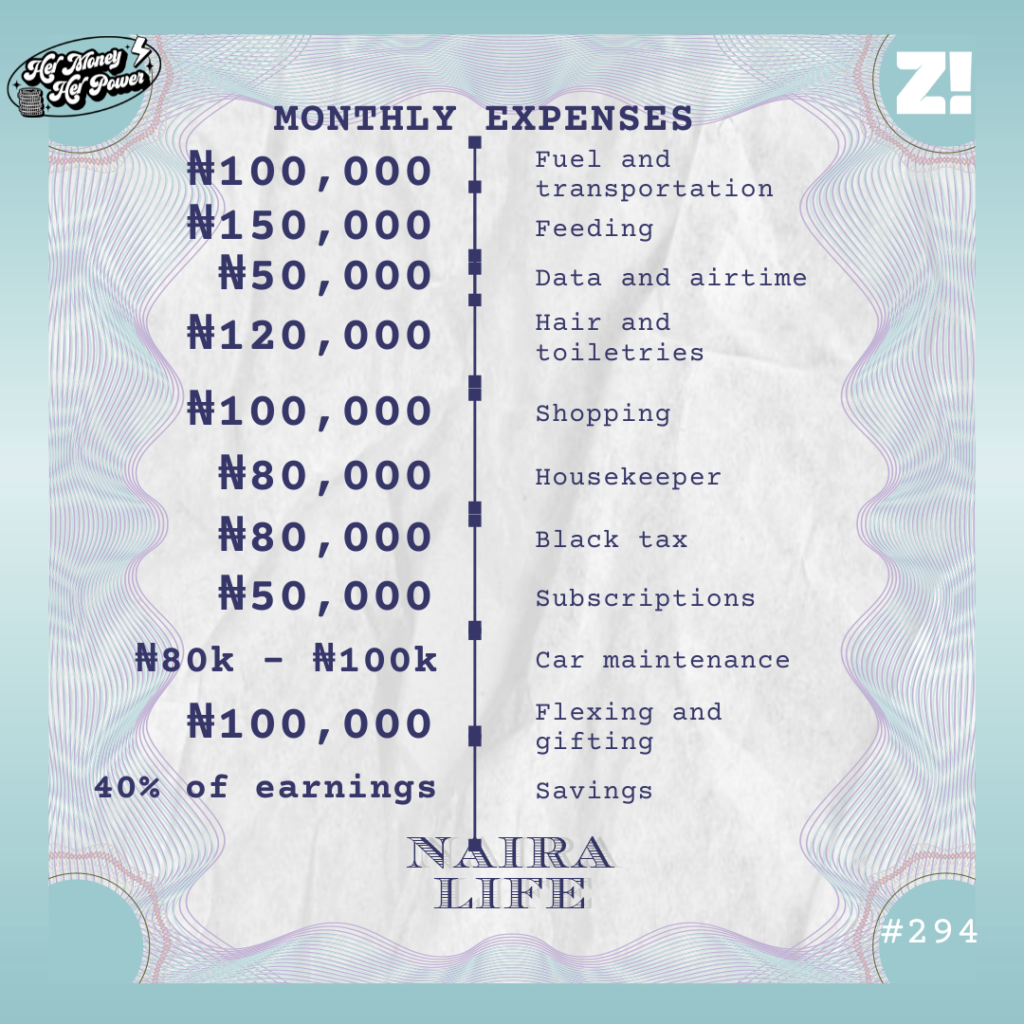
I’ve saved at least 40% of my income since I got another raise to ₦200k in 2019. Once I input the salary into the spreadsheet, it automatically calculates the 40%, and I send that amount to a separate account. Over the years, my savings have come in handy for emergencies and major projects. Like when my dad fell ill and passed in 2020, I used my savings to handle my share of the funeral expenses.
I’m sorry about your dad
It’s fine. I often wish he’d stayed alive for at least another year; 2021 was my big break, and I’d have loved to spoil him a little. I landed a sales manager role at a fintech company and went from earning ₦200k to ₦750k from one job change.
That’s more than three times your previous salary. How did that feel?
It felt like I was finally seeing the benefit of all my hard work. I was still going to be pursuing clients up and down like I did at my previous job, but the fintech job came with a 7% commission on every deal I landed in a specific category.
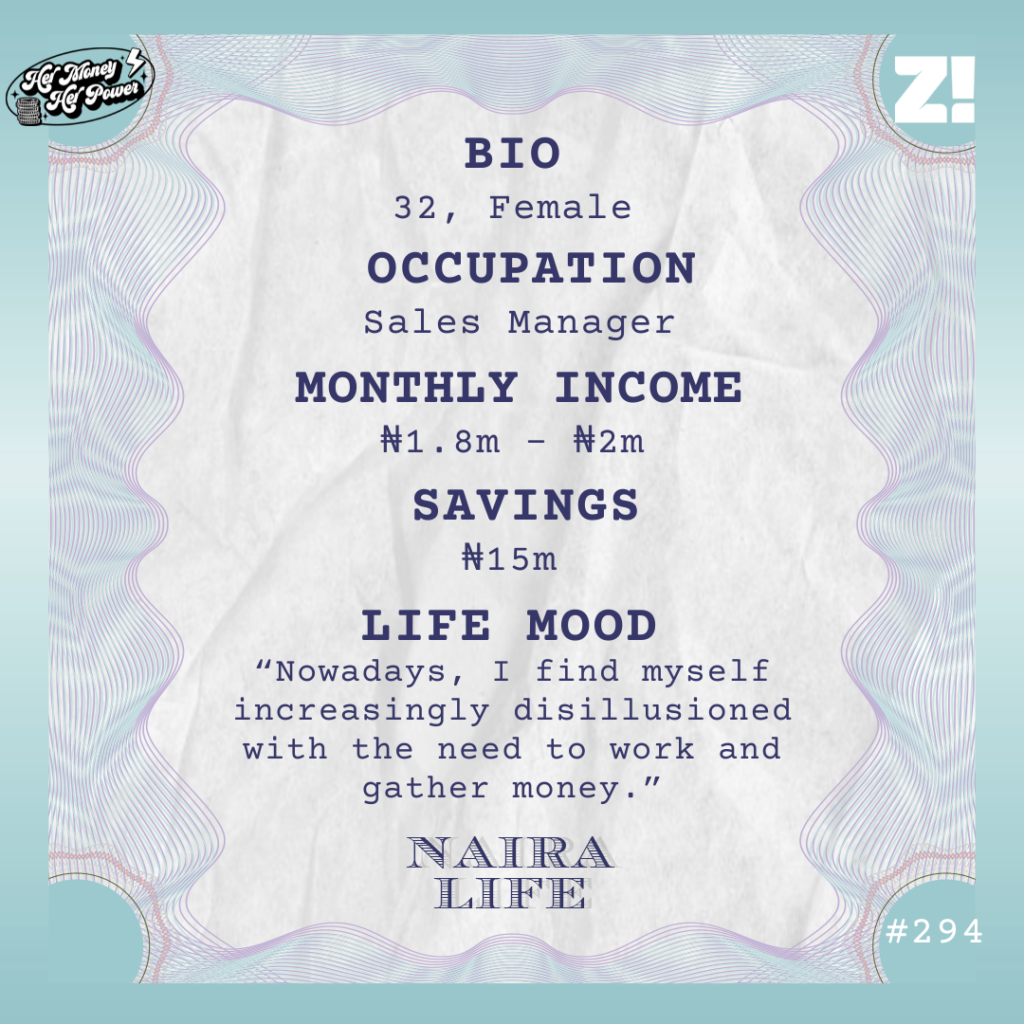
I’m still at the job, and my salary has increased over the years to ₦1.2m. With commissions, that’s often between ₦1.8m and ₦2m.
That’s not bad at all
It’s not. I know I’m more privileged than most, and I’m fortunate enough to afford to live below my means. My mum and siblings don’t bill me, so my primary responsibility is myself. But I’ve been battling a deep sense of tiredness and lack of motivation since late last year.
At first, I thought it was a desire to make more money, so I began applying for other jobs, but when I got invited for interviews, I ghosted them. I’ve also gone on leave at work a couple of times, but I returned even more burnt out than when I left. I have a theory for why I feel this way.
What’s that?
I’ve worked nonstop since 2015, and it’s starting to catch up with me. Nowadays, I find myself increasingly disillusioned with the need to work and gather money. Like, is the point of my life to go from one meeting to the next trying to upsell people and pretend I’m passionate about one fintech product or the other?
To be honest, I’m considering quitting my job and taking an indefinite sabbatical to travel around Africa and see if I can drum up the passion to do anything again. Going on leave didn’t work because leave had an end date, and I found myself becoming increasingly anxious as the time to resume work grew closer. An indefinite sabbatical may be just what I need to get my head in the right place.
Have you considered how you’d survive without a job?
I think about that every day, and it’s the reason I haven’t dropped everything to sleep on a beach somewhere.
I have about ₦15m in savings right now—spread out across my mutual funds and dollar savings—but I know that’s nowhere close to sufficient to fund my travel dreams or keep me comfortably unemployed for long. My rent alone is ₦1.5m/year. It was ₦800k when I got it in 2022, but my Lagos landlord did what he knows best and increased it this year.
I’ll need a safety net of at least ₦45m to plan an indefinite sabbatical without worrying about getting a job when I’m ready to work again. The way it’s looking now, I may only be able to achieve that by 2027, assuming I have no major expenses and manage to drastically reduce my living expenses or get an impressive pay rise. 2027 is still far away, but it’s the only hope I have right now. Let’s see if I can last that long.
You mentioned living expenses. What does that look like in a typical month?
My dad gifted me a Toyota Camry car in 2020, and that car behaves like an evil spirit. I’m constantly repairing one thing or the other. I can afford to sell it and buy another, but that’ll really eat into my savings and push my sabbatical plans even further. On the days I can’t manage the car, I just take cabs.
How has your income growth over the years impacted your perspective on money?
I used to consider money an all-important thing when I started my career, but now that I make more, I see that it’s essentially just a means to an end.
Don’t get me wrong. I still like money and know how important it is — I wouldn’t be overthinking quitting if I didn’t — but it’s not a yardstick for happiness. It’s good to have money, but it’s not the most important thing. One can have millions of dollars and still not feel fulfilled.
Interesting. Do you think you’d return to sales if you eventually went on a sabbatical?
I honestly don’t know. It’s been a while since I felt the rush of closing a deal that made me love my job. If that returns after my break, I might continue. If not, maybe I’ll just start dancing on TikTok.
Haha. What’s the last thing you bought that made you happy?
A ₦500k wig I bought last week. I still randomly wear the wig around the house just to admire myself, haha. I can’t wait to install it.
How would you rate your financial happiness on a scale of 1-10?
7. I’m in a good place financially. But mentally? That’s most likely a 3.
If you’re interested in talking about your Naira Life story, this is a good place to start.
Jeremiah*, 30, worked non-stop 18 hours a day for 18 months until his health forced him to take a break, but his boss had other plans. From earning in dollars to living on vibes, read how the ting go.
I spent my NYSC in Abia State serving as a teacher in a public school. During that time, I saved up my monthly allowances to buy a laptop and learnt how to build websites through tutorials. In 2018, after my youth service, I saw an internship opportunity online. The company promised that after the internship, I would be offered employment. I took a leap of faith and left for Lagos.
The internship was a breeze because I already knew most of the things they taught. I was just there for networking and making connections. I was the first person to get a job from my set — I was hired even before the end of the internship. I’m still at that job to date. The company works with the government, so there are usually lengthy intervals (about four months) between projects where there is no work. I had to find a way to fill in those downtimes. Early 2019, I found an online software engineering peer-review cohort, applied and got accepted.
How I became a workaholic
I was the least experienced during the cohort, but I made the extra effort to upskill. I would spend up to 12 hours writing code. I desperately wanted to level up, and so I gave it my all and some extra. At the end of the cohort, I interviewed with a US-based startup and got a three-month internship contract.
The cohort facilitators would supervise the contract. The initial pay was $400 monthly. If I performed well after the internship, I would be offered a full-time position and my compensation, doubled. I couldn’t believe my luck.
I resumed my internship and found out that I was the only other person in the startup. The founder was a back-end engineer; I’m a front-end developer.
My internship contract stated that I was only meant to work a maximum of six hours daily, but I wanted to prove my worth and get more dollars at the end of the internship period. I ended up working twice longer than required. I built the whole front-end of the application from the ground up.
At the end of the internship, the founder refused to offer me a contract, but he did not let me go. He claimed he was still testing me and asked me to intern for another two months.
After the two months had elapsed, he wanted to extend the internship yet again. The cohort facilitators had to intervene. They demanded that he sign me on full-time and update my monthly payment or let me go. He eventually conceded. He was supposed to double my pay, but he only increased it by $200. He also delayed payments by weeks.
The situation wasn’t ideal, but I needed the money. I am the firstborn, and my family depends on me for finances. $600 a month wasn’t nearly enough for the amount and value of my work, but when converted to naira, it wasn’t so bad.
Here’s what my typical workday looked like:
Remember that I took this job to supplement my other job.
I would wake by 7 a.m. and go to my day job by 9 a.m., working till 5 pm. Then I would rush back home to resume the remote job. Ideally, I was supposed to close for the day at 1 a.m., California time, but I often found myself working until 6 a.m. the next day.
I worked like this for another year. During that time, the startup launched and started getting customers and revenue. My workload quadrupled, but the founder refused to hire new hands. I’m a front-end developer, but he forced me into doing backend work as well. I wouldn’t have minded, but it was how he went about it. He never acknowledged his faults, always looking to blame me even when he was wrong. He also refused to hire a designer, so I was ideating designs as well as implementing them.
I worked like this until my body shut down
I didn’t get any paid leave; I worked during Christmas and the New Year. I was on my laptop 18 hours a day with no breaks and no time off.
Last year, when my father fell sick, I took a break from my Nigerian job and travelled to visit my family in the village, but I still had to work at the remote startup. The power supply is poor where my parents live, so I would go to a late-night restaurant to work and sometimes stay there till dawn.
There were days when I would break down in the middle of a workday (night) and weep. My physical and mental health fell off, and my productivity nosedived.
It was brutal.
One day, I explained to the founder that I needed a break. The work was taking its toll on me, and I feared I could fall sick or slump at any time. He refused. I begged and begged until he reluctantly agreed, but there was a catch: I had to complete a few more tasks before I went on leave.
I told him I could not handle anything new. At that point, my hands were trembling from stress and lack of sleep, and I couldn’t focus on anything.
Get More Zikoko Goodness in Your Mail
Subscribe to our newsletters and never miss any of the action
I got the sack on my second day of leave
Any developer who has ever worked at a startup knows that things need to move fast. Founders want to ship products and updates, and they typically don’t care about code quality. Many times, developers have to do lots of patchwork and sellotaping to keep up with demand.
I’m a workaholic, so I blocked out some time to clean up the codebase and make it more readable even while on leave. I also wanted the codebase to be easy to read for future hires as the company was expanding.
On the second day, I went to GitHub and discovered that the founder had removed me. He also deleted me from Slack and revoked my access to every other company channel.
I didn’t receive a termination notice or anything — I didn’t even get fired. I got dumped.
The aftermath
After the initial shock, I just went to sleep. I slept like my life depended on it (honestly, it did). For two weeks, I slept like it was the only thing I was born to do.
Two weeks later, I hadn’t heard from the founder. He fired me but was stalling on paying me. I reached out to the cohort facilitators to help demand my outstanding remuneration. He resisted at first but eventually paid up.
A month later, I got a recommendation to work for a startup in Nigeria. I’m also building this one from the ground up, but I like this one so far. My CTO is a designer, and his designs are delightful to implement.
What I learned
I now value my mental health more than anything else. I take care of myself and make efforts to be at peace. It’s a long, winding road, but I have made progress. My current income is not great, but I now have the semblance of a healthy work-life balance.
But it’s not been smooth at all
While I’m consciously rebuilding my life (and mental health), I’m not happy. As the first child, I’m the primary breadwinner. The startup I currently work at has run out of money, and I’m being owed for two months. I’m only staying put because I believe in the business, and I have stock options. They also rate me highly. However, I need money to sustain myself.
When I got fired, my father got into trouble. He lost a huge amount of money from the community esusu; I had to pull every last penny of my savings to get him out of trouble. Right now, I’m pretty much rebuilding my life from scratch.
Looking forward to something hooge
I‘m actively looking for a well-paying job. I constantly second-guessed myself at my previous job, but I’m great at what I do — I have built functional software from scratch at two startups. One year later, my code still powers the company whose founder dumped me; it is my work bringing them revenue, and I have nothing to show for it. I will not let another person make me feel small.