• Remember how we all woke up one morning and heard we had a new national anthem to learn? It looks like affliction might actually arise a second time because your faces are cooking up something sour.

    The National Assembly (yes, the same people that approved the State Of Emergency declaration in Rivers) is working towards passing a bill that will potentially restrict bloggers and `other social media users’ in extension.

    What’s going on?

    We’ve called the people at the National Assembly agbayas before and that’s because they were fan-boying President Tinubu, instead of keeping him in check. We don’t know the name to call them again because their latest move has left us confused. On March 18, the Nigerian Senate passed for a second reading a bill that will compel bloggers and social media platforms to have physical offices.

    This piece of legislature titled “A Bill for an Act to Amend the Nigeria Data Protection Act, 2023, to Mandate the Establishment of Physical Offices within the Territorial Boundaries of the Federal Republic of Nigeria by Social Media Platforms and for Related Matters,” was first read at the Senate on November 21, 2024 and was sponsored by Ned Nwoko, the senator representing Delta North Senatorial District.

    Get More Zikoko Goodness in Your Mail

    Subscribe to our newsletters and never miss any of the action

    What exactly is the bill about?

    The bill is looking to amend the already existing Data Protection Act of 2023 to include the following clauses:

    • All bloggers operating within Nigeria must have a verifiable physical office in any of the country’s capital cities before they can be allowed to operate.
    • All bloggers operating within Nigeria “must keep proper records of their employees and belong to a recognised national association of bloggers, which shall have its headquarters in Abuja.”
    • Social media companies (like Meta and xAI) whose social media platforms (Instagram, X, Facebook, TikTok, YouTube, etc) are used in Nigeria must establish identifiable physical offices within Nigeria.

    Why is this bill a bad idea?

    AI generated image depicting a sad Nigerian

    Not to play Captain Obvious here, but this bill is a recipe for disaster for many reasons. For starters, it will clamp down on Nigerians’ freedom of expression, which is already shaky.

    If allowed to pass, this bill will also be another way for the government to shut down opposition or regular Nigerian citizens saying things they do not like. They are already doing this with Section 24 of the Cybercrime Act. This Section of the Cybercrime Act was used to target journalists like Daniel Ojukwu, who was tracked down and illegally detained by the Nigerian Police for his investigative report exposing corrupt practices in the government. The same section has been used to detain people like Olamide Thomas and Olumide Ogunsanwo, also known as Sea King, who “insulted” government officials and agencies.

    Journalists and regular social media users are going to be in hot soup if this new bill is allowed to pass, and there is no dainty way to say it. The Socio-Economic Rights and Accountability Project (SERAP) agrees, too, which is why they recently wrote to the National Assembly (NASS) on April 12, telling them to stop working on this bill.

    SERAP pointed out in their letter to NASS that in addition to infringing on Nigerians’ rights to access information and digital technology, the bill’s success could “severely hamper business operations in the country, as many are reliant on foreign tools, services and technologies for their operations, as well as other sectors that rely on online information.”

    Why we should call out the National Assembly

    Photo image of women protesting. Photo: African Feminism

    The Senate President and Senator Ned Nwoko (who sponsored the bill) swears that this bill is not targetted at the freedom of boggers and social media users but we should all take that with a shit ton of salt.

    As the bill passed its second reading, Senate President Godswill Akpabio said, “I don’t want the world to misunderstand us that the Senate wants to gag social media, it is about tax. For the purpose of tax.” The thing is, this logic makes no sense at all because as Punch Newspapers pointed out in an editorial, these social media companies already employ tons of Nigerians remotely and are “ already contributing robustly to Nigeria’s tax revenue.).

    So, even though the National Assembly might be packaging this bill as something that will be economically beneficial to Nigeria, we should all call it out because the maths is clearly not mathing. What this bill smells like is an opportunity for the ruling class to deprive Nigerians of their rights to freedom of speech and access to information.We should also act fast in calling out this suspicious bill because the current National Assembly has a reputation for supporting unnecessary things. They did it with the surprising change of the National Anthem in 2024, and more recently with the ratification of the State Of Emergency declaration in Rivers state.

    What can you do to stop this bill?

    You can do either or all of the following:

    • Talk about it on social media everyday until it is scrapped. You can do this by using hashtags and tagging international organisations like the UN and Amnesty International, and Human Rights Watch.
    • Call out lawmakers in both chambers of the National Assembly and always tag them when you do
    • Call the lawmakers representing you at both the House of Representatives and the Senate to tell them you don’t want this bill to become law. You can find all of their contact information here.Create and share online petitions advocating for the bill to be scrapped. Petitions are easy to create, and you can make one on platforms like this.
    [ad]
  • Wake up, kids! There’s a new update from your faves, and it is sizzling—the tea is that lawmakers want to make voting binding by law, and they’re floating a bill to make it happen.

    The piece of legislature is titled “Bill for an Act to amend the Electoral Act 2022 to make it mandatory for all Nigerians of majority age to vote in all national and state elections and for related matters” and is being sponsored by the House speaker, Tajudeen Abbas.

    Just as its name suggests, this bill wants to make it compulsory for every Nigerian citizen of legal age to vote in all elections, with the punishment being a ₦100,000 fine 6-month jail term, or both.

    What does this mean?

    The lawmakers will be tweaking four sections of the Electoral Act to effect this change and they include section 9 (which addresses the registration of voters and the responsibilities of the Independent National Electoral Commission, INEC regarding the maintenance of the voter register), section 10 (which lists the eligibility criteria for voter registration and recommended procedure for transferring a voter’s registration between locations), section 12 (which outlines the condition for a person to be deemed unqualified for voter registration), and section 47 (which addresses the accreditation of voters and the use of smart card readers or other technologies for voter verification).

    The details of the amendment are not fully out yet, but at the moment, we know they want the amended version of section 47(4a) of the Electoral Act to read as follows:

    “It shall be mandatory for all registered voters who have attained the majority age of 18 and above to vote in all national and state elections;

    “(b) A person who has attained the Majority Age of 18 years who refuses to perform his civic duty to vote commits an offence and is liable on conviction, to a fine not more than N100,000 or imprisonment for a term not more than six months.”

    How would this work?

    Once amended, the new law will require INEC to compile and maintain a voter register comprising the names of Nigerians of legal voting age (18 years and above) for continuous voter registration.

    Why are they proposing this bill?

    I have two words for you— voter apathy. Lawmakers say there is massive voter apathy in Nigeria, and they’re sick of it, primarily because it is bad for the democracy of the country.

    “The percentage of Registered Voters that present themselves for actual voting is abysmally low and requires parliamentary attention.”

    “For instance, according to INEC, a total of 94.4 million registered to vote in the 2023 general election, 87.2 million collected their Permanent Voters Card (PVC) while only 25 million persons participated in the February 25, 2023, presidential election,” the bill’s explanatory memorandum read.

    What can I do?

    Your next course of action depends on how you feel, but whether you agree with the measures proposed by the lawmakers or not, you can take either of the following actions:

    • Bills go through various stages before they become law. Track the progress of this bill to the Public Hearing stage so that you can directly tell the reps how you feel.
    • Engage in advocacy campaigns on social media by creating hashtags, posting consistently with the hashtags, and tagging concerned authorities.
    • Pressure your lawmakers to vote for or against the bill through phone calls, social media posts, written petitions, or emails. Click here to find the contact details of the lawmakers representing your constituency in the House of Representatives.
    • Organise or participate in peaceful protests to raise awareness about the bill among the general public; chances are that most people are not aware of its existence.
    • Create and share online petitions for or against the bill. The idea is to gather enough signatures to indicate that many citizens are in support or against the bill. You can create your petition on this platform.

    News is boring, but we make it fun. Subscribe to The Big Daily to be the first to know the day’s biggest news.

  • Roughly two weeks after Nigerians campaigned against the “Counter-Submersive Bill,” which has now been withdrawn, the Nigerian Senate is back with another shocker: a bill to repeal the Violence Against Persons Prohibition (VAPP) Act.

    The VAPP Act, passed in 2015, aims to safeguard individuals from gender-based violence, including rape, domestic abuse, spousal battery, intimidation, physical injury, coercion, female circumcision or genital mutilation and harmful widowhood practices. This legislation was enacted in response to the alarming surge in violence, particularly targeting women.

    About the repeal

    Senator Jibrin Isah of Kogi East District presented this new bill sponsoring repealing the VAPP Act 2015. The first proposal of the bill was in April 2022. The Senate kept the bill under review and returned to the Senate in July 2024. After passage of the bill for a second reading, the President of the Senate, Godswill Akpabio, referred it to the Senate Committee on Judiciary, Human Rights and Legal Matters for further legislative action and asked for a report back in six weeks, which coincides with today, August 21, 2024.

    Senator Jibrin argued that the compensation provisions for victims of violence were insufficient, and given Nigeria’s current economic conditions, proposed increasing the fines and imprisonment penalties in the Act to serve as a more effective deterrent.

    According to Senator Jibrin, these are his primary concerns about the Act:

    Although it’s just getting on the radar, its implementation suggests an overhaul of the law introduced to curb the widespread issue of gender-based violence (GBV) in Nigeria, leaving zero protection for women and children.

    The law is gender-inclusive, criminalizing physical, emotional, and sexual violence. It adopts a broad definition of rape, offers compensation to victims, and recognises that men can also be victims of sexual assaults.

    In his lead debate, the bill’s sponsor, Senator Jibrin Isah, claimed that “the bill seeks to eliminate violence in private and public life, prohibit all forms of violence against persons and to provide maximum protection and effective remedies for victims and punishment of offenders and related matters in 2024.” He also stated that provisions are “inimical to the realisation of its objective.” The senator argued for a complete reform of the act, saying that violence alone isn’t sufficient to prove abuse and violence; intent must also be established.

    The senator also distinguished between “absence of consent” and “consent obtained by fraud, undue influence and other unlawful means.” This stance suggests that the passed law was deceitfully presented. In his bill, he states, “In the face of opposition to its obvious gender-biased nature, the promoters resumed it, tinkered with some of its provisions, introduced seemingly gender-neutral language, and successfully obtained passage.”

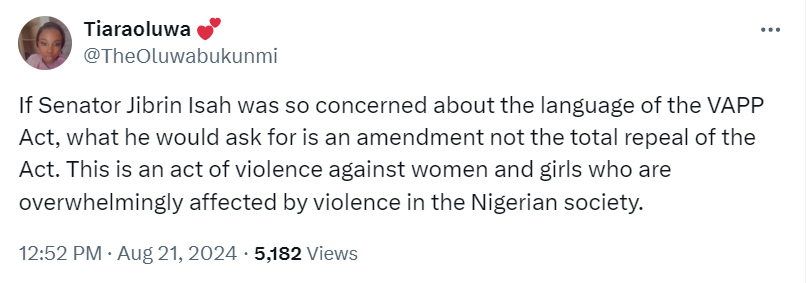
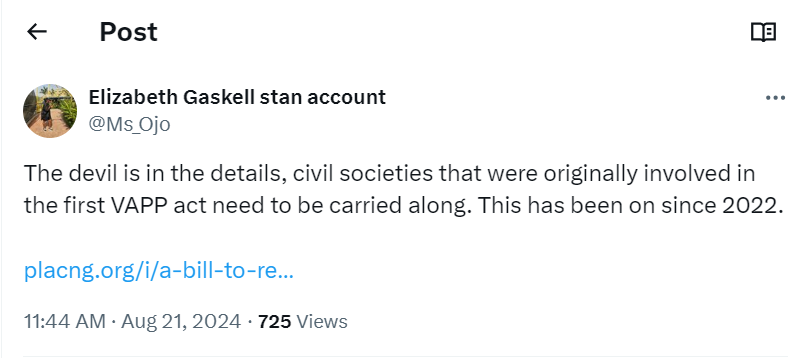
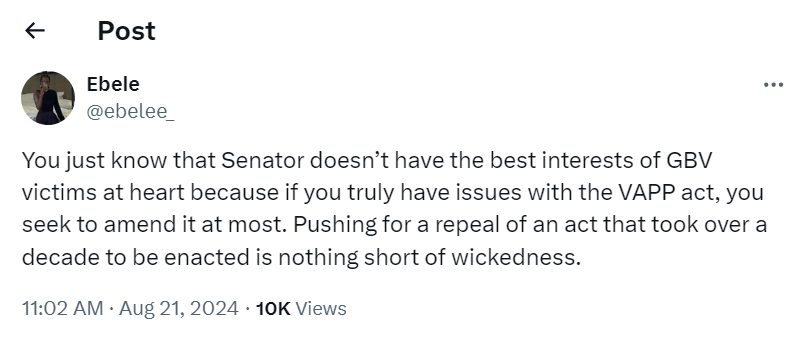
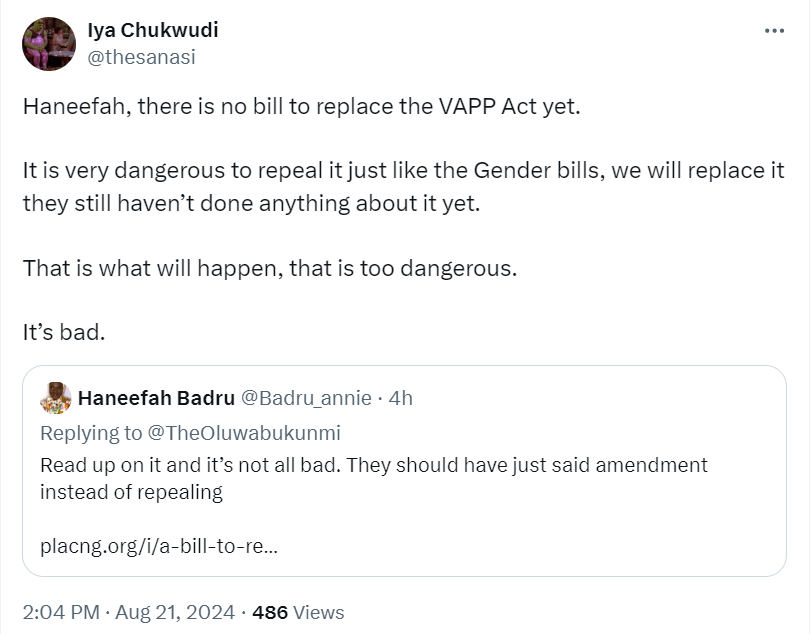
    This bill undermines the hard work of activists and women groups that pushed for the VAPP Act to be implemented across Nigeria’s 36 states, and regresses on basic human rights law. [ad][/ad]

    What can you do to get this bill recalled?

    As stated earlier, this proposal has passed the second hearing, leaving its implementation to the consensus of the third hearing. Nigerians must prevent the bill from reaching the third reading. They are advised to call, text, and email their senatorial representatives to do this. To do this, go to shineyoureye.org to find the details of current Nigerian representatives.

    What Nigerians are saying

    This is a developing story.