• With stories about suffering first and finding success later, to how women should behave, Nollywood didn’t just entertain us growing up—it shaped us, whether we were conscious of it or not. But then real life happened, and we found out that we’ve been fed mostly half-cooked ideas and lies. 

    In an interview with Zikoko, Nneka* reflects on growing up believing what Nollywood told her was the experiences of women who chose to pursue corporate careers and how she started working and adulthood and life slowly peeled those layers of fiction away.

    This is Nneka’s story as told to Marv

    There’s a Nollywood movie whose name I can’t remember, but the storyline I will never forget. I watched as a child. In it, Patience Ozokwor played a terrible boss. She made everyone who worked for her scared. When I watched that movie, I remember not thinking how awful she was. But how awful all women in power were.

    I grew up in a house that watched Nollywood movies in the days of video clubs. Many of them told similar stories about women.

    In the 2012 film Mr. and Mrs, Thelma Okoduwa plays Linda, a woman who had a full-time job at a bank. Eventually, her husband begins to have an affair with the maid and the foundation of her marriage is threatened.

    For a young, impressionable me, this is what happens when women don’t give their husbands time. The film told me that busy working-class women lost their families or their husbands to the housemaids who gave them food, and I wholly believed this. I felt bad for her. She had lost her most precious possession—her marriage.

    Nollywood told me marriage was the holy grail for women, and I believed. Growing up, whenever adults asked what I wanted to be, I’d freeze a little, because deep down, I wanted to say something simple like “work in an office.” But I was scared. Saying I wanted a regular 9–5 felt almost shameful, like I was asking for too much. It was always “I want to own a business,” because there was always that fear of “You want to work? Who’ll take care of your husband? You’re too busy in the office. They’ll snatch your husband.”

    I began to struggle with this idea as I approached my 14th birthday. It was around this time that I discovered Christiane Amanpour, the veteran British war correspondent on TV. She was in Kabul during the Iraq War. I sat with my father in the sitting room watching her report — father and daughter attentive.

    I was so incredibly surprised that I turned around and asked my father, “Is that a woman in a place they’re fighting, shooting guns and bombs going off? A woman can do this?” My father’s response was “Yes, indeed.”

    I grew interested in foreign media and started reading novels by Sandra Brown and other authors with female protagonists doing strong things. It made me realise that, “Come oh, all these things Nollywood is telling me aren’t exactly true o.”

    Consuming other forms of media outside Nollywood began to change my mindset. It showed me women doing big things, making me want to do big things, too. At some point, I decided I wanted to work in news media. I went to university and studied mass communication, where I learnt about the concept of “male gaze.” 

    Later, as a young cub in a newsroom, I was determined to prove that I belonged, that I deserved this job. I, too, began to spend hours upon hours longer at the office.

    My mind began to flicker back to The Bank Manager, the 2005 movie, where Eucharia Anunobi played a bank manager who prioritised her job over her husband and young children. I will never forget the scene where, during a heated argument with her husband, Anunobi’s character retorted, “I will never resign my appointment with the bank.”

    I remember siding with her husband at the time. Years later, in my newsroom, I began to see why she had to spend long hours at the bank. It dawned on me that women just have to do a lot and put in more work than men to prove that they’re capable and deserve things like promotions.

    I also discovered that female bosses aren’t terrible. It’s not a gender thing; it’s a personality thing. I have had bad male and female bosses—more of the male, to be honest.

    I will never forget what someone told me at the newsroom: “After all this your hard work now, one man will just bench you.” What this person meant was that I didn’t need to work as hard because I’d get married. I was just working so hard to get a promotion.

    Now I try to make sure that nothing I do or say puts those ideas in anyone’s mind. I know how powerful those ideas can be. It could even be a joke, but it plants something in someone’s path and spirit. As a career woman in the media, I don’t play with rhetoric like that. I don’t even allow people to make jokes like that to me. It’s that serious.


    Get More Zikoko Goodness in Your Mail

    Subscribe to our newsletters and never miss any of the action


    Studying mass communication at university and working in the media in Nigeria have indeed shown me that Nollywood was very wrong. In fact, not just wrong. It did a whole generation dirty. I see people believe those ideas; many still struggle with them in 2025.

    Anybody who’s 35 to 40, who grew up watching Nollywood and reeducated themselves, would find out they have been fed a lot of wrong information about gender roles, not only at the workplace, but also at home.

    Now, as a grown-up, I’ve realised that it isn’t true; some women are full-time housewives and they still lose their husbands.

    Looking back at those older Nollywood movies, I realise that those men who made those films weren’t exposed. Most of those movies back then came from Aba, in the South-East, which is one of the global capitals of sexism. As much as they were making movies, most of them were really chauvinistic men who grew up with expectations about women.


    READ NEXT: Can Nollywood Love Stories Stop Failing Its Strong Women?


    These days, I catch myself scrolling through YouTube comments under Nollywood movies and laughing out loud. Some women would comment something like, “God will punish that man. This is exactly my story.” And I get it. It’s a movie, but I notice it’s personal and painful for a lot of people.

    The chokehold Nollywood had on me growing up is losing now.

    These days, I have been thinking about making my own Nollywood movies. I want to explore the panic around turning 30 and being unmarried. The movie will reflect the anxiety about being 30 and show how real it is for single women. It’ll also ask if the pressure to get married is as prominent as it used to be. These days, women are getting married in their 40s. I want people to know that marriage isn’t the ultimate for women.

    Note: The name of this interview subject has been changed for confidential reasons.


    ALSO READ: I Am a Feminist Who Enjoys OdumoduBlvck’s Music

    [ad][/ad]

  • It’s another year of capitalism and just like you, we’re over it already. We’re back to the early morning struggles of waking up and rushing out by 8:30 a.m. with the hopes of getting to work by 8:00 a.m. The absolute ghetto. 

    If you’re heading back this week, we bet you can relate to at least one person on this list.

    1. The confused one

    You have absolutely no idea about how we went from “Merry Christmas” to “Please find attached” all over again.

    2. The angry one

    You’re not even in the mood for eye contact, much less someone telling you, “Welcome back! ” HR won’t be able to separate the fight that’ll start between you and whoever tells you that shit.

    3. The hungry one

    The only thing you missed about work is the fluffy amala and soft kpomo Iya Sukirat sells on the street behind your office. Capitalism is awful so we can’t even judge you for using food to numb the pain.

    4. The unprepared

    You haven’t re-downloaded Slack and are still wondering if  the Monday meeting you have memory of was a dream or not. Like, does your boss really expect that document by Friday? What is work?

    5. Eye service ogas/madams

    You’ve already prepared a powerpoint presentation to explain how your holiday went, and cc’d everyone for the catch up meeting on Friday. All your colleagues hate you and will pour laxatives in your coffee/tea whenever they get the chance.

    6. Already tired

    It’s barely noon and all you want to do is sleep. Like can we skip ahead to another holiday season? You pull out the year’s calendar to check for the next public holiday and find out that there isn’t one until APRIL. The despair you feel makes you even more tired.

    7. The lovers

    You’re back and ready to continue your secret but steady knacks in the office toilet.

    8. The scapegoat

    It’s been two days since you resumed and your line manager has already dragged you across Slack for the entire company to see.. Pele dear.

    9. The newcomers

    You are just filled with energy and happy to be employed. Give it another week. Nobody will tell you to relax.

    10. The ones that never go back

    Who capitalism epp?

  • job interview

    Congratulations! You finally got selected for an interview after the many days of submitting applications all over Nigeria. You are prepped to answer their numerous questions and blow them away.

    However, interviews are not a one-sided conversation regardless of how grateful you feel for the invite. It’s also a chance to ask your prospective employers questions.

    Here are some things you could ask at the end of an interview:

    1) “What does success in this role look like?”

    The answer helps you know what is important to the company and also guides you on what to do to fit in at work. Especially in your first 90 days.

    2) “Why do people leave this company?”

    This is a very important question to ask to avoid “I thy known.” The answer helps you determine whether this is a short term or long term role. If too many people leave the organization, it’s probably a red flag.

    3) “Why did the last person in this role leave?”

    Was the person sacked? Did they leave on good terms? It’s important to understand the company culture of your new 9-5.

    4) “Are the skills from this position globally competitive?”

    In this age of jaapa, you don’t want to be left with skills that are only useful in Nigeria. It helps if the skills from your role are useful worldwide especially if you plan to eventually migrate.

    5) “What’s the pay like for this position?”

    Let’s focus here because money makes everything easier. This is also a chance to sell yourself and finesse higher wages than they may have been considering. It also shows your employers that you aren’t afraid to ask for the value of your service.


    If you like this, you can check out our new column titled ‘A Week In The Life Of” that documents the struggle of what it means to hustle in Nigeria and try to earn a living.

    Click here to read the first episode about Odunayo, a keke rider. She shows us what it means to be a breadwinner, a chief, and a woman in a male-dominated field.

  • Every week, Zikoko seeks to understand how people move the Naira in and out of their lives. Some stories will be struggle-ish, others will be bougie. All the time, it’ll be revealing.


    What’s the first experience in your life that made you realise ah, money sweet o? 

    That would be JSS1 in 2004. I went to a boarding school and it was my first time away from the safety of home. My pocket money for the term was ₦200, and I had classmates who had ₦1,000 for a week. That was when I realised, you don’t have money. Your father doesn’t have money anymore. 

    Anymore? 

    Yeah. My dad used to be work for the government, at some of the highest levels. There was some contract thing that involved bribes and all that. Super straight man, he didn’t want to be a part of it. 

    What did that mean for him?

    He quit. He quit his job, and we had to move to a new town. He started a small business. Started building a house, but he never got around to finishing it, so we had to move to a house near my dad’s. Then two years later, there were issues with the landlord, and we had to move into the uncompleted house. 

    In primary school, my school fees never got paid early, but neither did my friends’ school fees. So we just hung out during school hours, outside school, and played, hahaha. I knew what we were going through at the time wasn’t normal.

    I feel like knowing the money situation forces you to ask another question — where will this money come from? 

    Yes. There was the part where my dad paid us stipends to work at his factory for him. But my first lone experience has to be leaving home after secondary school and going to Lagos – this was 2011. 

    How did your folks react? 

    Oh, my dad was already dead. He died when I was 12 going on 13. He was the breadwinner and the controller – he was the one who sent you on an errand and knew exactly when you were supposed to be back. 

    He also didn’t let my mum work. He was the kind to go, “What do you want that I can’t provide?” even when he couldn’t provide. Also, he always felt like there weren’t enough opportunities for my mum where we were. 

    So, this was your mum that had never worked, and suddenly, she had how many mouths to feed? 

    Four. He was sick for a while, so his business was dying as he was dying in the hospital. When he finally died, his family wanted a burial they couldn’t fund. 

    In the end, my mum had four mouths to feed and a lot of debt. 

    It’s a tragedy that this happened, and I’m sorry that you all had to go through that. Another great tragedy is that this happens to a lot of women every year – I don’t have stats to back this up. 

    Yeah. My dad was pretty confident that we were going to be fine. He was polygamous, so somehow he believed his other, much older kids would look after us the children. 

    How did that go? 

    Well, the first one tried to kill my mum, because my mum refused to release my dad’s paperwork to him – death certificates, documents, etc.

    But, he didn’t get it right? 

    He did. He was my father’s next of kin, and all my dad’s benefits went to him. Now, imagine my mum showing up from her shop one day and finding out that they’d put a notice at our house, ‘Caveat Emptor’ – he sold my father’s house while we still lived in it. Welcome to life. 

    What? 

    Yep. I said that too many times. You know, my mum always told my dad to write a will, and he’d respond that she wanted to kill him. The day he decided to write a will was the day he died. Even worse, they were never legally married. 

    Shit. Leaving home at 15 suddenly makes a whole lot of sense.

    I had a friend in Lagos, and I lived on and off with her for three years. The first job was short – I was an assistant. In the first month, I got my salary. By the second month, he told me to come to pick up my salary at his house on a Sunday morning. No, thank you. That’s how that ended.

    I don’t remember that first salary from the first job, but my first proper cheque was ₦60k – 2012. I worked in client services. I also gained admission into uni that year. 

    How did you juggle that? 

    The bulk of my work was phone calls and emails. So I was doing that from school. Also, I worked from the office when school was on break. 

    I’m assuming your boss was reasonable – letting you work remotely and –

    – Nope. He tried to grope me or kiss me every other morning I was at work. I worked for him for a few years sha. 

    Did he ever stop? 

    Nope. I didn’t quit because I had school fees to pay. This ₦60k was gold in my house at the time, so there was no quitting. In 2015, I did my Industrial Attachment at this place that paid ₦40-50k. 

    At this point, I’d squatted in a few places, and made a few friends, and I didn’t exactly need that ₦60k salary. So even when I finished my attachment, I didn’t have to go back to the abuser’s job. 
    I lived with someone I worked for, who is the kind of older friend that you call aunty. So she mostly paid in bits here and there, no lump sums. But the accommodation and the network was priceless.

    How did 2016 go? 

    When was 2016 again? 

    The year Nigeria went into a recession.

    It’s a blur, but I finished uni in 2017 and went to work at a firm that was supposed to pay ₦100k but paid ₦40k in the first month. There’s also the part that my boss tried to sleep with me again – they always do. 

    Argh. 

    I spent three months at the job. He never paid that ₦100k. The time he paid ₦100k was when he wanted me to go buy clothes so we could travel for a ‘work trip’ to Ghana. Then when I was arranging, and doing bookings, he told me to book one room, instead of two. Because how would he ‘apologise properly if we were sleeping in different rooms.’

    What? 

    That’s not the worst thing that’s happened. 

    I dunno if I want to ask you about the worst. 

    Oh, you’ll hear it. It happened recently too. We’ll get to it. Anyway, I clocked 21 and quit shortly after that. That was when my life went to shit. You know how I had older friends that doubled as older siblings? They just started to disappear. Two had to relocate out of Nigeria, a third one died. And somehow, I managed to get blamed by her mother-in-law for killing her so I could marry her husband. 

    Wonderful.

    She pulled her wrapper and swore that I was going to die before the end of the year. This was Christmas Day. She kicked me out by midnight – I was staying there too because the couple were like family to me.

    That is sick.

    I travelled home to my mum, and I even followed her to church on New Year’s Eve. I held her hand all through because I was sure I was going to die. I didn’t die, obviously, but then I just started to fall sick a lot. The first half of 2018 was spent treating one thing after the other. Typhoid and whatnot. So I shuttled between my friend’s house and my mum’s outside Lagos. I wondered a lot, why did everything have to happen to me? And then came the depression. And a boy still managed to break my heart in the midst of all of this. That 2017 ended in tears. 

    I imagine your money problems didn’t go away.

    Yeah, I had a job managing someone’s blog and social media pages. I had to write 20 news articles and one original article, Monday to Sunday. Then there was also social and Nairaland. 

    Ehn, how much? 

    ₦40k. I still got owed for five months. Three months have already been paid though, but that job ended in November 2018. All I got was how I wasn’t ‘good enough’. 

    Anyway, I so I started working more actively on social media. Running small gigs on the side. 

    I joined a new company in December – I already arranged my posting to a company that was going to pay good money. ₦250k. But I got paid that amount once. This one also tried to sleep with me. Anyway, that was how that one ended, no pay. 

    In the time being, I started selling clothes, but I honestly wasn’t taking it as seriously as I should have. If I buy ₦50k worth of stuff and I sell, I can make up to ₦150 to ₦200k on Instagram.  

    I got another gig in July where I was supposed to lead creative direction on a project. The manager was pretty straightforward. 

    Straightforward about what?

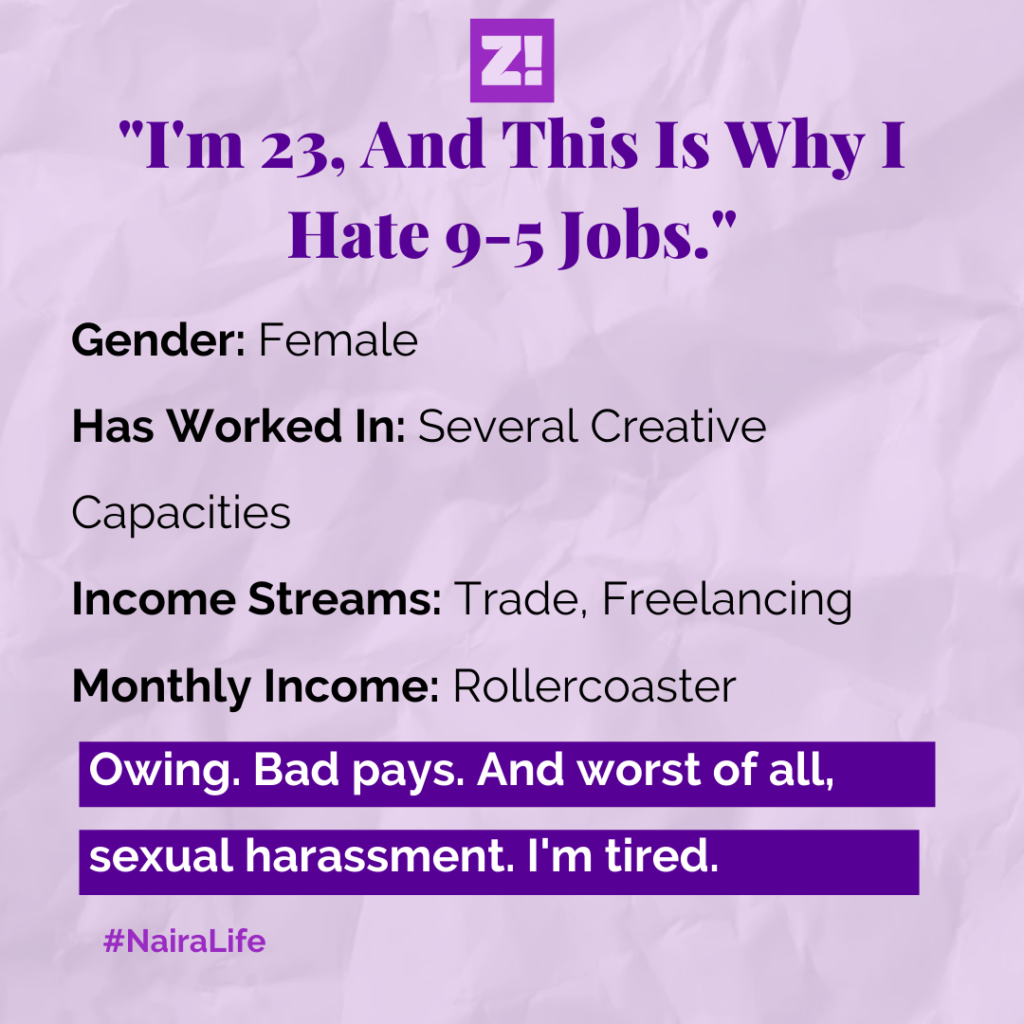
    Sex. He literally said, “Don’t fight it” – this one was a job in the entertainment industry. Anyway, by the time I quit that, I just grew completely tired and took a break. I’m completely tired of office work. I need these assurances: 

    • Really good money
    • Not being owed
    • Not being sexually harassed at the office. 

    Every man you’ve worked with has tried to sleep with you. 

    Yep. The women just focus on owing me my salary. People work so they can get paid, so it sucks when you work and not get paid. 

    Now, I just work freelance managing people’s pages, buying and selling stuff, promoting stuff on my social media pages, and just trying to get by. So I go from up to 400k on a good month to making nothing on a bad month. 

    Let’s talk about your best money month this year. 

    My biggest problem is that I don’t track all my expenses and incoming. My life is scattered. But there was this month I worked for someone running supplies. I stopped calculating after 300k, out of excitement, but it might have been up to 600k. 

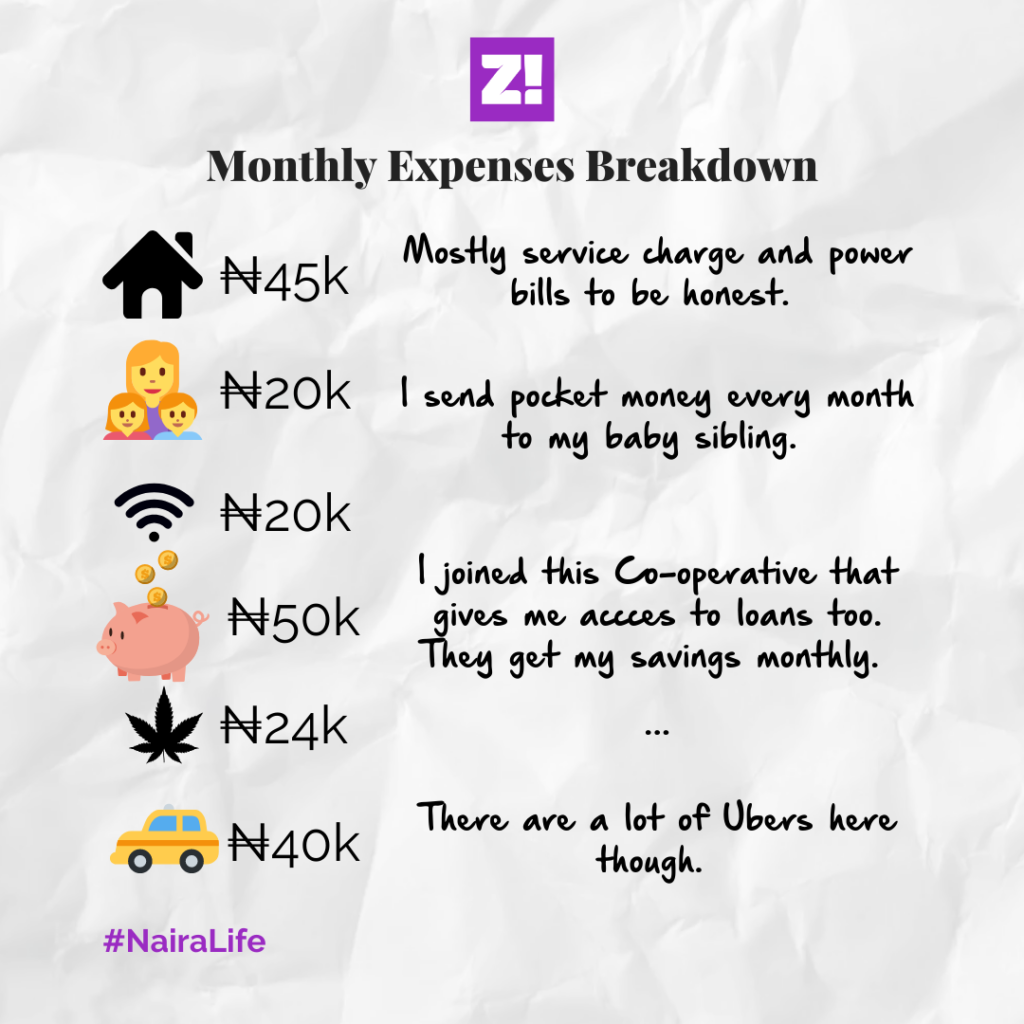
    Let’s try to put the excitement in one corner, and track what your month looks like in expenses.

    I only buy ice cream when I’m sad.

    How frequently do you eat ice cream? 

    A lot. I don’t eat a lot, but I can’t do without my ice cream. When I’m super hungry, I drink garri. 

    What’s something you really want but can’t afford?

    A car.

    Let’s paint a picture of what life would look like in 5 years.

    Please, don’t ask me that question, it’s too serious. I dunno. 

    Okay. What’s something you honestly wish you were better at?

    That would be reducing my ice cream. But then I work, and I deserve ice cream. It keeps me sane.

    How do you even think about this money thing, generally?

    Money is a visitor. It’s the same thing our parents said – it comes and goes. But there’s this documentary that I watched – it’s the Billionaires episode on Netflix’s Explained. Changed my perspective on money. I have a lot of rethinking to do. 

    Financial happiness, 1-10. 

    Omo, it’s 2 o. I’m just getting by. I can’t even afford to be creative with disposable income. Invest-what? 

    I bet you didn’t see this coming. 

    No, I didn’t. Inside Life. 


    Check back every Monday at 9 am (WAT) for a peek into the Naira Life of everyday people.
    But, if you want to get the next story before everyone else, with extra sauce and ‘deleted scenes’, subscribe below. It only takes a minute.

    Every story in this series can be found here.