For years, Ruth, a Lagos-based collections analyst, lived with the mindset that money would always return whenever she spent it. That lack of savings left her broke every December until a sudden rent increase to ₦1.2 million forced a complete lifestyle reset.
In this story, Ruth shares how shifting her discipline, ditching traditional ajo schemes, and using targeted Yield wealth management options helped her buy a ₦700k work laptop cash and build a ₦2 million portfolio in eight months.
This is Ruth’s story, as told to Boluwatife.
I’m not the most disciplined person when it comes to money. My financial philosophy used to be: “Money will always come back. If you spend it today, it will return tomorrow.”
Because of that mindset, I didn’t see any real reason to save. Whenever money came into my hands, I spent it. When I did manage to set aside cash in my bank account, it never stayed there for long. I’d constantly dip into it for transport, data, or everyday expenses. There was no boundary, structure, or any real difference between my “savings” and my spending money.
That lack of discipline always caught up with me at the end of the year.
I work as a collections analyst for a fintech company. Every December, my employer allows us to work from home so we can spend time with family, relax, and attend end-of-year events. It’s supposed to be a fun, festive period. But imagine being in Lagos in December, having all the time off to enjoy yourself, and being completely broke because you failed to save all year. It was embarrassing and frustrating, and for a long time, it was a recurring pattern in my life.
The real turning point came in December 2025 when my landlord dropped a bombshell: my rent was going from ₦700,000 to ₦1.2 million. On top of that, our residential area was moved to the Band A electricity tariff, which more than doubled my power bill to ₦8,000 – ₦10,000 per week. Combined with transport costs and my financial responsibility to support my siblings who are still in school, the pressure became all too much.
I realised I couldn’t keep living paycheck to paycheck or pretending that money would magically fix itself. I needed to take my life and my finances seriously.
Before then, I used to do a monthly ajo contribution to cover my rent. Every month, once my salary came in, I’d split my rent target by 12 and hand that money over to the organiser. But one day, I asked myself: why was I giving someone else my hard-earned cash to hold — and potentially earn interest on in their own bank account — when I could grow that money myself?
That was when I started using Yield by Credit Direct. I first heard about the platform through Instagram. A content creator mentioned it in her post, so I decided to check it out.
What drew me to the platform initially was its high return. They offer up to 21% per annum, which is much higher than the other financial platforms I’d tried. Beyond the returns, the platform’s structure forced me to build actual discipline.
Back when I first started using it in December, there wasn’t even a mobile app yet; we were using a web link to save monthly. But even then, the setup made it easier to stay committed.
I started separating my income into clear categories based on my goals.
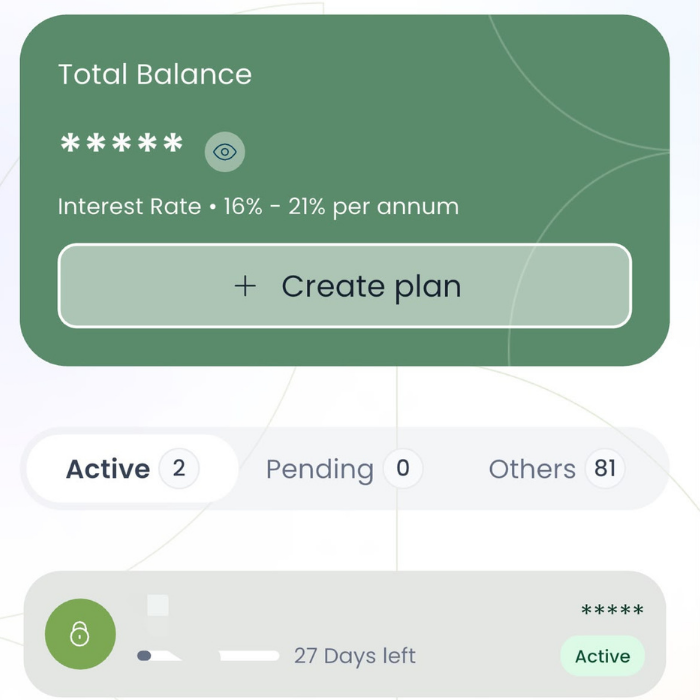
First, I used the Fixed Yield Plan for my rent. I chose that specifically because I knew I couldn’t trust myself not to touch my rent money. The moment my salary and commissions land each month, the very first thing I do before paying for anything else is lock away my rent contribution. Because I receive commissions in addition to my salary every month, my income isn’t fixed. Some months are higher than others. In good months, I put in ₦100,000 or more, and in leaner months, a bit less. But the non-negotiable rule is that I must lock something away every single month.
The platform also allowed me to do goal-based savings. For years, I had been procrastinating about buying a laptop. This year, Yield helped me finally buy it. I wanted to take a professional course (which was to start in May) that I couldn’t do on my office device. So, between January and April, I intentionally locked every extra cash that came my way into my Yield savings. Before the course started, I was able to buy the laptop cash without stress. It cost me ₦700,000.
I also use the Flex Yield option for my emergency funds and general savings. Since emergencies can happen at any time, I need access to these funds, and using the Flex option still allows my money to grow at around 15% per annum while keeping it accessible.
The platform’s security also played a big role in keeping me consistent. Unlike other fintech apps I’ve used in the past, knowing they offer accessible 24/7 AI support and a physical head office where you can walk in to resolve complaints gives me total confidence that my money is safe.
Honestly, I just wish the platform had as much visibility as other apps. That 21% interest rate alone is something everyone needs to jump on, and I think a lot of people are sleeping on it.
Before I took control of my finances, I couldn’t boast of having ₦500,000 to my name. Today, by consistently building my assets, I’ve grown my portfolio to ₦2 million in just one year.
For the first time in my life, I actually feel financially independent, disciplined, and fully in control of my future.
NEXT READ: These Nigerians Moved Cities to Make More Money. Did It Pay Off?