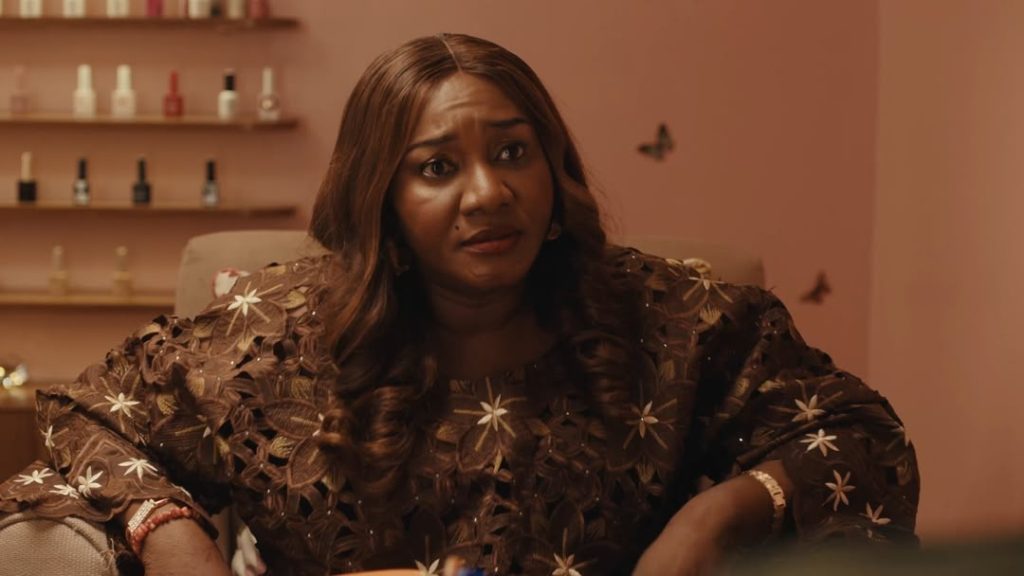
In 1996, Anne Njemanze played Domitilla, a character so popular that “Domitilla” became a Nigerian slang for “whore.” Thirty years later, she has returned to the same world from a different position. In A Happy Ending (2026), Anne plays Madam Ngozi, the sophisticated owner of a luxury spa where wealthy clients can opt for sexual services. Unlike Domitilla, who spends the entirety of the 1996 classic trying to survive on the margins of Lagos society, Madam Ngozi is on the other side. She owns the business, and she manages the women who work for her.
The connection between the two characters is not a coincidence. “A Happy Ending seems like we are trying to mirror the two characters,” Anne tells Zikoko. “I think of Domitilla as a younger version of Madam Ngozi.”
When Anne first picked up the script, she didn’t make the connection. It wasn’t until she saw Domitilla and A Happy Ending placed side by side on merchandise for the latter that she saw a parallel between the two characters.
In Domitilla, Anne plays a young secretary who takes up prostitution as a side hustle to supplement her meagre income. The film eventually becomes a cautionary tale when a wealthy politician dies after spending the night with her. A Happy Ending approaches the theme of sex work from a different angle. The film seems to tell us that Madam Ngozi is who Domitilla was trying to become.
Anne describes Madam Ngozi as a pragmatic and highly perceptive woman who is polished and sophisticated. But she has also “been through life”. She sees her as a survivor who has ridden the vehicle of opportunity to get to where she is in society.
Madam Ngozi’s vehicle of opportunity, however, makes her a morally questionable character. Her business model is built around wealthy clients requesting sexual services from her female workers. This makes us wonder whether she is exploiting vulnerable women. One might say that she is giving them a way to survive in a patriarchal society with a harsh economic climate.
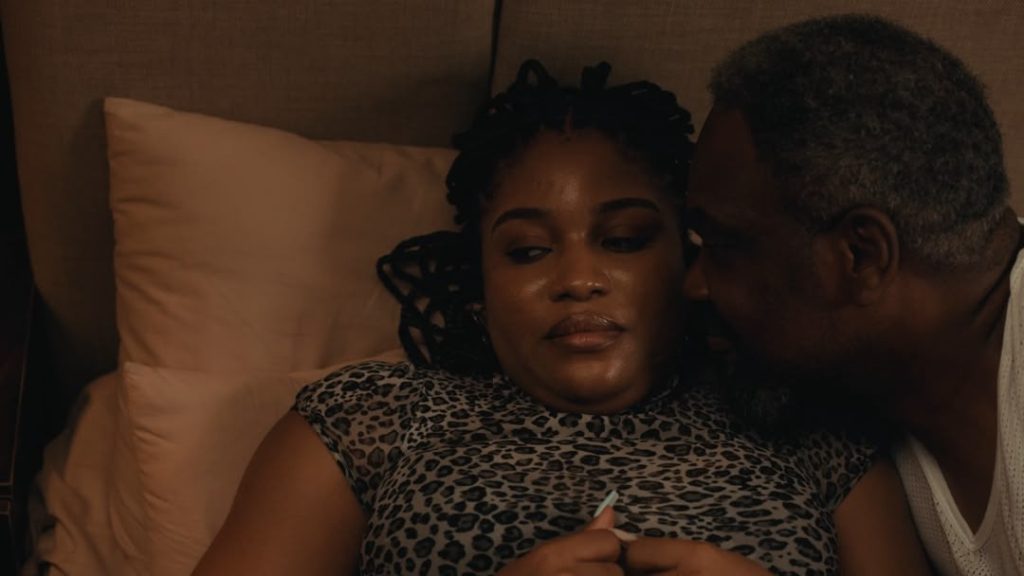
To Anne, the depravity of human beings is not something anyone can control. And in doing business, the primary goal is to satisfy the needs of the client. Madam Ngozi does not force the women who work for her to give anyone ‘ A happy ending’.
“I love the part where Madam Ngozi tells Tatiana, ‘He doesn’t own you’” She says. When Madam Ngozi approaches her workers, she acknowledges that a ₦70,000 salary may not be enough to build the kind of life they want. At the same time, she makes it clear that they are free to decline the opportunity without putting their jobs at risk.
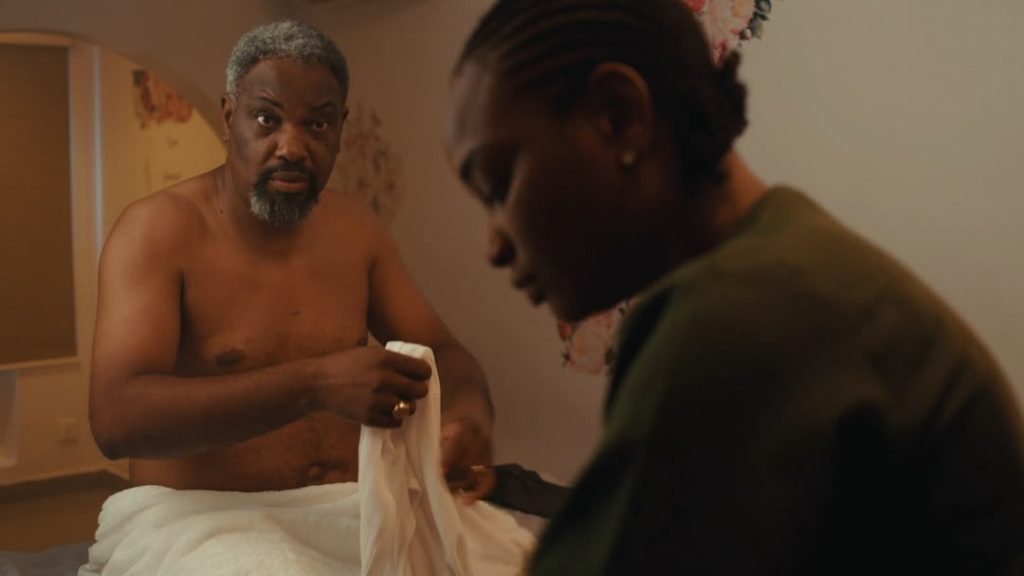
Anne also thinks the conversation about sex work often leaves out the people who create the demand for it. Anne believes that there is an element of hypocrisy in this conversation that we aren’t questioning. More fingers should be pointed at the “so-called rich man” in A Happy Ending.
“What stops the Senator from saying, ‘Tatiana, what are your qualifications? What is your educational background? What do you think you want to do in life?’ What stops him from simply being kind and investing in her life and her future?” She asks.
Instead of telling her to learn a skill or do something else, he exposes her to a wealthy lifestyle she cannot afford. The senator tells her that the only way to gain access to it is on his own terms.
For Anne, this dynamic reflects a wider problem with the way Nigerian society talks about women who do sex work. The women are often judged for the choices they make, while the men who pay for sex remain invisible.
“A woman can come out and tell you confidently that ‘I be ashewo’, but a man can’t come out and tell you confidently that he pays for sex,” she says. “Unfortunately, a lot of men do.”
She believes this double standard is part of a culture that makes it harder for vulnerable women to survive. It also makes it easier for society to blame them when they take desperate measures.
“There are men who are upset when they see successful women. They ask, ‘Why is she successful?’ They assume she must have done something ‘immoral’ to get there.”
That is also why Anne rejects the idea that A Happy Ending endorses prostitution. She believes the film is asking the audience to understand why some women might find themselves there in the first place.
“It’s easy to judge women like Tatiana and Madam Ngozi. But people like this are not invisible; they live with us. These characters deserve empathy too,” she says.
That empathy also extends to how these stories are told. Anne doesn’t believe every story about a woman in commercial sex work needs to end in tragedy.
“For the sake of cinema, we had to create a moral ending for Domitilla. But the stories of commercial sex workers do not always end badly. Some people actually stay in transactional relationships long enough to become ‘Madams’. They go to university, pay their bills, support their families and become success stories. There are horrible stories, of course, with drugs, rituals and murders. But some women go on to have homes, and live good lives.”
In the thirty years between Domitilla and A Happy Ending, not much has changed about the way society views women in sex work. “It has just become more visible, fashionable, and modernised,” she tells Zikoko. What was once hidden is now much harder to ignore.
A Happy Ending is a story that teaches people to understand that these realities exist in our society, but Anne also sees it as a story that encourages women. She hopes women everywhere understand that they have choices. “I’ll tell you what: I’ve met a woman who washes cars on Sunday mornings. She has two teenage boys, and they wash cars with her. That’s a choice. The choices may not be palatable, but we do have choices.”
Anne’s return to this world is also a meeting between two generations of Nollywood. She played Domitilla for Zeb Ejiro, one of the industry’s most recognisable filmmakers of the 1990s. Three decades later, she’s working with Dika, a young director whose approach to filmmaking feels different.
“He allows you to breathe as an actor, which is something a lot of directors don’t do,” she tells Zikoko
After spending time on set with him, she says she would like to work with him again but this time on something more intense.
“I wish I could work with him on something much more demanding. It would be an honour for me.”
Next Read: ‘The Cost of a Better Life’ — Ifeoma Obinwa on love and survival in A Happy Ending