The Nigerian experience is physical, emotional, and sometimes international. No one knows it better than the amazing people on #TheAbroadLife, a series where we detail and explore Nigerian experiences while living abroad.
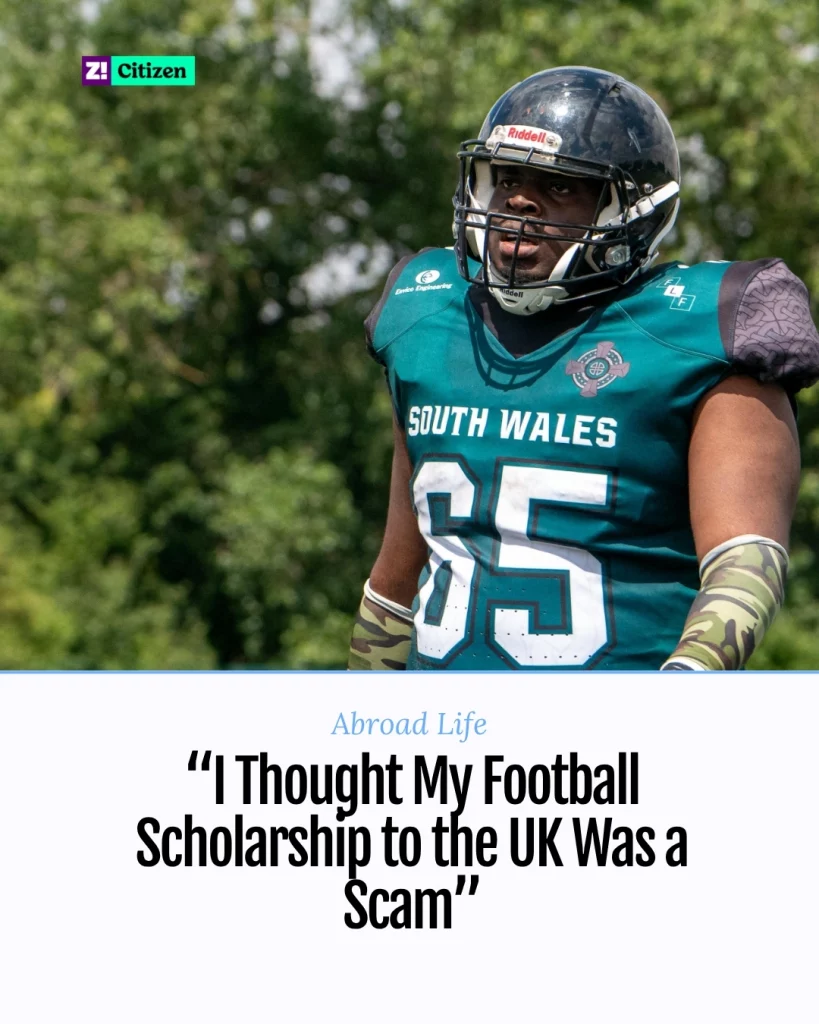
Niyi got an opportunity to move to the United Kingdom in September 2023, and that was the beginning of it all for him. In this edition of Abroad Life, he tells us how an unlikely sporting opportunity took him to Wales, how he’s building a career, and why returning to Nigeria isn’t an option for him right now.
Where do you live at the moment and when did you leave Nigeria?
I currently live in Wales, United Kingdom. I left Nigeria in September 2023
Why did you leave?
I got a scholarship for my master’s and also to play the sport I love.
After I got my university degree in English from Obafemi Awolowo University in 2019, I felt the country was not helping young graduates like me. Then, after COVID-19, it became clear that things were getting worse. Jobs were scarce, and even when you found one, the pay was often poor. I knew I would leave someday.
So leaving was always the plan?
Yes, I considered places like Luxembourg and Lithuania because I wanted somewhere I could realistically afford. Then the opportunity to play American football in the UK came along, and I ended up in Wales. Looking back, it was one of the best decisions I’ve made.
How did American football enter the picture?
I was doing taekwondo full-time in Nigeria. I competed as a student-athlete for Obafemi Awolowo University and also participated in open competitions in Osun and Lagos states. But taekwondo wasn’t paying the bills. It was something I did out of passion, and when you’re becoming an adult, your parents naturally expect you to start working and planning for your future. So, I started looking for opportunities in another sport I love: American football.
Why sports and not academics?
I was good academically, but I didn’t really want the conventional office life. I wanted to do something different.
Does this run in the family?
Funny enough, my family has an athletic background. One of my uncles ran for Lagos State, and I almost represented Nigeria. But nobody in the family had really pursued sports as a career.
So how did you start your journey to play American football abroad?
It was 2023, after the National Youth Service Corps (NYSC). I had plenty of time on my hands because NYSC posting was delayed. One day, I randomly came across The Express, a 2008 film about American football player Ernie Davis. I found the story interesting, and so I went on Facebook to look for American football teams in Nigeria. There were only about ten teams in the entire country at the time, and one of them was the Lagos Marines.
They were about three hours away from me, but I started travelling from Ife to Lagos for training. I was learning the game from scratch. I wasn’t a starter or one of the team’s biggest players when I joined, but I think my taekwondo background gave me an advantage. Within six months, I was starting as a key player on the offensive line, playing right tackle.
What happened after?
I got an opportunity to play college football in the United States, but it wasn’t funded. My parents couldn’t afford to sponsor me, and the American team wasn’t going to cover the costs either.
Also, I would have had to return to college rather than continue from where I was academically, and it felt like going backwards. So we let that opportunity go.
How did the UK come into the picture?
While with the Lagos Marines, some of my teammates were contacted by teams that found us on Instagram. The Lagos Marines’ page was still active then, and the South Wales Warriors eventually reached out to me too.
At first, I thought it was a scam. I was like, “How are you playing American football in the United Kingdom?” It sounded strange, especially because scams were everywhere in Nigeria at the time. I didn’t respond.
The team then contacted my coaches, who reached out to me about it. Even after that, I wasn’t convinced. They handled much of the process by speaking to my dad because I genuinely thought the whole thing might be a scam.
It wasn’t until I started going for visa appointments and medical tests that I realised it was real.
Was it fully-funded?
Yes, and it also came with a Master’s degree program.
What did you study for your master’s?
I studied and graduated with a master’s degree in Management from the University of South Wales in 2024.
What was your family’s reaction when you realised you were actually going to the UK?
It was overwhelming because it was something we’d been praying for. The UK was a country we couldn’t easily afford to move to at the time.
We had been looking at less expensive destinations, and suddenly, I was going to one of the countries we’d always considered difficult to reach financially. I was also going there to play a sport I loved, with the opportunity to study. It felt like a win-win situation. It was God’s grace.
What was it like joining the South Wales Warriors as a Nigerian player?
When I joined, I was the only Black person on the team and their first international recruit. The players were welcoming, but there was that initial surprise when they saw someone who looked different from them.
I’m also a big guy, so I probably fit the stereotype people sometimes have of Nigerians as big, aggressive men. My first training session involved a one-on-one drill against someone who considered himself one of the best players on the team. I dominated that session, so I think that helped me settle in.
Is there any difference in the way the game is played in the UK compared to Nigeria?
I quickly discovered that American football in the UK was different from what we’d been playing in Nigeria.
The game here was much more strategic. In Nigeria, we played very physically. It sometimes felt like we were trying to kill ourselves on the field. We would be told to run a play, do something, and hit somebody.
Here, there was a whole intellectual side of the game I hadn’t understood. Every team had a playbook containing the plays and strategies the players were expected to learn. You couldn’t just be physically strong. You needed to understand the plan and know your role in every play.
That was why I spent much of my first season as a backup. I was learning the playbook, which was enormous. It was frustrating because I was physically capable, but I still had a lot to learn mentally.
How did your first match go?
In our first game of the season, one of the starting players on the offensive line got injured around the second half. We were losing, so the coaches had to bring me in.
They simplified some of the plays to help me learn them quickly enough to play without disrupting the game plan. I ended up winning the MVP award for that game because I made a game-saving tackle and blocked throughout without making any mistakes.
I still finished the season as a backup, but that year was significant for the team. In the previous ten years of its existence, the Welsh team had never made the playoffs. We made the playoffs in my first season.
That was an amazing feeling. By my second and third seasons, more Nigerians had joined the team, so I wasn’t the only Nigerian player anymore.
Outside football and school, what was adjusting to life in Wales like?
I was fortunate because I arrived in a house with a number of Nigerians living there. I didn’t have family in the UK, and I was relatively young, so having a community around me made a big difference.
On my first night in the country, someone I had just met in the house cooked Nigerian spaghetti and chicken for me. That was how welcoming the people around me were.
My first job in the country also came through someone in that house. People shared opportunities with me, and some even offered me jobs I didn’t eventually take.
I’ve been in boarding school since I was eight, so adapting to different environments and living with different people wasn’t particularly difficult for me.
The weather wasn’t much of an issue either. Even when the temperature dropped below zero, I would still wear shorts and a T-shirt. My friends would look at me like I was crazy.
Are there things you didn’t get used to quickly in Wales?
One thing that took some getting used to was how people smiled at strangers. In Nigeria, if someone you don’t know smiles at you on the street, you might wonder what they want. Here, people would smile or greet me simply because they were being friendly.
I also noticed people staring at me because Wales didn’t have as many Nigerians around when I first arrived. Most people weren’t being disrespectful; they were curious and sometimes asked personal questions because they wanted to know more about me.
The smoking and vaping culture was another surprise. You’d see adults smoking and young people vaping in public places. It wasn’t something I was used to seeing so openly in Nigeria. Eventually, I understood that people had different social norms, even if I wasn’t particularly comfortable with all of them.
What were your biggest challenges when you first arrived?
Finding a job was one of the biggest challenges. It wasn’t easy to find work that matched my qualifications or the kind of career I wanted.
My first job was as a stocktaker. It was a decent starting point, but I was still trying to figure out how to build a professional career beyond football. Eventually, I got another job with the Ministry of Justice, which helped me move towards the professional career I wanted.
Any difference in the educational system there?
In Nigeria, I was used to studying for examinations, memorising information and reproducing it. Here, I had to think more critically and demonstrate that I understood what I was studying.
You couldn’t simply cram everything and pour it out during an examination. You had to analyse things, make arguments and show that you understood the material. As someone who had been accustomed to memorising information, I had to work harder to adapt.
The Big Daily is your weekday shortcut to the biggest news shaping Nigeria. We cut through the noise, connect the dots, and explain why the news actually matters, all in one quick read.
What’s been the most rewarding part of living abroad?
Being able to take care of my family is a big one. At the age I was when I left Nigeria, it would have been difficult to find a legitimate job that paid enough to support both myself and my family back home.
Here, I can work, earn a living and help my family without having to do anything illegal to make money. That means a lot to me.
I also appreciate the way the system works. You can do your job and expect to receive your salary at the end of the month. You don’t have to spend your time begging an employer to pay you for work you’ve already done.
The basic things you need to live are more accessible. You can cross at a zebra crossing and expect drivers to respect it. You can leave your car parked without constantly worrying that someone will steal its parts. You don’t have to feel anxious whenever you see a police officer because you’re wondering whether you’re about to be harassed or extorted.
Healthcare is available through the National Health Service (NHS), although the NHS is under pressure and waiting times can be long. You may not always receive attention as quickly as you’d like, but there’s a system through which you can access care.
The Nigerian community I’ve met here has also been supportive. People check on one another, share opportunities and look out for one another. Even colleagues at work make an effort to ask how you’re doing.
For me, the biggest difference is that the system works, and there’s a reward for labour. You work, and you get paid. You’re able to plan your life and take care of your responsibilities.
What do you do now, apart from playing American football?
I still play American football, and I work with the NHS. I started as a receptionist, but I currently work as an executive assistant to the clinical board. So, I’ve been able to build a professional career alongside my sporting career. That’s something I’m grateful for.
Do you miss Nigeria?
Of course, I miss the food. I cook Nigerian food here, and I’m even planning to start a food business soon. There are moments when you just want to eat something that reminds you of home.
I also strangely miss Lagos traffic. There’s a particular excitement that comes with being in Lagos, and I miss some of those moments. The energy is different.
But I don’t miss Nigeria as a country in the sense that I want to return and live there now. Going home has become scarier because of how unsafe the country feels. People are being kidnapped, including people who aren’t celebrities or public figures. It feels like ordinary people can become targets.
Would your life have turned out the same or even better if you had stayed in Nigeria?
I think about it sometimes. Would I have found a job that allowed me to take care of my family? Would I still be playing American football? Would I have been able to pursue the things I wanted without constantly worrying about survival?
I can’t say exactly what would have happened, but I know that the opportunities I’ve had here have made a difference. If I had stayed in Nigeria, I might have reached a point where I felt pressured to do things I had always promised myself I would never do just to make money. I have always wanted to make an honest living, but surviving in Nigeria can put people under enormous pressure. I was this close to doing things I wouldn’t be proud of to make a living.
I might also have stopped playing sports because Nigeria doesn’t encourage people to pursue those dreams seriously.
What’s your perception about Nigeria’s sporting system?
Nigeria doesn’t help sporting dreams. That’s how I would describe it. I had a passion for sports, but it wasn’t something I could easily turn into a sustainable career at home. I had to look elsewhere for an opportunity to keep playing and build a future.
People have talent, ambition and the willingness to work, but the environment doesn’t always give them a fair chance to succeed. I left because I wanted a better opportunity to build my life. I found that opportunity, and I don’t think you necessarily miss the things you had to escape from just because you’re living somewhere else.
Do you see yourself returning to Nigeria someday?
Not anytime soon. I can’t say I’ll never return, but given the way things are right now, I don’t see myself moving back.
Is that so?
I was already worried about the direction Nigeria was heading during the 2023 election campaign. I felt things would get worse, and I believe what has happened since then has reinforced those concerns.
What frustrates me is that so many people have the opportunity to demand better from their leaders, but the country keeps finding itself in the same situation. When people continue to support a system that isn’t working for them, it’s difficult to see how things will change.
For now, I want to keep building my career, playing football and taking care of my family. I don’t want to return to Nigeria and find myself struggling to survive again.
I miss home, but missing home isn’t enough reason to go back to a place where I don’t believe I can build the life I want.
On a scale of one to ten, how would you rate your experience abroad?
I’d say nine. This place has been very kind to me.