Written by: Matilda Inioluwanimi Adegbola
Chief Anthony Enahoro went from being celebrated as the “Father of the Nigerian State” for introducing the motion for self-rule on March 31, 1953, to having to flee the country, be extradited, tried and imprisoned for treason shortly after independence.
Born in 1923 in Uromi, in modern-day Edo State, Enahoro was the eldest of 10 children and grew up with a penchant for reading and writing. He received his primary education at the Government Schools in Uromi and Owo, Ondo State, before advancing to King’s College, Lagos. As a student, he rose to prominence within student activist circles, organising several demonstrations against British colonial rule in the 1940s.
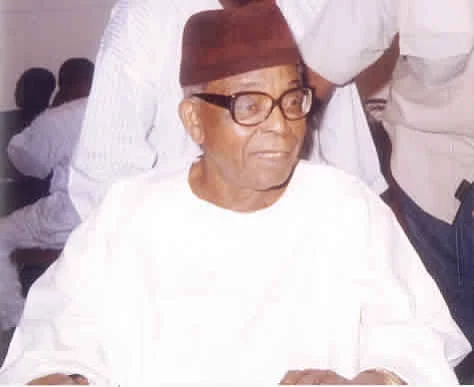
After his early education, he became a journalist, working with the Southern Nigerian Defender. In 1944, at 21 years old, Enahoro’s strong relationship with Nnamdi Azikiwe led to his appointment as Editor of the Southern Nigerian Defender in Ibadan, making him the youngest newspaper editor in Nigerian history. Over the following decade, he held major editorial roles across the country, including the Daily Comet, the West African Pilot, and the Sapele-based Morning Star.
Enahoro entered formal politics in 1950, co-founding the Mid-West Party with Arthur Prest. Following the party’s integration into the Action Group in 1951, Enahoro was elected to the Federal House of Representatives, where he introduced the historic 1953 parliamentary motion demanding Nigerian self-governance, directly paving the way for full independence in 1960.
While he seemed to rise quickly in life and career, political instability soon tested his career. During the 1962 Western Region crisis, Enahoro was detained and subsequently implicated in the treason trial against Obafemi Awolowo. He escaped to the United Kingdom through Ghana in 1963; however, the Nigerian government, seeking his extradition under the Fugitive Offenders Act of 1881, complicated his request for asylum.
By 1963, Enahoro had become a household name in Britain due to his fight against extradition. In what would be notably referred to as the Enahoro affair, debates ensued in the House of Commons, and Harold Macmillan’s Conservative government was forced to balance human rights concerns against diplomatic relations with Nigeria. Despite the uproar, Enahoro was extradited, tried for treason, and imprisoned. He remained in jail until he was freed by the military government in 1966.
Amid the crisis following the 1966 coups, Enahoro represented the Mid-West region at the Ad Hoc Constitutional Conference in Lagos. He subsequently held key ministerial roles in General Yakubu Gowon’s government, serving as Federal Commissioner for Information and Labour from 1967 to 1974 and Federal Commissioner for Special Duties in 1975. Simultaneously, he served as President of the World Festival of Negro Arts and Culture between 1972 and 1975.
Enahoro’s commitment to governance extended into pro-democracy advocacy as chairman of the National Democratic Coalition (NADECO), leading opposition against General Sani Abacha’s military dictatorship. His civil leadership also encompassed the chairmanship of both the Movement for National Reformation (MNR) and the Pro-National Conference Organisation, PRONACO, advocating for a people-driven constitution and true federalism.
In recognition of his lifetime achievements, he was awarded an honorary D.Sc. from the University of Benin in 1972, conferred with the Commander of the Order of the Federal Republic (CFR) in 1982, and authored the notable autobiography ‘Fugitive Offender’.
Beyond his impact on emphasising Nigeria’s need for independence, Enahoro’s story is also remarkable for his impact on the push for women’s rights. He simultaneously challenged the male-dominated Western House of Assembly by sponsoring a motion that highlighted how discriminatory electoral laws routinely excluded women. He stressed that women constituted an important but still unrepresented interest.
He successfully petitioned the government to exercise its constitutional powers to appoint qualified, high-integrity female members to the regional legislature, leading to the historic appointment of Remilekun Aiyedun in the Western Region. This set a powerful precedent across regional parliaments and paved the way for activists like Margaret Ekpo to be appointed to decision-making bodies in the East, cementing women’s rightful place in Nigerian civic affairs.