
Consent, according to various dictionaries, refers to the voluntary agreement to engage in a specific activity or to allow something to happen. It is a mutual understanding that requires clear communication and respect for individual autonomy.
It sounds simple. Almost embarrassingly simple. Yet somehow, when sex is involved, people become determined to make it complicated.
The conversation around the Cornell case is a good example. A former Cornell student, identified as “Jane Doe”, alleged that what began as consensual sex with two men changed as more men became involved. She has said that she was given ketamine, alongside alcohol and marijuana, and became increasingly intoxicated and unable to make decisions. Her lawsuit alleges that the incident involved seven men and lasted about seven hours, from late on October 19, 2024, into the early hours of October 20. The men named in the lawsuit have denied wrongdoing. A criminal investigation initially resulted in no charges but has since been reopened, and the case remains subject to legal proceedings.
But what stood out in the public conversation was not only the allegations. It was how quickly people returned to the same argument…but she agreed to a threesome.’


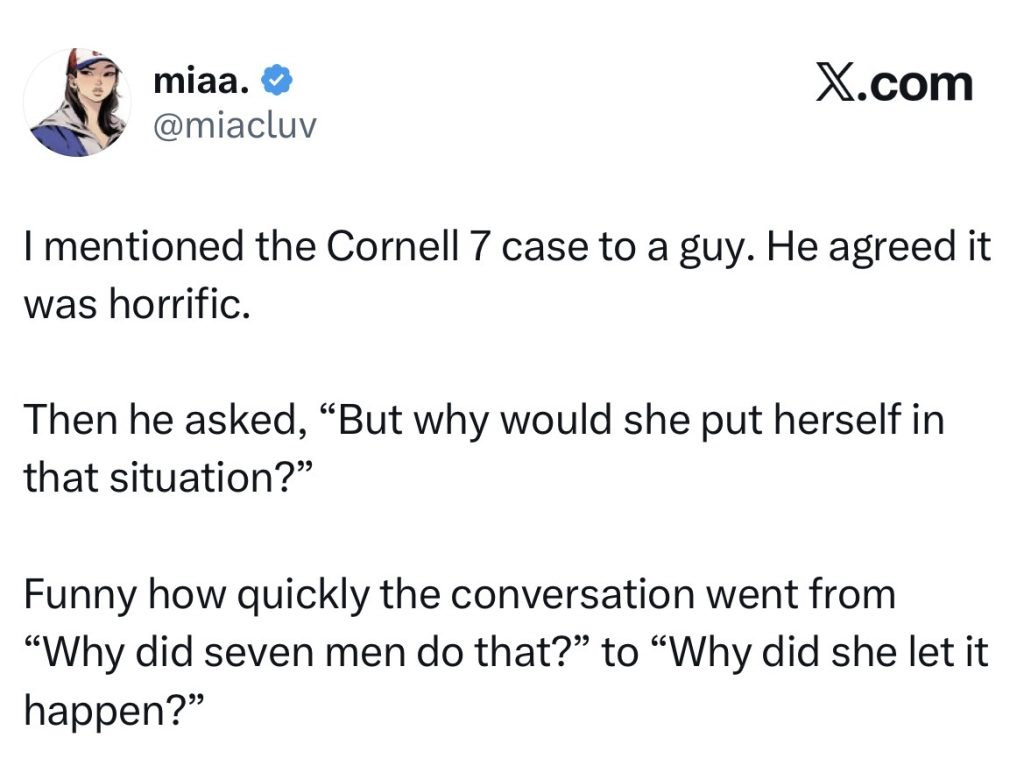
This is where the average person’s understanding of consent seems to collapse, particularly when the person involved is a woman. Agreeing to a threesome is not agreeing to every person who subsequently enters the room. Agreeing to kiss someone is not agreeing to have sex with them. Agreeing to sex is not agreeing to every sexual act that person might want. And agreeing to something at 10 p.m. does not mean agreeing to it at 10:30 p.m.
Consent is specific. It is ongoing. Most importantly, it can be withdrawn. This should not be a radical concept. Most women already understand it because they have had to.
A woman can agree to go home with a man after a date because she wants to spend more time with him. They can kiss. They can make out. She can even initiate some of it. Then she can decide she does not want sex and say so. At that point, the conversation should be over.
Instead, this is where the negotiation often begins.
“But why did you come here?”
“But you were kissing me.”
“You knew what I wanted.”
“So you got me turned on for nothing?”
“Are you serious? After all this?”
Suddenly, the woman is no longer exercising a boundary. She is being accused of creating a problem.
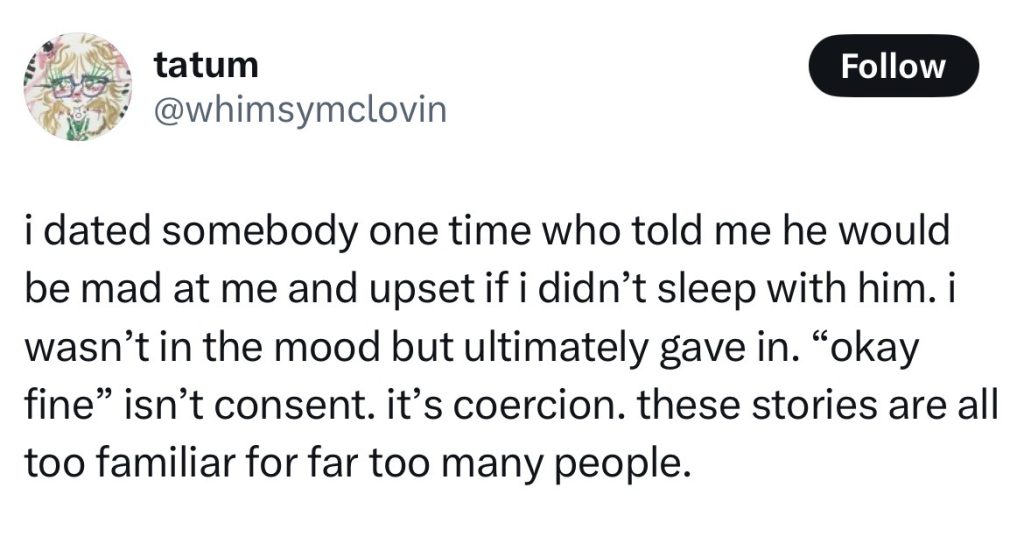

Sometimes the man does not physically force anything. He just keeps asking. He sulks. He gets angry. He becomes cold. He makes her feel guilty. He tells her she has wasted his time. Eventually, she says yes because continuing to say no has become exhausting.
Consent is not simply the existence of the word “yes”. It is about whether the person was actually free to make that choice. If someone has to weigh the consequences of saying no before deciding whether they want sex, there is already something wrong with the situation. This is where many women recognise themselves in conversations about consent.
The boyfriend who gets angry every time his girlfriend refuses sex.
The man who keeps asking until his partner gets tired.
The person who treats a woman’s previous sexual history as evidence that she cannot possibly reject him.
The man who interprets flirting as consent.
The person who thinks going to his house means sex is guaranteed.
These experiences do not always look dramatic from the outside. Sometimes there is no screaming, no struggle or obvious moment that makes everyone in the room immediately understand that something is wrong. Sometimes, there is simply a woman becoming increasingly uncomfortable while a man decides that her discomfort is not important enough to stop.
You’ll Love: I Was a School Prefect Before I Became a Mother at 13
This is also why the question “Why didn’t she leave?” is so frustrating.
It assumes that every woman in an uncomfortable sexual situation has clarity and a safe way out. She may be drunk or frightened. She may be surrounded by people she does not trust or may be trying to avoid making the situation worse. She may freeze or may simply not know what to do.
Women are constantly taught to prepare for these situations. Watch your drink. Don’t walk alone. Share your location. Don’t go to his house. Don’t drink too much. Don’t trust strangers. Don’t trust familiar men either. Be careful with what you wear. Be careful with who you date. Be careful, be careful, be careful.
Women are taught to anticipate male behaviour so thoroughly that when something happens, the first question is often what the woman could have done differently.
Why did she go there?
Why did she drink?
Why did she flirt?
Why did she agree initially?
Why did she not fight?
Why did she not leave?
At some point, the questions stop being about the person who crossed the boundary and become an investigation into why the woman failed to prevent him from doing it.

There is a particularly strange double standard in the way consent is understood.
Men generally have no difficulty recognising that they can change their minds about sex. A man can agree to a date and decide he does not want anything physical. He can kiss a woman and decide he does not want sex. He can agree to sex and change his mind halfway through. He can go to someone’s house and decide he would rather sleep on the couch. Nobody asks why he went there. Nobody says, “But you knew what she wanted.” Nobody tells him that because he had already agreed; he owed her consistency.
His no is understood as a boundary. A woman’s no is too often treated as the beginning of a negotiation.
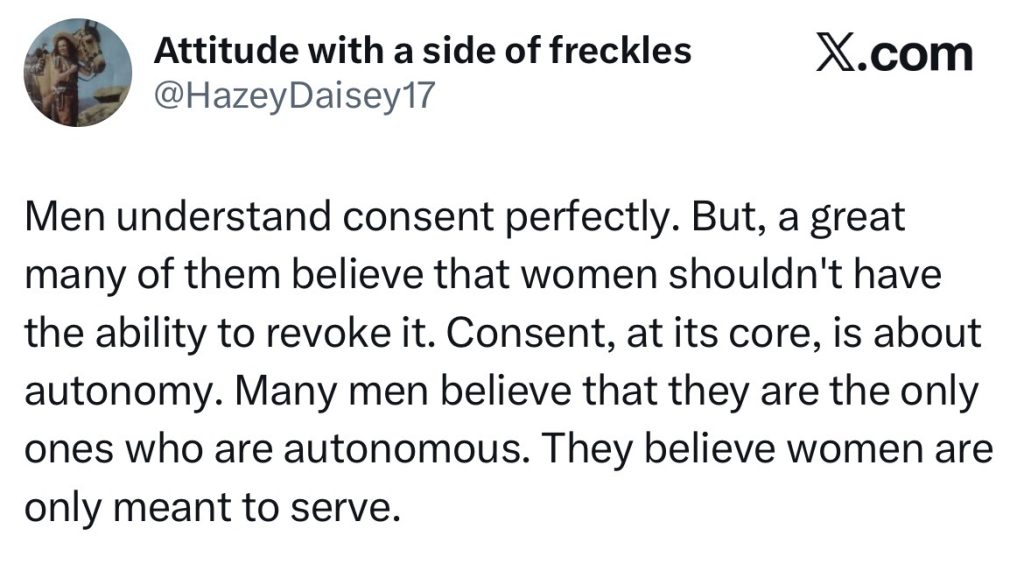
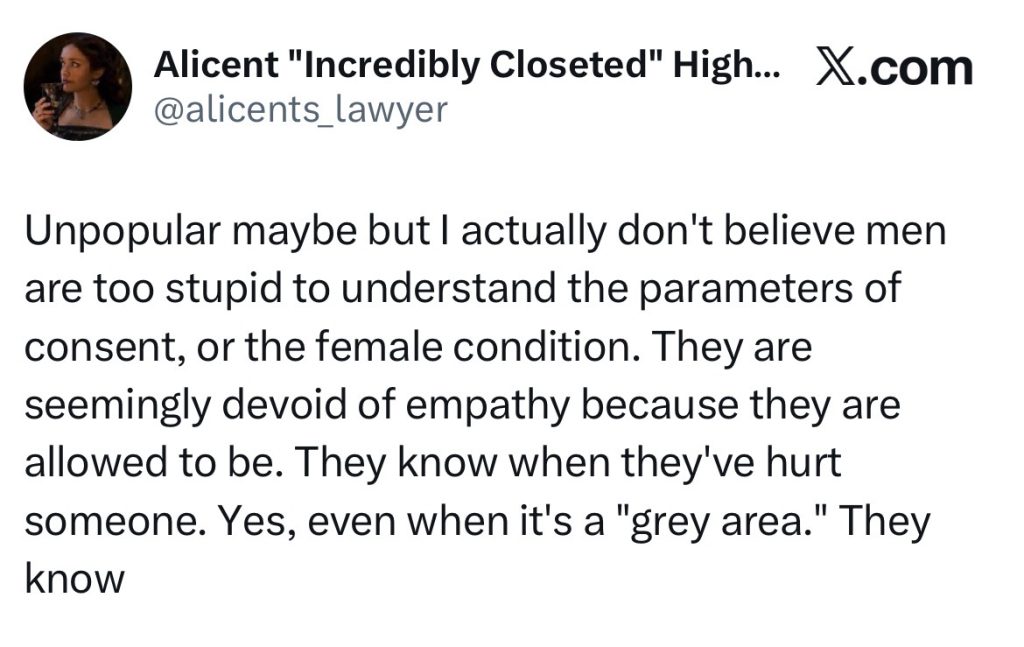
This is what makes this conversation so frustrating. The problem is rarely that people genuinely do not understand what consent means. Most people understand it perfectly when they are the ones exercising it. A man does not need to scream, fight or provide a five-minute explanation before his refusal becomes valid. His discomfort is enough. His decision is enough. His no is enough.
Women deserve the same standard.
A woman can be attracted to a man and still not want sex. She could have slept with him yesterday and not want to tonight. She can agree to one thing and refuse another. She can change her mind halfway through. None of these things is contradictory. They are simply examples of a person deciding what happens to their own body.
An average man does not necessarily misunderstand the definition of consent. He understands that he can reject someone. He understands that he can stop. What becomes difficult is accepting that the same freedom belongs to women.
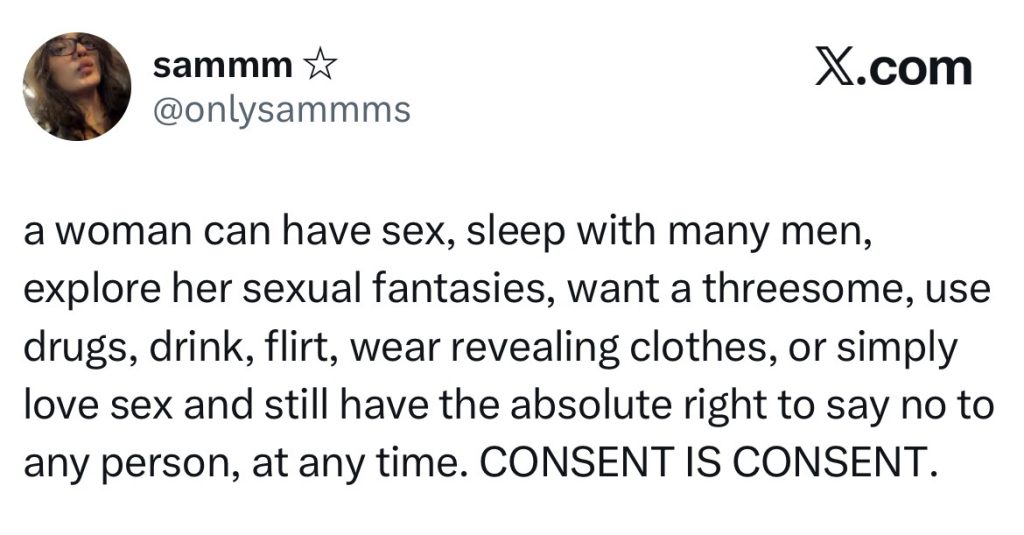
Genuinely understanding consent means accepting rejection. It means understanding that being turned on does not create an obligation for someone else to have sex with you. It means accepting that someone changing their mind is not an attack on your masculinity. She does not have to scream, cry or explain herself. Sometimes she simply does not want to. That should be enough.
Perhaps the most important part of this conversation is what happens when consent is absent.
Rape is not caused by alcohol. It is not caused by flirting. It is not caused by a short dress, a late night, a sexual history or a decision to go home with someone. None of those things rape a person.
A rapist does.

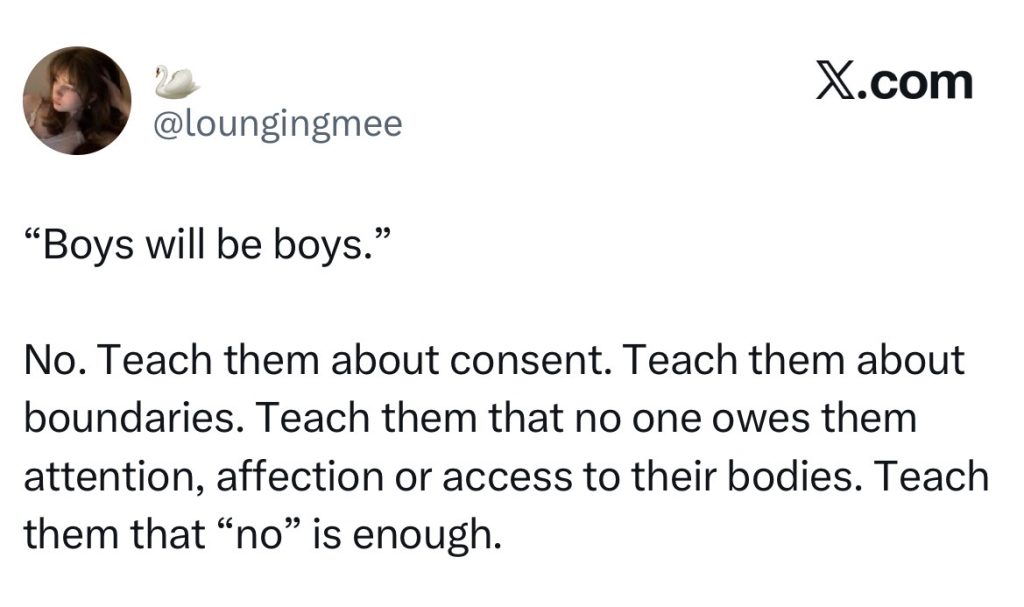
Yet whenever a woman is raped, the conversation somehow becomes an investigation into what she could have done differently. Why did she go there? Why did she drink? Why did she trust him? Why did she not leave? Why did she not fight? Why did she not scream?
There is something deeply wrong with a society that can produce an entire list of things a woman should have done to prevent her rape before asking the person who raped her why he decided to violate her.
A woman is allowed to make a bad decision without forfeiting her right to safety. She is allowed to flirt, drink, trust the wrong person, go home with someone, have sex and change her mind. None of these choices gives permission for someone else to violate her.
The responsibility belongs to the person who crossed the boundary.
It was never the dress. The drink. The location. The flirting. The previous yes. It was the person who chose to ignore the no.
Maybe that is the simplest way to understand consent: a woman’s imperfect choices do not make her body collateral damage.
She does not have to be perfect to deserve bodily autonomy. She only has to be a person!
Next Read: How Much Does It Cost to Make Your Hair in Nigeria? — We Asked Hairstylists in 4 Cities