Every week, Zikoko seeks to understand how people move the Naira in and out of their lives. Some stories will be struggle-ish, others will be bougie. All the time, it’ll be revealing.
Your money deserves more. Grow it with Yield by Credit Direct and earn up to 21% p.a.
Sign up on the Credit Direct App using the code NairaLife26.
What’s your earliest memory of money?
It was in primary six. I passed the entrance exam for King’s College, but I couldn’t go because of money. My best friend didn’t pass, but his parents paid his way through. Meanwhile, my parents had to put me in a cheaper day school.
I’m the first of five children. My dad was going through a rough patch with his business at the time — he imported female shoes in Balogun Market, Lagos — and they told me they couldn’t justify paying expensive boarding fees for one child while others were behind me.
That was when I realised money was very important.
What was the financial situation at home like growing up?
I’d say middle class, but my mum was a primary school teacher, and my dad’s business often experienced rough patches.
When I was in primary six, my school organised a ₦35k excursion to Ghana. I was so excited to travel outside the country, but my parents couldn’t afford it. To save money, my siblings and I went to the private school where my mum taught because staff children received substantial fee discounts. My mum started working at the school before I was even born, and I schooled there from creche all the way through their secondary school.
My dad’s business eventually went bankrupt in 2016 due to shifts in import and border policies. My mum had to shoulder the responsibilities for a long time while my dad kept borrowing from others to support us. He eventually had to get into farming.
Things were really tough for us.
When was the first time you did something to earn money?
In 2019, when I got into the university. My school fees were ₦70k, but paying them was a massive struggle for my parents. They even had to borrow half of it for my first year. Seeing them struggle made me realise I was 18 and needed to take care of myself.
My parents didn’t want to hear that I was doing any work in school; they were resilient and wanted to provide everything. But I did it quietly. I joined a book club where I reviewed books, earning between ₦2,500 and ₦5,000 per blog post. I also started running errands for senior students, writing their lecture notes, term papers, and printing assignments. The highest I made was around ₦10k per paper or note.
These hustles didn’t consistently bring in money. Students could go broke and decide to do their assignments themselves. And after writing a few reviews, the book club owner began suggesting it was a voluntary role with no specific payment.
Were you getting pocket money from home?
Yes, but it wasn’t regular. My parents sent between ₦10k and ₦15k weekly, or if I needed textbooks. I inflated textbook prices a few times so I could have a little extra to survive. If it cost ₦4,000, I’d tell them ₦10k.
My financial situation made me very frugal. Everything I did in uni was delayed gratification. I declined invitations to eateries or parties with friends because I knew I couldn’t afford to spend unnecessarily. Sometimes, I even cooked up lies to get out of events. For instance, if it were a night event, I’d say I get cold easily and couldn’t stay out.
When COVID hit in 2020, my parents didn’t want me to return to Lagos because of the high cost of transportation, so I went to stay with my uncle, who lived in the same state as my university. The ASUU strike followed after the lockdown, so I ended up staying at my uncle’s from April 2020 till January 2021.
For a while, I was comfortable staying home all day watching Big Brother Naija, but by August, I realised I couldn’t keep doing that.
So, what did you do?
My uncle was a manager at a large bakery. I asked to work there too, but he said I couldn’t keep up with the large-scale production. Instead, he helped me get a job at a smaller bakery.
I worked in the store, removing fresh bread from the oven pans, letting it air out, packaging it, and tying it. My salary was ₦15k per month.
Since I lived with my uncle, who fed me, I saved almost all of my salary. I’d just buy biscuits for his kids or recharge cable TV for the house to show I was earning something. I also randomly got credit alerts from relatives and family friends back in Lagos who were concerned that I couldn’t return home for the lockdown. My uncle also often dashed me the change whenever he sent me on errands. I saved all those, too.
By the time school resumed in 2021, I had saved over ₦150k. The bakery even paid me double my last salary because they appreciated my work. From that money, I paid ₦70k for a single off-campus room and bought basic furniture: a mattress, a fan, a table, a chair, and hangers.
How did you make money when you went back to school?
Towards the end of 200 level, I started positioning myself in student politics. I got close to a senior who was the departmental president, helping him as a campaign manager and mobilising people. When big figures and celebrities came for convocation, being close to student politicians meant making small change here and there.
This senior also connected me to his friends, and I’d run errands for them to the VC’s office, get documents, write their assignments, and take carryover tests for them since I was offering those courses. The lowest I received from them was ₦7k, but mostly ₦10k upwards.
By 300-level, I became secretary-general of my department. When my senior mentor graduated and joined politics as an SA to the governor, he made me his virtual assistant (VA). He’d pay me ₦15k to ₦20k every other week, plus data allowances, to write his speeches and press releases and manage his schedule.
In my final year, I contested and became departmental president, overseeing 1,500 students. Between departmental dues, corporate event sponsorships, and political activities, I was averaging about ₦50k per week, around ₦150k to ₦200k per month.
By the time I graduated in March 2024, I had saved almost ₦500k.
What came after uni?
While I was waiting for NYSC clearance, my VA boss increased my pay to ₦40k per month. In some months, he paid me ₦60k. I also joined a media house as a student intern writer, earning ₦20k monthly.
I returned home to Lagos in June 2024 and immediately took a job as an administrator at a private school owned by a church member. I was paid ₦50k monthly, which was revised to ₦70k in September. Plus, the students’ parents would give me tips of up to ₦30k monthly because I was friendly at the front desk.
My internship at the media house ended in October, leaving me with only the VA and administrator jobs. I left the school in April 2025 when I left for NYSC. After the orientation camp, I got posted to a media company in Lagos as a reporter.
What was the pay like?
The media company paid ₦20k/month, but as a reporter, I was often sent to cover events and usually made anywhere from ₦25k to ₦50k per event. In a good month, the events could push my salary up to ₦100k. I was also receiving ₦77k/month allawee from the government.
Around the same time, my VA boss left the governor’s office and founded his own tech startup, so he increased my pay to ₦100k per month, bringing my total income from all three sources to about ₦277k.
I was also still saving religiously. I diversified into mutual funds and stocks to earn better returns on my savings. In 2025, my total savings reached ₦1 million for the first time.
Whoops! Did you have a plan for it?
Sort of. While in the NYSC camp, a real estate firm advertised land investments to corps members. I consulted my dad, took a leap of faith and signed up for a 150 sq. metre agro-residential plot in Ogun State, costing ₦737,500. It had a flexible 24-month payment plan, but I aggressively channelled every extra income I got into it and finished paying it off in full this August.
The plan is to farm on it. My dad has more farming knowledge, so after the firm allocates my plot to me in September, we’ll do a bit of subsistence farming to get food for the house before eventually building on it.
What’s your current monthly income?
I finished serving in March 2026. The media company put an embargo on retaining corps members years ago, but I got retained as a full-time journalist in April 2026, earning ₦250k/month.
In addition to my 9-to-5, I have the ₦100k VA role and a writing/SEO publishing side hustle with a colleague who has a blog. That one brings me an extra ₦100k/month. I also get invited to events in my main role as a journalist, and that brings me at least ₦50k extra.
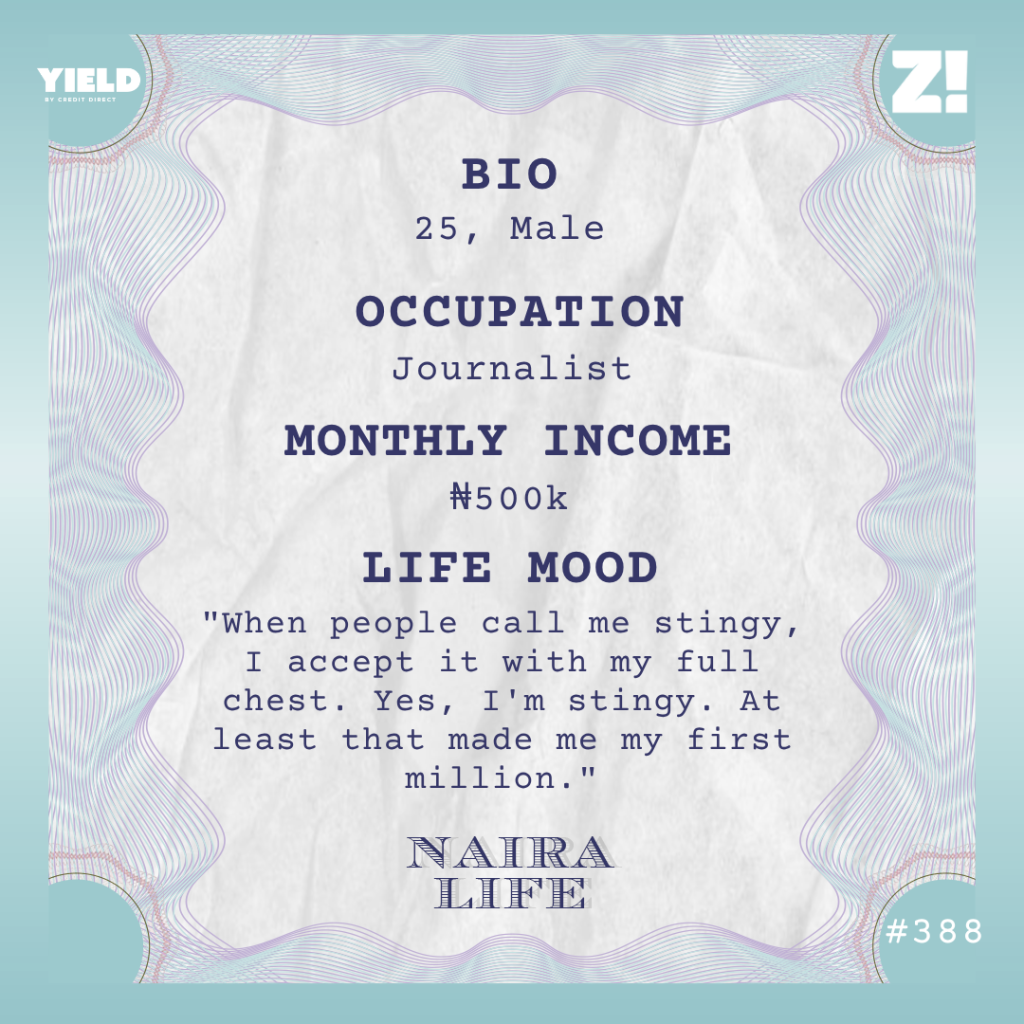
So altogether, my average monthly income is ₦500k.
Your monthly expenses?
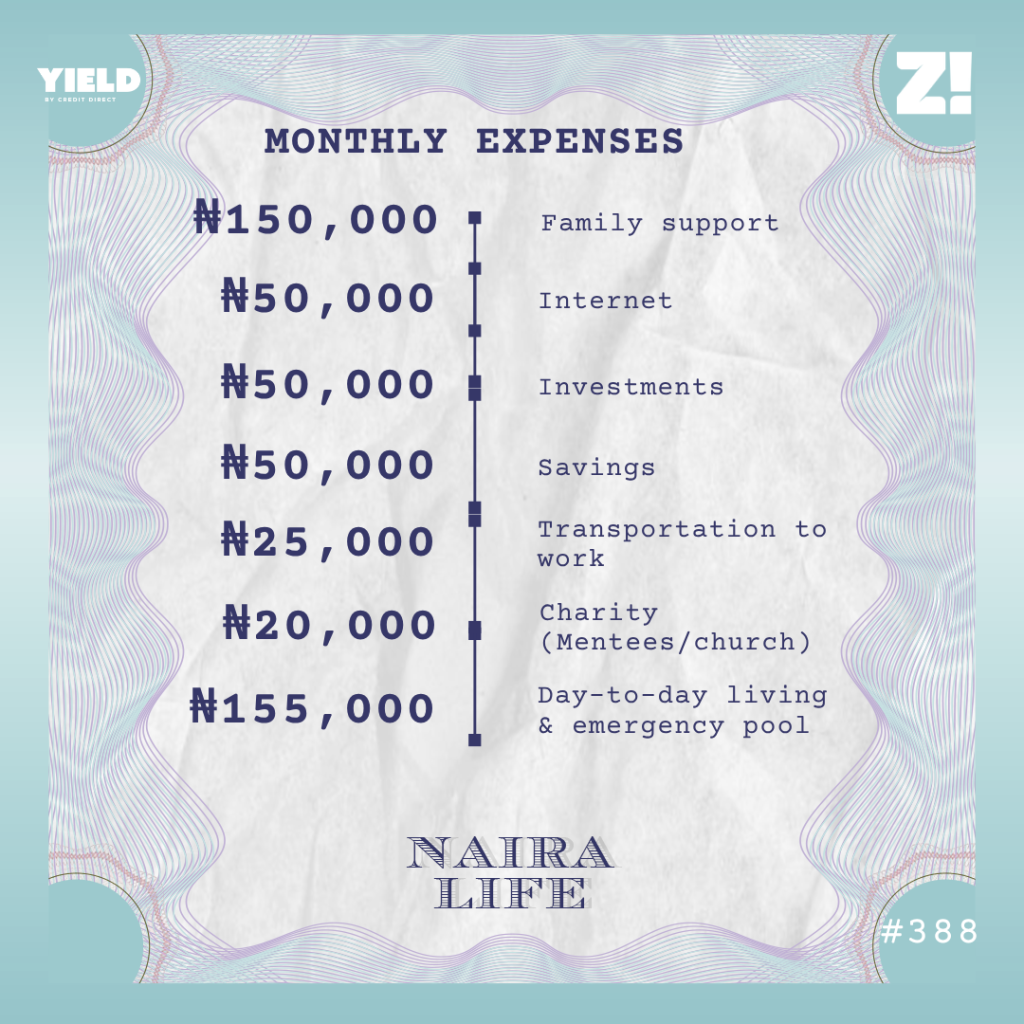
I live with my parents in Lagos, but I support the home. Here’s the breakdown:
What do your savings and investment portfolios look like right now?
I have three. First, there’s the emergency savings account, which I try not to touch. It’s currently approximately ₦750k. I had more than this, but I dipped into it in July to support my parents with ₦1 million when we changed apartments.
Secondly, I have my regular savings, currently ₦500k. I keep it in my mutual funds account.
Then, I have my stock market investments, currently worth ₦200k, which mostly consist of Nigerian equities. I suppose I can also count the land in Ogun State as part of my real estate portfolio.
Of course. How would you describe your relationship with money?
I’m very frugal. My siblings and friends call me stingy, but someone who has passed through the childhood I did would understand. So, when people call me stingy, I accept it with my full chest. Yes, I’m stingy. At least that made me my first million.
I don’t spend on frivolities. In fact, I hate it. I live in Lagos, but I don’t go to the cinema. I wait for movies to be out for download. I don’t buy clothes anyhow; I have one main colour, black, because if you wear black, you can wear it multiple times without people noticing. I’d rather spend on my personal development than on buying new shoes. That doesn’t stop me from looking smart.
If someone asks for money for non-essentials, I won’t give it. I don’t give in to begging or any emotional tricks. My parents know me. Once I’ve supported the home with my ₦150k monthly budget, they know nothing can take money out of my pocket again. But when it’s an emergency, like when my dad was ill some time ago, or having to give them ₦1 million for rent, I step up.
Does your approach to money affect your relationship with people?
I don’t have many friends. I keep a very small, close circle.
I don’t have a girlfriend because having one means spending money, no matter how you look at it. My only relationship in university ended partly because the girl was too materialistic. Being the kind of person I am, I was not going to throw money around anyhow. So we had to break up. I told myself it was better to save the money than spend it on a girl, especially when I wasn’t ready to get married.
I’m seeing someone right now, but we are not official yet because I want to know where it’s headed and whether it’ll lead to marriage.
My friends know me. I refuse to go to places where I foresee having to spend money. But since NYSC, I’ve started coming out more often. As a journalist, my work is outside 24/7, so I’ve started scheduling meetups and doing one or two things I couldn’t do due to a lack of funds while in school.
Is there an ideal amount of money you think you should be earning monthly?
Of course. I’m looking forward to earning at least ₦2 million monthly.
I want to settle down at a young age, so I’m planning towards that. Earning at that level will give me the cushion to build a family, level up my investments, and sustain the life I’m building without constantly worrying about financial setbacks.
Is there anything you want right now but can’t afford?
A car.
My dad and friends spoke against it, seeing it as a liability, but I don’t see it that way because I can use it for e-hailing cabs on the side or carry paying passengers when going to the Island to cover fuel costs and add to my income. A small used Toyota Corolla costs around ₦5.5 million to ₦6 million.
How would you rate your financial happiness on a scale of 1 to 10?
8. Coming from a family where it was difficult to pay my ₦70k school fees, to becoming a landowner at 25, working three jobs, saving millions, and supporting my parents with rent; I’m proud of how far I’ve come.
But there’s still room for improvement. I know I can achieve more.
If you’re interested in talking about your Naira Life story, this is a good place to start.
Find all the past Naira Life stories here.