Every week, Zikoko seeks to understand how people move the Naira in and out of their lives. Some stories will be struggle-ish, others will be bougie. All the time, it’ll be revealing.
What’s your earliest memory of money?
I remember my parents giving my siblings and me ₦20 daily in primary school. It wasn’t big money, but it was the standard among my classmates. We used it to buy sweets and biscuits.
I also remember we celebrated special milestones, like birthdays or passing exams, by cooking chicken at home. It wasn’t like we only ate chicken on special days; it was just the sign that something good had happened, or that my dad was in the mood to treat us.
What was the financial situation at home?
My dad was a businessman, and my mum was a teacher. Their incomes afforded us good schools and nice clothes. I vividly remember my mum travelling from Abuja to Lagos just to buy our Christmas clothes, so we weren’t poor.
We weren’t rich, either. We had periods of lack and experienced the usual landlord kicking us out of the house for late rent and all that. My siblings and I were also driven home from school a few times due to unpaid fees or a lack of textbooks.
However, even when we had money problems, my parents maintained a high standard. When we were sent home for school fees, they locked us indoors so the neighbours wouldn’t know. They also strictly forbade us from speaking pidgin English. People in our neighbourhood assumed we were wealthy but had hit a rough patch. My parents were just trying their best to raise us.
When was the first time you did something to earn money?
JSS 2 or JSS 3. During one holiday, my siblings and I organised lessons for younger children in the neighbourhood. At first, we did it for fun to pass the time, but the class grew to about 20 children. They paid ₦20 or ₦50 each, and we pooled the money to buy biscuits and other minor things.
We also sold homemade “vim” around the same time. We ground eggshells and mixed them with ash and detergent. Then we sieved the mixture and sold it as scouring powder to scrub cooking pots. It actually sold quite well, considering we did it for fun. We dropped it after two months. I don’t even remember how we spent the money we made.
The next time I tried something for money was during my diploma, just before university. I don’t know if it counts because it was so short-lived.
Tell me about it
It was 2016, and my sister and I were running a diploma programme to get us into uni via direct entry. We lived together away from home and didn’t have a structured monthly allowance. My parents just stocked us up with foodstuff and provisions. We called home if we needed money.
However, there was one period when we were incredibly broke and hungry. Out of desperation, I took a job at a local restaurant. The pay was ₦5k/month, but my main motivation was the free food. I served food, cleared tables, and washed plates, and in addition to the salary, my employer gave workers breakfast and dinner.
I didn’t last more than a week there, though. It was so stressful, and it only took me a few days to realise I couldn’t survive that life. So, I gave them a random excuse and stopped going. I didn’t lose anything because I just wanted to eat, and I did.
After that incident, I finished my diploma and moved on to uni. I didn’t need to do anything for money until I graduated in 2022 because I was getting pocket money.
What did you do next?
I got a job as a special needs teacher. The salary was technically ₦20k/month, but the school remitted only ₦18k to me. They held the remaining ₦2k to save and return it as a lump sum whenever I resigned. I think it was like a pension arrangement.
A few months in, I approached the school director and asked for a raise. The woman was quite nice. She agreed, and my take-home pay increased to ₦25k/month. I worked there for eight months and eventually quit when I got tired. I didn’t like the way the teachers struggled to survive.
They were trapped in a cycle of collecting salary, spending it all to clear debts, and borrowing again until the next payday. Some teachers would be in school by 7 a.m., work till 3 p.m. and still do private tutoring for extra money until 7 p.m. I knew I didn’t want that life.
Did you secure another job before you quit, though?
Somewhat, but it wasn’t exactly a job. Just before I left the school, I got an opportunity with the National Population Commission (NPC) for the proposed 2022 national census. I trained as a Specialised Workforce (SWF) facilitator. If the census had held, my job would have been to train the enumerators.
The facilitator’s training lasted two weeks, and they paid me ₦171k. Then we started hearing stories of embezzlement and corruption, and the operation was suspended. Later, we heard the census was back on, and we did a three-day refresher training. I made ₦46k from that. However, things scattered again and the census eventually didn’t hold. Some facilitators have actually not been paid to this day. Fortunately, I got mine.
When it didn’t work out, I decided to go for NYSC. This was in 2023. My Place of Primary Assignment (PPA) was at a government parastatal, where I mostly did admin work.

The Naira Life Conference is returning on August 22, 2026, in Lagos! Come learn from finance experts and industry leaders, and partake in unfiltered conversations about building wealth and diversifying your income stream in a country like Nigeria. Real stories, expert advice you can actually use, and a community ready to build wealth together. Secure your spot here.
What was your income like during the service year?
The parastatal didn’t pay corp members, but luckily, I was posted to the office of a lawmaker representing my home constituency. He graciously decided to pay the corp members a ₦30k stipend on top of the ₦33k NYSC allawee.
In May 2024, one month before rounding up my service year, I started a business selling wristwatches. The business really pushed me out of my comfort zone because I’m naturally shy, but I had to pack my watches in my bag and knock on random office doors to sell.
My efforts paid off, though. The profit margin on each sale was high. I could buy one piece for about ₦10k and resell it for ₦22k or ₦25k. I just had to make sure the watches were non-tarnishable so I could build trust and get returning customers.
In slow months, I made ₦50k to ₦80k, but in peak months, I cleared ₦100k to ₦150k in profit.
What happened after you completed your service year?
I continued the business since I was still at the office. They’d asked if I was willing to stay on and work full-time, and I excitedly agreed. I even told my mum that our prayers had finally been answered and that my life was changing for the better.
I assumed that, since it was a government agency, I would make good money. However, at the end of the month, they paid me the same ₦30k stipend I was getting as a corp member.
I questioned it, arguing that as a full-time employee, I deserved a proper salary. After dragging out the issue for two months, they added a mere ₦10k, bringing it to ₦40k/month under the title of “Office Assistant.”
I did everything from managing the website and compiling lists of over 1,000 names for empowerment programmes to working as the office errand girl and dishwasher whenever guests came to eat. I tolerated it until late 2025 because I had no other options, all while applying for jobs everywhere. I was also still selling my wristwatches.
My breaking point came when a position opened up within the office, and instead of giving it to me despite my experience, they nominated a new guy. When I found out and challenged them, they said he was “a man and had more bills to pay.”
The heck?
See. The blatant misogyny was so annoying. Unknown to them, I had been quietly training on the side for a remote debt-collection and customer-support gig.
The agency was recruiting people to work for a US-based brand, so the idea was that after the training, I’d get the job. So, when that issue at the government agency happened, I stopped going to the office.
The remote gig was temporary, though. I did the onboarding and worked for one week, earning ₦75k. Unfortunately, the company suddenly decided to lay off their Nigerian contractors, so I was let go.
While that was happening, the government agency realised they couldn’t handle the workload without me. They begged me to return, saying they’d removed the guy’s name from the nomination list and put mine instead. They also claimed the job would click within a few months and that my pay would increase.
I agreed to return, but on my own terms: I only went in twice a week. Half the time, I only went to the complex to move around and sell my wristwatches because it was the business that kept me afloat.
Did the government job eventually click?
It didn’t. I left in January 2026 when I got another job as a personal assistant/secretary to a consultant. My new salary was ₦150k/month.
At this point, my wristwatch business had slowed down due to a lack of customers. Sadly, the new job turned out to be another misrepresentation. I was promised a project management path with opportunities for interstate travel. Instead, it turned out to just be me running personal errands for my boss all day. I wasn’t satisfied with that. That’s not what I came to this life to do.
Even worse, the salary payment structure was highly inconsistent. One month, it would come on the 2nd; the next month, on the 11th. I had even spent ₦50k upgrading my laptop’s hard drive from an HDD to an SSD in January because she claimed I would handle some projects remotely, but I never ended up using the laptop for anything meaningful.
Sigh
Between April and May, I requested a formal review of my job description so we could align on my actual professional duties. My boss took it as a personal insult and told the mutual connection who introduced us that I was being disrespectful and that she was going to fire me.
She then went on an unannounced international trip for over a month. I kept showing up to an empty office, reading on my laptop, and sending daily “activity reports” on absolute nothingness just to fulfil righteousness. Before travelling, she intentionally told our mutual contact that she would pay my May salary early so I would “spend it and waste it” before my birthday in June, after which she’d fire me.
She returned, paid my June salary on July 2nd, and officially fired me on the 10th.
That’s terrible. How are you handling the sudden loss of income?
Honestly? I felt relieved. The environment was draining, and I wasn’t growing. I was already exhausted and deeply unhappy with that phase because it wasn’t what I had imagined for myself. The only small positive was the money.
To keep myself from slipping into a depression or wallowing in anger, I woke up early the following Monday, dressed up sharply, and went straight to a friend’s office at the government agency. I tweaked my CV and have been actively submitting it to different offices and places ever since.
Do you have savings to fall back on?
I don’t have any savings. Between the high cost of transportation, black tax and data, it was impossible to keep anything aside. In fact, the very month I received my first ₦150k salary, my phone spoiled. I had to get a new phone through a Buy Now, Pay Later platform. For the next four months, I was paying about ₦50k/month to complete the payment. That money was supposed to go into my savings, but it went into the phone instead.
Before that, on the ₦40k salary, saving was completely out of the question. Even with the wristwatch business, there was no real structure. I spent the money as it came. If someone bought a watch, I’d immediately use the cash to cover my transport to my main job.
I’ll admit that I’m not a big saver. When I really need to keep money away from myself, I have to give it to someone else to hold for me. I used to have a savings app on my phone, but I would always end up going back into the app to withdraw the money. The inconsistency of my income and the sheer cost of things made it hard. Even if you don’t buy big things like clothes, shoes, or hair, you become an adult, and people start looking up to you. Siblings or family members can just ask for ₦3k or ₦5k, and as an adult, you have to turn up for them.
Can you break down what your expenses used to look like?
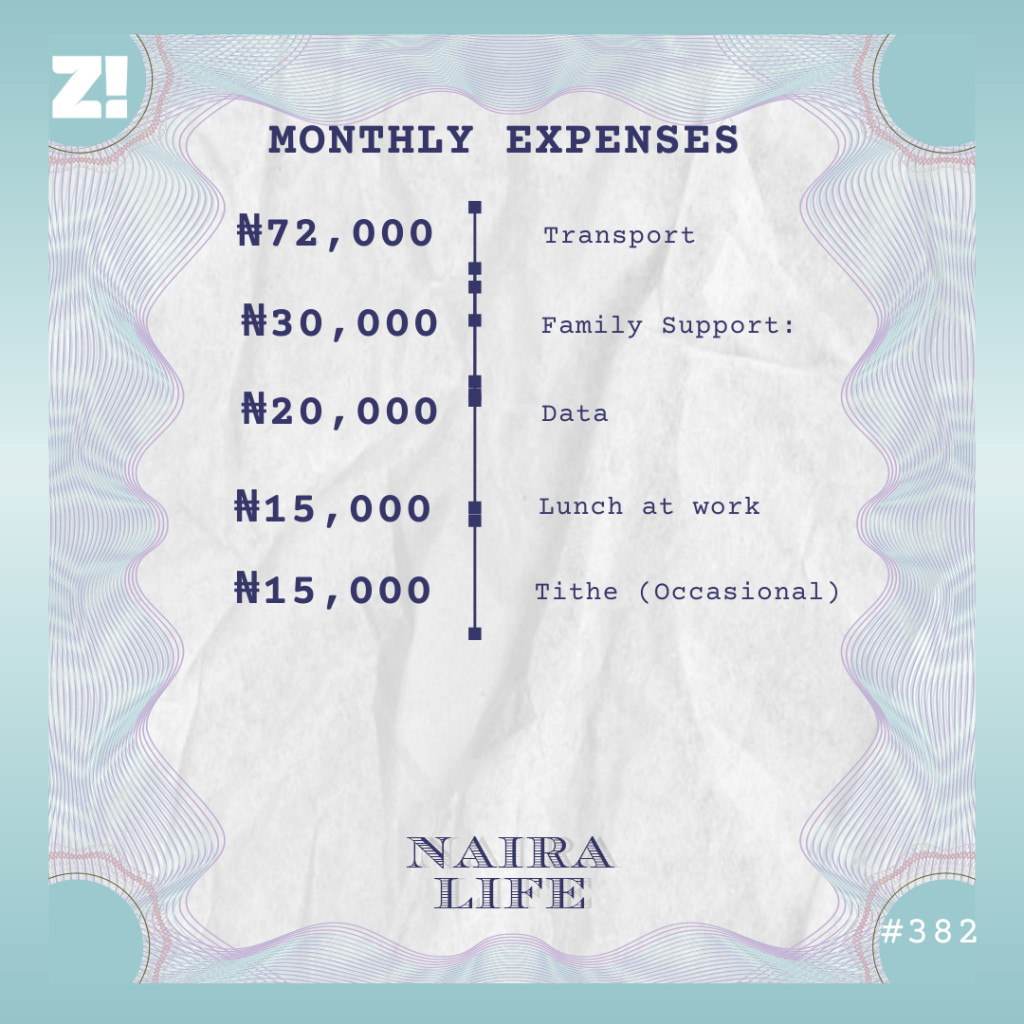
I live in Abuja, and transportation is a major cost. There are frequent price hikes. Sometimes I had to borrow money from my mum to cover expenses before salary day.
Pending when you get another job, what’s the plan for day-to-day survival?
My family is very supportive. I live with my family, so I don’t have to worry about rent or food. It’s just adult things like going out with friends that I can’t afford right now. I’ve even had to ghost most of my friends to avoid the pressure of spending money I don’t have.
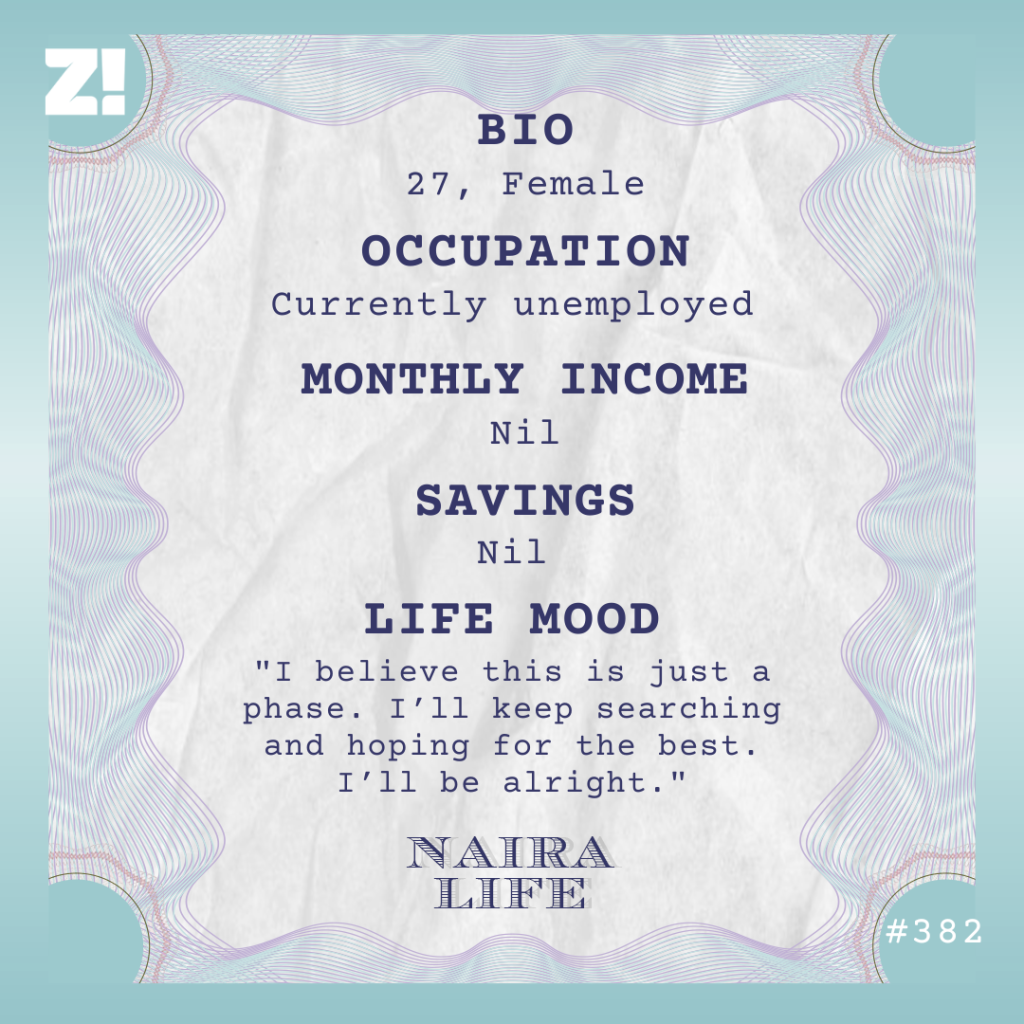
I believe this unemployment is just a phase, though. I’ll keep searching and hoping for the best. I’ll be alright.
Fingers crossed. What would be the ideal monthly income you’d expect from a new job?
₦300k – ₦400k
Is there anything you want right now but can’t afford?
Many things, but mostly the independence of not having to worry about money. I just want to have money for its own sake. I have people who have helped me that I want to be there for, like my mum, but I can’t afford to do anything for them. It’s a concern for me.
How would you rate your financial happiness on a scale of 1-10?
4 or 5, even though I really feel like it’s a zero. At least, I have a roof over my head. But there are many things I can’t do because I don’t have money.
When things finally fall into place, that number should go up to 9 or 10, especially when I am able to make my mum proud and improve the lives of the people around me. For now, I’m continuously applying for jobs and hoping for better days.
If you’re interested in talking about your Naira Life story, this is a good place to start.
Find all the past Naira Life stories here.