Every week, Zikoko seeks to understand how people move the Naira in and out of their lives. Some stories will be struggle-ish, others will be bougie. All the time, it’ll be revealing.
What’s your earliest memory of money?
At the beginning of the term, my primary school would give us a long list of textbooks. The parents handled the book purchases, but my parents handed the responsibility to me when I was in primary two.
They’d give me money for the entire list so I could sort myself out. Not all the books were compulsory, and I got to choose which one I wanted to buy each time. My parents didn’t really care what I did. They believed I could handle it myself.
And you didn’t “chop” the money?
I mostly used it for the books. But since I didn’t buy all the books at once, I’d hold on to the money to see if the teachers would actually demand some books. If by the mid-term, the teachers hadn’t checked, that book money automatically became mine. But if they asked, I’d quickly bring out the saved cash and buy it.
I understood the power and value of money because of this book thing. I saw how teachers routinely chased students out of the classroom because their parents couldn’t afford the books. I was never chased out.
What was the financial situation at home like back then?
Looking back now with adult lenses, I realise we weren’t rich, but my parents were incredibly hard workers.
My mother was a trader, and my dad worked at the Nigerian National Petroleum Company Limited (NNPC). People will hear NNPC and assume we were swimming in oil money, but he wasn’t a high-ranking staff. He was more like a third-party consultant. Still, our family didn’t lack the basics. Our rent was never late, and I was never sent home from school. We didn’t own cars, but we were okay.
When did you start earning your own money?
Right after my JSS 3 exams in 2013 or 2014. I got a job at a local bakery. The pay was ₦500 per day.
Why did you take a job at that age?
My parents only provided the basics, such as food. Nobody was going to give me flexing money. Some of my peers went into block moulding, but I chose the bakery.
At the bakery, I wrapped bread, washed baking pans, and carried heavy logs of wood to the ovens. I didn’t work every day; the bakery didn’t open on Wednesdays and Sundays, and as a casual worker, I could show up to learn that there was no space for the day. So, I worked on and off for two months before resuming senior secondary school.
What did you do with your daily ₦500?
Honestly, a big chunk of the money went right back into treating my body. I always returned home from work with body pains from the heavy lifting.
I couldn’t even complain to my mum or anyone because they’d remind me that it was my decision to work there. So, I used my earnings to buy medications to patch myself up. The rest went to buying evening suya. Nothing meaningful came out of it.
The Naira Life Conference is returning on August 22, 2026, in Lagos! Come learn from finance experts and industry leaders, and partake in unfiltered conversations about building wealth and diversifying your income stream in a country like Nigeria. Real stories, expert advice you can actually use, and a community ready to build wealth together. Secure your spot here.
Phew. Did you try anything else for money in secondary school?
Yes. In SS 2, I joined a voluntary youth organisation in church called the Royal Ambassadors of Nigeria. To fully participate, I needed to buy the uniform and pay for a ranking exercise. The uniform and sewing cost ₦9,000, and the exercise was ₦1,500, totalling ₦10,500.
When I asked my mum for the money, she said, “That thing is not your school, so I’m not paying for it.” I had to raise the money myself.
What did you do?
I hawked pure water after school hours and on Saturdays. I made about ₦700 – ₦800 in daily profit.
Every Saturday afternoon, after selling water, I’d head straight to our weekly Ambassadors meeting. Then I’d hand over my daily profit to the unit president, who kept my payment record. I did this for about five months until the ₦10,500 was fully paid up, and I got ranked. Today, I use that experience to mentor younger boys whose parents refuse to support their extracurricular goals.
The next time the “spirit of hustle” returned was when I was in SS 3. I was supposed to be preparing for WAEC or NECO, but based on my calculations, I predicted that year’s WAEC results might be bad.
Wait. How?
I noticed that if the WAEC results for a year were good, the following year’s would be bad. It looked like that year’s WAEC might be bad, so to avoid wasting money, I suggested to my parents that they either pay for just NECO or for both exams.
NECO was more expensive than WAEC, which was only ₦7k in 2017. My parents were like, “We don’t have more than ₦7k. It’s either you register for WAEC or go and look for the NECO balance.”
Other people would have gotten frustrated. Me, I just smiled. I stopped going to school regularly to read my books at home instead. I used the free time to look for a job.
What did you find?
A job packaging nylon sheets at a cellophane factory for ₦12k/month. I worked there for a few months to cover part of the NECO registration fee, which ended up costing over ₦60k in total, including school logistics.
When I needed more money to cover the costs, someone connected me with an aluminium and glass company. The salary there was ₦15k/month. But there was a catch; the owner asked if I was still a student. Everyone assumed I had graduated, and if I told her the truth, she wouldn’t hire me because the workload required full-time commitment. I lied and said I was done with school, even though I still had NECO exams to write.
How did you manage work and your exams?
It was chaotic. On exam days, I’d pretend I was terribly sick and rush out of work. Balancing it was so hard that I actually missed my economics paper completely and got an ‘absent’ in my results. I still passed the general requirements sha.
The work itself was stressful. I cut the aluminium, managed banking deposits because they trusted me, and travelled alone to Warri and Onitsha to source materials. My salary eventually increased to ₦20k, but transportation costs ate up most of it. To save money, I would trek for hours every single morning from my house to the workshop. I worked there from June until September 2018, when I moved to Warri, which wasn’t far from home.
What was the plan?
I hoped to secure a job with my O-Level results and start my life. I squatted with friends and relatives in Warri, since I couldn’t afford accommodation.
Thankfully, soon after I arrived, I found an open security guard position at a private school. The ₦18k/month salary was small, but I took it because it was a Monday-to-Friday gig, which meant my Saturdays were free for my Royal Ambassadors meetings.
A few weeks into the job, the school’s owner noticed my competence and computer literacy. She pulled me away from the gate and put me in her office as the school secretary. I stopped wearing the security uniform, even though I was still doing both jobs — I monitored the school gate from the office window.
Did she increase your salary for the double role?
No. She pleaded that the school was small and couldn’t afford an increase. I accepted because I was running an event-planning hustle on weekends. I was highly active in the entertainment scene in Warri and other neighbouring towns. I did everything from promoting clubs and handling stage management to working as a DJ assistant and selling tickets for music concerts and festivals.
I was incredibly good at convincing people. I could talk a group looking for a table of four into upgrading to a table of six on the spot. My pay wasn’t stable since my work depended on what service was needed, but a typical event weekend brought me between ₦5k and ₦10k.
How long did you stay at the school?
About three years. I was there from September 2018 until 2021. By January 2019, the school’s student population had dropped drastically, and the owner called a meeting to lay off staff. Some of us agreed to take a pay cut instead of losing our jobs, so my salary dropped to ₦15k.
During school holidays, when there was no work to do, the owner would arrange for me to work at her husband’s hotel so I could earn something. It wasn’t until after the COVID-19 lockdown that she returned my salary to ₦18k.
By 2021, I looked around and realised all my friends were already in higher institutions. Even though I was making money from events, I told myself, “If I don’t go to school now, I will lose interest forever.” So, I resigned and got admission to a polytechnic in a different town.
How did you fund your education?
I’m not proud of this part of my story.
When I first arrived at school, my accommodation plans fell through, and the place I ended up staying was so far that my daily commute cost could pay a student’s monthly rent in town.
Also, I was too far from Warri to continue my event planning side hustle, and I knew my savings would run out quickly. Out of desperation, I approached two lecturers to offer my services as an office assistant in exchange for small money, but they both rejected me. I was heartbroken, but I couldn’t wallow in it for too long. Instantly, I started looking for other options.
I noticed that some students were either too lazy or busy to complete assignments or school registrations, so I seized the opportunity to do them for a little change here and there. One day, while helping someone process their documents in an administrative office, I met a guy who had been hearing about my academic performance. He tested my intelligence right there, saw what I was capable of, and introduced me to exam impersonation.
As in, writing exams for other people?
Yes. It started small with continuous assessment tests. He’d pay me between ₦2k and ₦4k per test. Then the main semester exams arrived, and the first one was a computer-based exam. The guy who brought me in didn’t trust me with a major exam, but his main guy, who was supposed to write the exam on behalf of others, disappointed him on the morning of a 7 a.m. paper.
So he gave me the login details for three students. I walked into the hall, logged into the first portal and completed the exam. Then I logged into the second, cleared it, and did the third. Nobody suspected a thing because I have a very calm, gentle face. When I walked out, ₦100k was credited to my account instantly.
Interesting
That single morning changed everything. From that moment on, a large portion of my polytechnic tuition and rent was paid entirely with money from impersonation. I’m not proud of it, but the money kept me going. Every semester, I was guaranteed at least ₦200k from exam runs.
Eventually, it grew into a full operation. Because I didn’t like seeing intelligent, broke students struggling, I started outsourcing the jobs. Clients would bring jobs, and I’d hire brilliant students who needed cash, pay them excellently well — sometimes ₦10k just to sit beside me and copy answers — and ensure everyone was taken care of.
Then, in 2023, around the tail end of my National Diploma (ND) program, I decided to stop the impersonation.
Why?
People started to know me at school, including some from my hometown. I didn’t want to destroy my reputation at home, so I deliberately began to pull away and transitioned to running legitimate online tutorials for students. I was also predicting exam questions based on the lecturer’s patterns. It didn’t pay real money, though. I mostly just got “Thank you, boss” as appreciation.
But I still needed money, so while writing my final exams, I deliberately failed a course to remain in school for one month of remedial work. The way these exam impersonations work, it’s less risky if you actually have a reason to be in the exam hall. I made about ₦80k during that period before I finally left school in August 2023.
What came next?
I immediately got a job as a hotel supervisor and storekeeper for ₦70k/month. The money was quite low compared to what I made from impersonation, but it came with a clear conscience and free accommodation.
A few months later, my salary climbed to ₦75k. It kept increasing little by little until the final increment to ₦90k in May 2025. I had to leave the job in July 2025 because of problems in the town: cult violence, armed robbery and insecurity. So, I packed up and returned to Warri. I’ve been here since.
What do you do now?
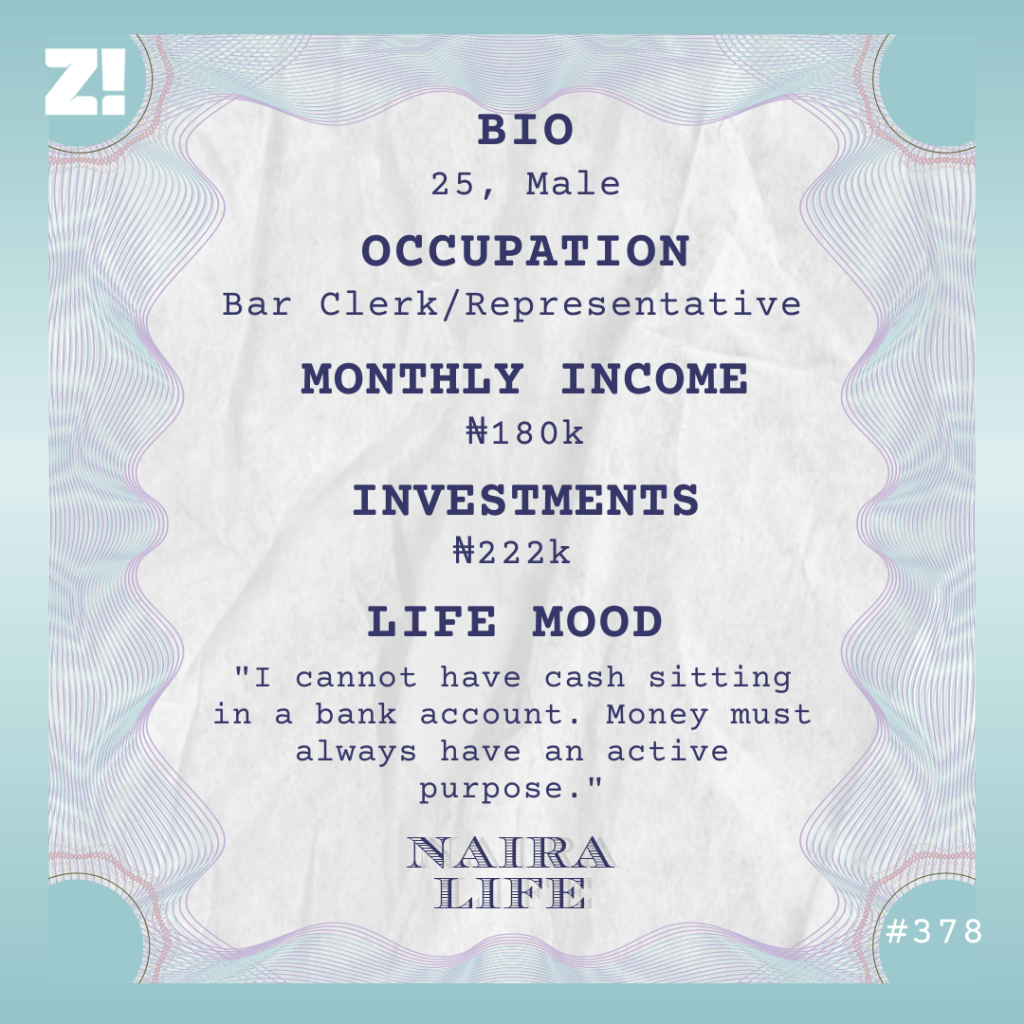
I work as a clerk/representative for a brewery. The brewery partners with local entrepreneurs who have land to run a bar. The brand builds the bar for them and, in exchange, takes 20% of total revenue. My job is to sit at the bar and ensure every single drink sold passes through our POS machines so the brand’s 20% cut is accurately recorded.
I earn ₦180k/month. The job also comes with optional accommodation at the lounge if I work too late. I don’t live there permanently, though.
What kind of lifestyle does your income afford you?
It’s definitely not a luxurious one because I operate a very strict, aggressive financial plan. In fact, I would say I’m living an investor’s lifestyle. I share an apartment with a friend, and we split the ₦15k monthly rent equally. I still contribute to utilities and food, but most of my income goes into investments.
Let’s break that down for a typical month
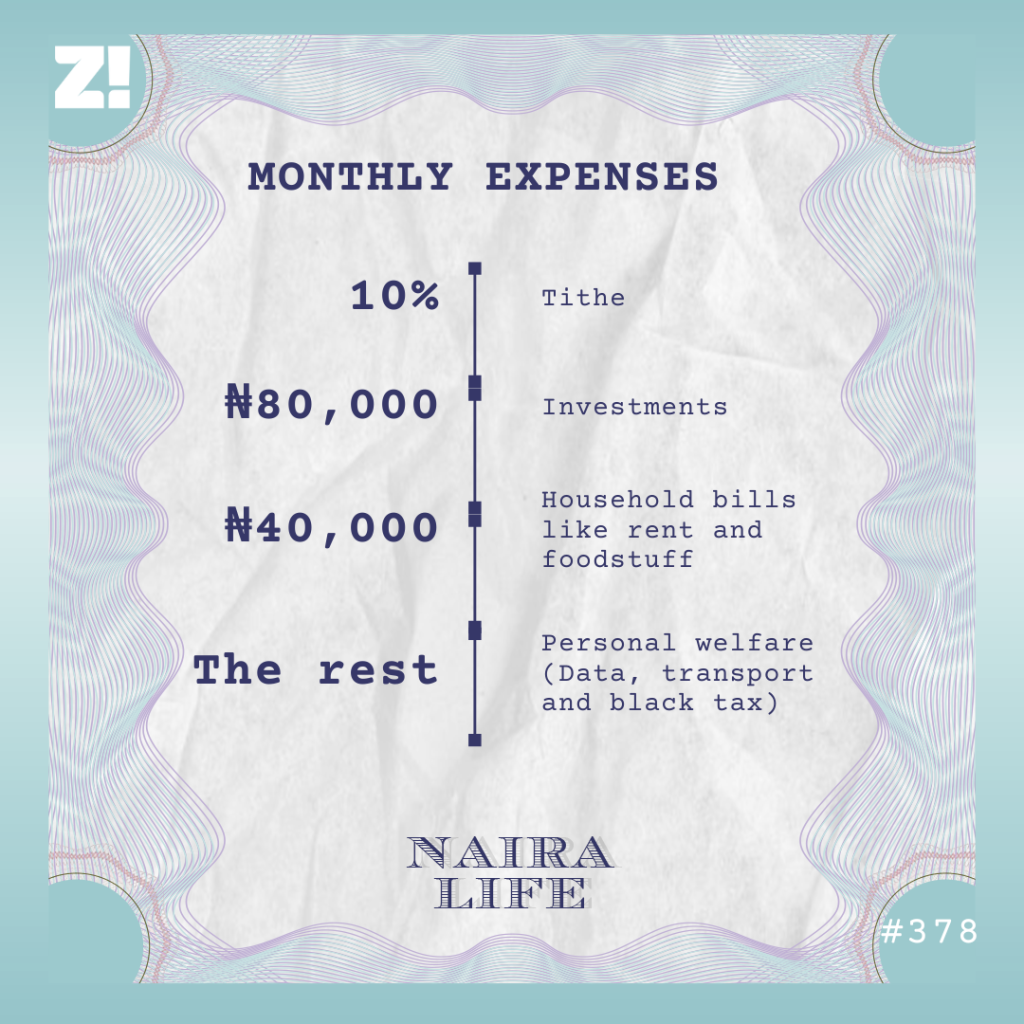
I look at that ₦80k as a gift to my future self. Even if I have to starve or squeeze through the month, that ₦80k investment is non-negotiable. Sometimes I look back on 2021/2022 and wish I had known about investments when the exam money was flowing in. I would have been unstoppable.
What exactly do you invest in?
Stocks. I’ve been learning about the stock exchange for a few years now, and my job now gives me some room to practice what I’ve been learning. I started buying shares heavily in April 2026. My investment philosophy is strictly long-term. My logic is that nothing that cost ₦100 in 2014 is less than ₦1,500 today. The price of things must definitely increase, so it’s better to buy now and let the value grow for me.
Currently, I have about ₦222,000 actively locked in stocks. I have shares in the brewery I work for and some banks. I also buy shares in consumer goods companies because I remember my dad buying their products years ago, and they are still standing strong. I avoid Nigerian insurance companies because I’m not sure the system here works. If I ever buy insurance stocks, it will be in the US market.
How would you describe your relationship with money?
It’s highly risky because I really hate money sitting idle. I cannot have cash sitting in a bank account. Money must always have an active purpose. If it doesn’t have a purpose, it will be wasted.
People around me sometimes complain, saying, “You are a grown man, how can you say you don’t have up to ₦20k on you?” They easily forget that a few days prior, when the cash was there, I completely settled all household and family emergencies. Once those are sorted, the rest goes straight into my stock portfolio. I don’t care who falls sick or complains after that. My investment portfolio comes first.
Out of curiosity, do you have a net worth goal?
₦100 billion.
Billion?
Yes. The day I hit ₦100 billion worth of assets, I will pause and set a new goal. I don’t attach timelines to my goals because I don’t believe in putting unnecessary pressure on myself. I will chase this number until the day I drop into my grave.
My ultimate vision is real estate. I want to acquire land and build houses in every student area or around higher institutions across the country. My strategy is to crash student rent prices so low that other landlords will have no choice but to drop their prices or sell their properties to me. High student housing costs are a major reason students are driven to cybercrime and fraud just to keep a roof over their heads. If I can fix housing, I can reduce student crime.
Is there anything you want right now but cannot afford?
Two things. I want a Toyota Tundra for easy mobility. I recently saw one that cost about ₦120 million. Secondly, I want to go back to school to study Law. Based on my breakdown, ₦20 million will comfortably fund my legal education to graduation.
On a scale of 1 to 10, how would you rate your financial happiness?
A solid 9. The only reason it’s not a 10 is because of that hunger for more. But it’s a 9 because my 2018 self would look at me today and be incredibly proud. I have stable earnings, a roof over my head, and I can officially call myself a corporate shareholder in multiple institutions.
Also, I’d like to add something.
Shoot
To anyone who finds themselves in a desperate corner like I was during my campus days: if you must do something questionable to survive, never be proud of it. If you let greed keep you doing illegal stuff because the money is sweet, you will eventually get caught.
If you’re interested in talking about your Naira Life story, this is a good place to start.
Find all the past Naira Life stories here.