


More young Nigerians than ever are trying to make a living from what they love. Some are making it work. Most are somewhere in the middle, earning enough to keep going but not enough to stop worrying. All of them are doing it inside an economy that makes everything harder than it should be.
We spoke to six Nigerian creatives about what it actually costs to do what they love in Nigeria right now.
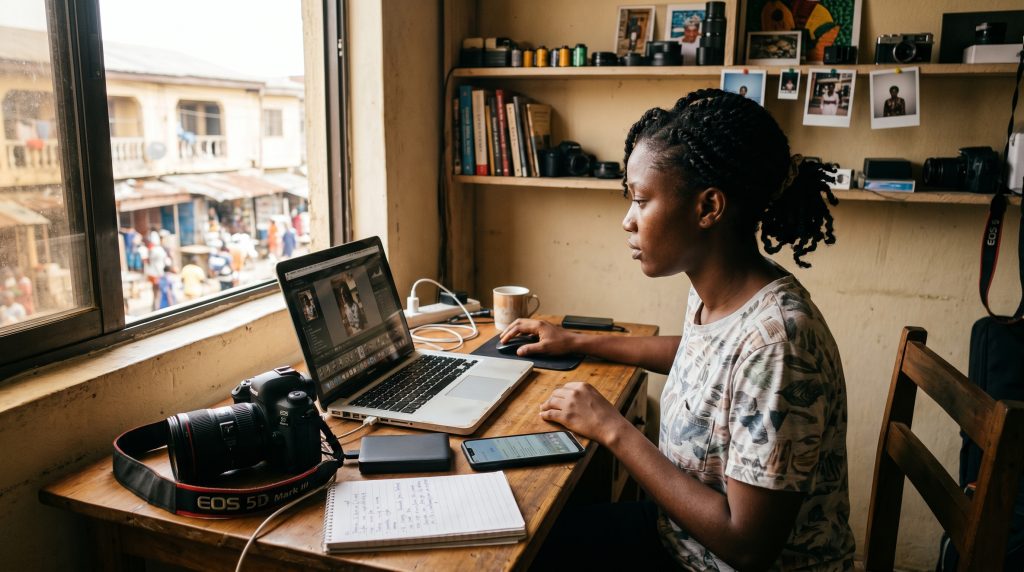
“Being a creative in Nigeria right now feels like self-inflicted labour.”
Teth Adam*, Photographer, 5+ years
Five years into photography, Teth Adam earns ₦300,000 or more per month, enough for rent and essentials, though there are still months when he has to adjust his spending and work harder to close the gap.
Even so, he doesn’t describe the experience as comfortable. The economy, he says, is his biggest challenge right now. Everything costs more. Clients are slower to commit. The margin between doing well and doing badly has narrowed. He concludes by saying, “Being a creative in Nigeria right now feels like self-inflicted labour.”
“It feels like taking a major life decision every day.”
David*, Musician, 3–5 years
This musician earns ₦300,000 or more monthly. But almost none of it comes from his own music.
He survives entirely within the creative industry; production work, songwriting for other artists, whatever keeps him inside the thing he loves while he waits for his own work to generate consistent income. There’s no backup plan outside of music. The biggest challenges, he says, are money and access to the right resources. “Surviving every day feels like a major life decision.”
The Naira Life Conference is returning on August 22, 2026, in Lagos! Come learn from finance experts and industry leaders, and partake in unfiltered conversations about building wealth and diversifying your income stream in a country like Nigeria. Real stories, expert advice you can actually use, and a community ready to build wealth together. Secure your spot here.
“Hell fire.”
Drey*, Musician, 3–5 years
He’s been making music professionally for three to five years. Music is his only source of income — no side job or fallback. And the income is so unpredictable that planning feels almost pointless.
Some months, he earns between ₦50,000 and ₦100,000 from gigs. Some months less. He makes beats, sells loop packs and vocal samples, but sales are slow. When it isn’t enough, his response is straightforward: work harder. “I just double the hustle.”
The rising cost of everything is his biggest challenge. When asked to describe what being a creative in Nigeria feels like right now, he simply says: “Hell Fire.”
“A lost battle.”
Tomisin*, Nail Technician, 2 years
She’s been in business for nearly two years, and by most measures, it’s working. She earns between ₦100,000 and ₦300,000 monthly. Her rent gets paid. Her essentials are covered. She says her strategy is less about earning more and more about spending carefully.
“I don’t live a lavish life,” she says, “So my income always covers my needs. My dad sends me pocket money every now and then, but I always put it in my savings account. I live off my earnings currently.”
But running the business has its own costs. Electricity is the one that grinds her most. Unreliable electricity means buying generator fuel just to stay operational.
“I spend about ₦30,000–₦50,000 on electricity units in a month, and even then, the light is still not stable. I buy fuel for my generator when that happens.”
When asked what it feels like to be a creative in Nigeria, she says: “It’s a lost battle.”
“A hustle on top of the hustle.”
CD*, Musician, 5 years
Five years in, this musician earns less than ₦50,000 monthly from his creative work. He performs at events and earns from streaming song requests and covers live on TikTok and Bigo, but neither is something he can plan around.
A good month might bring five performances, while another might bring only one. Streaming income moves the same way; he sings live, and viewers send virtual gifts during the sessions, which he converts to cash. The value of these gifts can range from ₦5k to ₦100k, but this income is not something he can count on. It depends on engagement, and on how often he’s actually able to show up and stream. When income slows, he creates content around his music and creative gigs to maintain visibility. But the barrier that frustrates him most is access.
“Funding and honestly getting people in higher places to notice you is the work, ” he says, “And if you are different from the mould like me, they just overlook, or gatekeep you from meeting the higher-ups.”
The creative industry in Nigeria, he suggests, is both economically difficult and politically challenging. It has a social architecture that determines who gets seen and who gets introduced. He calls it, “A hustle on top of the hustle.”
“Very exhausting.”
Margaret*, Content Creator, less than 1 year
Margaret is a full-time nurse and a new mother. She creates content on her days off, usually with her baby in frame. She hasn’t monetised yet; her income still comes from her ₦75,000 monthly nursing salary and support from her husband.
Her first TikTok was a GRWM video. It got around 3,000 likes and 15,000 views. She was proud of it. Then she read the comments. Some people were mocking her kitchen setup.
“Nigerians are not kind people,” she quips, “I make use of what I have, please.”
She says her husband teases her whenever she sets up her camera. She has told him that if she ever starts making money from TikTok, he should not try to famz her.
Time is her hardest challenge. “I don’t have time for myself even. Creating time is the issue. I’m still majorly focused on my job as a nurse.”
When asked what it feels like to be a creative in Nigeria, Margaret says, “Very exhausting.”
*Names have been changed for the sake of anonymity.
NEXT READ: 5 Nigerians Break Down the Side Hustles That Pay More Than Their Salaries
